Mastering WooCommerce Efficiency with AI: A Comprehensive Guide to Automating Store Management Through Novamira Pro

Managing a WooCommerce catalog often requires a significant investment of time, involving repetitive tasks such as manual price adjustments, category-wide updates, and the tedious process of patching broken product data. For many store owners, these administrative burdens detract from high-level business development. Recent advancements in AI-integrated WordPress management have introduced new efficiencies, notably through the Novamira Pro platform, which bridges the gap between Large Language Models (LLMs) like Claude and the underlying WordPress database.

By leveraging direct access to WooCommerce’s internal schema—including regular prices, sale schedules, product attributes, and shipping classes—Novamira Pro enables store administrators to execute complex commands through natural language prompts. This transition from manual interface navigation to automated, code-assisted workflows marks a pivotal shift in how e-commerce stores are maintained, updated, and scaled.
The Technical Architecture of AI-Driven Store Management
Novamira Pro distinguishes itself by moving beyond generic "chat-to-WordPress" plugins. Instead of functioning as an external layer, it establishes a direct conduit to the WordPress database and PHP execution environment. Because the model operates with an understanding of WooCommerce’s specific data structures, it avoids the common AI pitfall of "hallucinating" schema fields.

When a user prompts the system, the AI does not simply guess where information is stored; it queries the site’s actual database. This allows for precise operations, such as identifying products in a specific category and applying a percentage-based price increase, without the need for manual CSV exports or third-party bulk editing tools.
Chronology of a Workflow: From Deployment to Optimization
To understand the practical application of this technology, one can observe a standardized workflow, typically executed on a local staging environment to ensure system integrity. The following chronology outlines a typical deployment process for an e-commerce storefront:

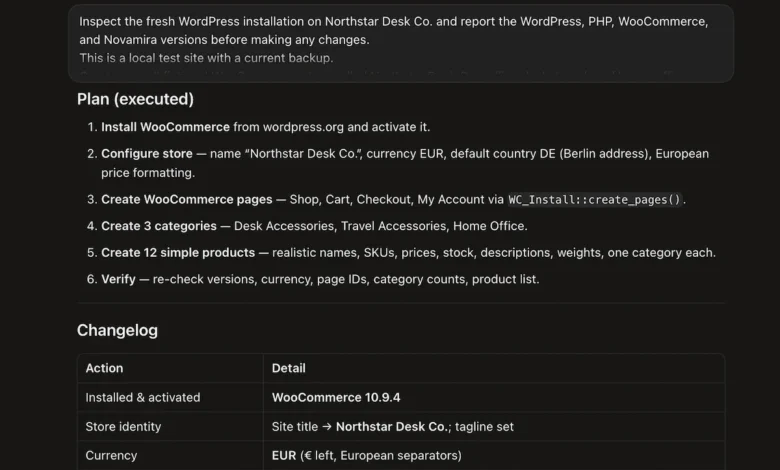
- System Initialization (0–15 Minutes): The process begins by connecting the AI agent to the local WordPress installation. A comprehensive diagnostic scan is performed, reporting on PHP versions, active plugins, and database health. Once verified, the AI generates a baseline store—creating categories, setting currencies, and populating sample products—which serves as the testing ground for subsequent operations.
- Bulk Pricing Implementation (15–30 Minutes): Rather than navigating through dozens of product pages, the operator requests a preview of price adjustments. The AI generates a structured table, allowing the user to review proposed price hikes, rounding strategies, and potential conflicts before any live changes are committed to the database.
- Sale Scheduling and Logic Injection (30–60 Minutes): Advanced store management involves scheduling sales across specific categories. When the standard schema lacks a specific field—such as a granular countdown timer—the AI can be tasked to develop a lightweight, custom plugin to display "Sale Ends" notices, injecting the necessary logic without bloating the main theme’s functions.php file.
- Data Audit and Maintenance (60+ Minutes): Finally, the system performs a heuristic audit, identifying missing SKUs, inconsistent descriptions, or orphan products. The AI suggests repairs, which the administrator can approve or decline, ensuring the catalog remains optimized for search engines and customer navigation.
Comparative Analysis: Free vs. Pro Capabilities
While the foundational tasks of data retrieval and basic price manipulation are possible within the free version of Novamira, the Pro iteration introduces significant advantages in consistency and "contextual memory." In a professional environment, a store’s specific conventions—such as how it formats descriptions or manages stock levels—must remain uniform.
Novamira Pro maintains a persistent understanding of these conventions across sessions. While the free version might require the user to restate rules or provide context repeatedly, the Pro version retains a "memory" of the store’s unique architecture. This reduction in "prompt engineering" overhead is a critical factor for businesses managing larger, more complex catalogs where accuracy is paramount.

Data Integrity and Operational Risks
Integrating AI agents into a production e-commerce environment necessitates a disciplined approach to risk management. Unlike human operators, AI agents can execute hundreds of changes in seconds. If a prompt is poorly defined, the potential for widespread data corruption is significant.
Industry best practices dictate the following safeguards:

- The Staging-First Mandate: No AI-driven command should be executed on a live site without prior testing on a mirror of the production environment.
- Backup Verification: Before any automated bulk update, a complete database and file-system backup must be validated.
- Human-in-the-Loop Approval: The most successful workflows involve a "preview-before-commit" approach. By requesting a table or report of intended changes, the administrator retains final oversight, mitigating the risks of automated error.
Broader Implications for E-commerce Professionals
The adoption of AI agents like those facilitated by Novamira represents a maturation of the "headless" or "automated" management trend. For many years, WooCommerce store owners have relied on an ecosystem of disparate plugins to manage prices, inventory, and design. The emergence of a centralized AI interface threatens to consolidate this fragmented toolset.
Economically, this shifts the cost of store maintenance. Labor hours previously spent on manual data entry can be redirected toward strategic initiatives, such as marketing, product development, or customer experience enhancement. However, this also increases the burden on store managers to become technically proficient in prompt engineering and data audit processes.

Future Trajectories: The Role of Autonomous Agents
As these models become more integrated with the WordPress core, the next phase of evolution will likely be "autonomous maintenance." Rather than waiting for a human prompt to fix a broken link or identify an empty description, future iterations of these agents may proactively scan for errors and propose "one-click" fixes during off-peak hours.
Moreover, the integration of real-time market data could allow these agents to suggest price adjustments based on competitor activity or seasonal demand patterns, effectively functioning as an automated merchandising assistant.

Conclusion
The use of AI in WooCommerce management is no longer an experimental curiosity; it is a viable operational strategy for those looking to increase their output efficiency. By focusing on structured data access, rigorous audit procedures, and a disciplined approach to automation, store owners can leverage tools like Novamira Pro to achieve a level of operational agility that was previously only available to large-scale enterprises with dedicated engineering teams.
For store administrators, the challenge moving forward is not whether to adopt AI, but how to integrate it responsibly. As the technology continues to evolve, the distinction between a managed store and an automated, self-optimizing store will likely become the defining factor in e-commerce competitiveness. The ability to articulate business logic into actionable code via natural language is rapidly becoming a core competency for the modern digital merchant.