Army Detonates Nearly Five Tons of Degraded Lead Azide Near Middletown Iowa Amidst Public Outcry and Scrutiny

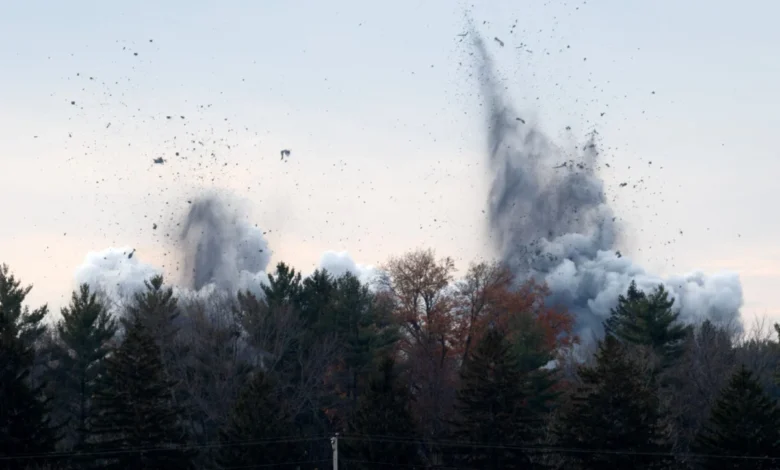
On Wednesday morning, the United States Army conducted a high-stakes, controlled detonation of approximately five tons of degraded lead azide at an installation near Middletown, Iowa. The operation, intended to neutralize volatile chemical compounds that had become too unstable for transport or conventional remediation, marks the culmination of a tense period of uncertainty for local residents. While the Environmental Protection Agency (EPA) reported that preliminary atmospheric monitoring detected no immediate presence of lead in the air following the blast, the long-term environmental implications remain a subject of intense independent investigation.
Chronology of the Middletown Detonation
The presence of lead azide—a highly sensitive primary explosive used in detonators—at the Middletown facility dates back decades. As the material reached the end of its chemical lifespan, it became increasingly prone to spontaneous detonation, forcing the Army to declare it an imminent safety hazard.
The logistical challenge began to manifest in late October, when local municipal leaders were notified of the Army’s intent to perform a “controlled detonation.” However, the communication strategy employed by the federal government was widely criticized as insufficient. For weeks, residents in the path of potential fallout expressed frustration over a lack of clarity regarding the scale of the blast, the potential for toxic particulate dispersal, and the specific mitigation measures being implemented to protect the surrounding agricultural community.
This communication vacuum led to a significant erosion of public trust. It was only days before the scheduled explosion that the Army issued a formal press release detailing the operation, a timeline that many local officials characterized as inadequate for public safety planning. As the tension mounted, the Army eventually constructed a protective dam around the detonation site to contain debris, while NASA deployed research aircraft and satellite sensors to track the plume.
The Role of Independent Scientific Oversight
In the absence of a unified federal communication strategy, the academic community mobilized to provide independent data. Several departments at the University of Iowa began establishing air and soil monitoring stations in the days leading up to the explosion, effectively operating in parallel to the federal response.
“Initially, we did not know that the EPA, the Army, or anybody else was going to be doing anything,” said Peter Thorne, a professor of environmental health at the University of Iowa. Dr. Thorne noted that his team’s efforts were not intended to compete with government agencies, but rather to provide a layer of verification that could restore public confidence. “If [the government’s] findings are in alignment with ours, then I think that helps quell some of those concerns,” he added.
Simultaneously, researchers at Purdue University, nearly 300 miles away, issued a call for local soil samples to be sent to their laboratories. Ellen Wells, a professor of public health at Purdue, stated that the decision to involve independent researchers was driven by the perceived instability of the government’s rollout. “Once we learned of the initial delay in the detonation date, we decided to put forth the call for independent analysis,” she said.
Analyzing the Environmental Impact
The primary concern regarding the detonation is the dispersal of lead-rich particulate matter. Lead is a heavy metal known for its persistence in the environment and its toxicity to human health, particularly in children. Monitoring teams are currently using advanced X-ray fluorescence (XRF) technology to measure lead levels in soil samples. These devices function by firing X-ray beams into a sample, causing the lead atoms to emit a specific electromagnetic signature that can be measured instantaneously.
While field testing provides rapid results, more sensitive laboratory-based mass spectrometry is required for granular data. Dr. Thorne estimates that definitive results from these more rigorous tests will be available by early next week. The EPA has also launched a live-access portal for the public to track air quality metrics, a move intended to provide transparency as the plume settles.
Agricultural Implications and Water Safety
Given that Iowa is a global hub for corn and soybean production, the potential for soil contamination has sparked significant concern among the agricultural community. However, experts suggest that the risk to the food supply may be lower than feared.
Jeffrey Catalano, a professor of earth and environmental sciences at Washington University in St. Louis, emphasizes that the biological mechanisms of regional crops offer a natural defense. “There is a large body of research showing that plants like corn are actually quite poor at absorbing lead through their root systems,” Catalano noted. He explained that the primary hazard would be physical—soil particles containing lead adhering to the exterior of leaves or stalks, which could then be ingested. “If you were to measure the lead content of corn produced in Iowa next year versus this year, I do not expect you would see anything other than random statistical variations.”
Regarding the local water supply, Patrick McNamara, a professor of environmental engineering at Marquette University, suggests that municipal water systems are largely robust enough to handle the potential fallout. “Most municipal treatment plants are specifically designed to strip heavy metals, including lead, from water supplies,” he explained.
The risk is more localized for residents relying on private wells or those whose property features surface streams. McNamara recommends that owners of private water sources utilize at-home testing kits in the coming weeks to ensure that no debris has compromised their water tables.
Contextualizing the Hazard
As the monitoring data continues to arrive, some experts are calling for a balanced perspective regarding the incident. While the Middletown detonation was an event of local significance, it does not compare to the chronic, long-term environmental hazards found in other parts of the United States.
Dr. Thorne highlighted the disparity between the Middletown event and other industrial legacy sites. “I’ve done work in places like East Chicago, Indiana, where they built a housing project and a school on the grounds of a former lead smelting plant,” he explained. “We were seeing soil lead levels that are roughly 10,000-fold higher than what we’ve measured in Iowa this week.”
This comparison is not meant to minimize the concerns of Iowans, but rather to contextualize the scale of the incident. It serves as a reminder that while accidental or emergency military detonations command national headlines, there are hundreds of communities nationwide struggling with the slow-moving, often overlooked crisis of legacy lead pollution in urban environments.
The Path Forward: Transparency and Remediation
The events in Middletown have highlighted a systemic failure in the way federal agencies communicate with the public regarding hazardous site operations. The lack of proactive engagement fostered a climate of suspicion that forced the scientific community to step into a vacuum of information.
Moving forward, the EPA and the Army face the task of reconciling their data with the independent findings of the University of Iowa and Purdue researchers. If the datasets align, it may serve to soothe local anxieties; however, any discrepancy between federal and independent findings could result in a protracted legal or public relations crisis.
As of Wednesday afternoon, EPA Administrator Lee Zeldin confirmed that the EPA will continue to maintain an active presence in the area. The agency is currently compiling data from air filters, soil samples, and surface water testing to construct a comprehensive model of where the particulate plume settled.
For the residents of Middletown, the next several days will be defined by waiting. The final reports on the soil loading and particulate dispersal will determine whether the Army’s "controlled" operation met the safety standards required to protect both the health of the local population and the integrity of the state’s agricultural output. In the long term, the incident may necessitate a shift in how the Department of Defense manages the notification process for hazardous operations, ensuring that transparency is prioritized as highly as technical safety.
Related posts: