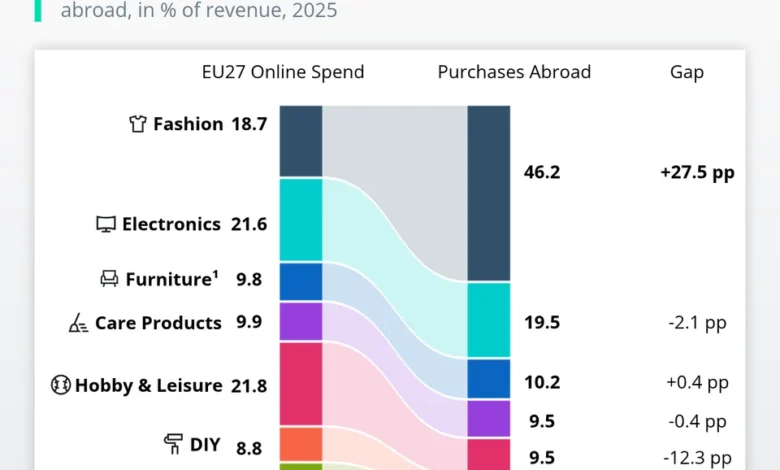
The European digital retail landscape is undergoing a significant structural transformation, characterized by a widening gap between domestic purchasing habits and the burgeoning trend of cross-border e-commerce. New data provided by the E-commerce Database (ECDB) reveals that while European consumers maintain robust domestic spending patterns for categories like leisure and electronics, their behavior shifts dramatically when shopping outside the European Union. Fashion has emerged as the dominant category in this international spending spree, accounting for 46.2 percent of all capital outflow to non-EU retailers.
This phenomenon highlights a dual-speed economy in European e-commerce: one defined by the traditional, localized consumption of hobby and leisure goods, and another defined by the rapid, price-sensitive procurement of fashion items from global, primarily Chinese-backed platforms.
The Divergence of Domestic and Global Shopping Trends
To understand the scale of this shift, one must contrast it with the standard domestic market. Within the European Union, the retail hierarchy is led by the hobby and leisure sector, which captured 21.8 percent of total online consumer spending last year. Electronics followed closely at 21.6 percent, while fashion occupied the third position with a 18.7 percent share.
However, when the scope is narrowed to cross-border purchases—defined as transactions occurring with retailers outside the EU—the hierarchy is completely inverted. In this segment, fashion becomes the undisputed leader. The contrast is stark; consumers appear to be curating two entirely different shopping baskets depending on the origin of the retailer.
Analysts at ECDB note that this is not merely a matter of product availability, but a fundamental change in the logistical and psychological barriers to entry. The data suggests that for goods categorized as hobby or leisure, Europeans still prefer the familiarity, shipping speed, and consumer protection standards of local or intra-EU retailers. Conversely, the fashion sector has been effectively "captured" by ultra-efficient, low-cost international models that capitalize on specific product attributes.
The Anatomy of Cross-Border Success: Why Fashion Wins
The dominance of fashion in cross-border trade is not accidental. Industry experts point to three primary drivers: weight, durability, and price. Clothing and accessories are inherently easier to ship than large-scale electronics or heavy furniture. Because apparel is lightweight, compact, and resistant to breakage during long-distance transit, it is the ideal candidate for the high-volume, low-margin logistics model employed by platforms like Temu, Shein, and AliExpress.
The ECDB report concludes that "light, cheap, and durable goods cross borders best." This efficiency allows international retailers to offer price points that domestic European retailers, burdened by higher labor costs and strict regulatory compliance, often struggle to match. As these platforms have scaled, they have created a "fashion-first" ecosystem where the category mix of cross-border spending naturally follows the market leaders.
A Chronology of the Chinese Retail Expansion
The rapid rise of these platforms within the European market can be traced through a series of milestones over the last 36 months:

- 2022: The surge in popularity for platforms like Shein and AliExpress becomes undeniable, as post-pandemic shifts in consumer spending prioritize budget-friendly fashion.
- 2023: Temu enters the European market with an aggressive, multi-channel marketing campaign, quickly climbing the ranks to become the top e-commerce player in several European nations.
- Early 2024: The European Commission begins formal discussions regarding the regulatory status of these platforms, particularly concerning product safety and the "de minimis" customs thresholds that allowed low-value packages to enter the EU without duties.
- Late 2024: Regulatory scrutiny intensifies. The European Commission demands that platforms like Temu submit action plans to address the proliferation of illegal and non-compliant products.
- 2025 (Current Outlook): Major non-EU players begin pivoting toward localized logistics, with some establishing physical warehouses within the EU to circumvent upcoming tax and customs barriers.
Economic Impact and Market Concentration
The financial footprint of these non-EU retailers is substantial. Last year, EU consumers spent approximately 55.1 billion euros on physical goods from outside the bloc. Of that total, a staggering 49.7 billion euros—or roughly 90 percent—was funneled through just three platforms: Temu, AliExpress, and Shein.
This level of market concentration has sparked alarm among European policymakers. While consumers benefit from lower prices, the loss of market share for domestic retailers poses a threat to the broader European retail ecosystem. The reliance on these platforms for nearly the entirety of cross-border spending suggests a high level of dependency that leaves European retail vulnerable to the strategic shifts of these non-EU corporations.
Regulatory Responses and the "Parcel Tax" Debate
The European Commission is currently evaluating a multi-pronged approach to level the playing field. The primary concern is that current customs duty exemptions are being exploited, allowing these platforms to undercut domestic competition by avoiding the standard import levies that apply to traditional retailers.
Several proposals are currently under consideration, including:
- Elimination of De Minimis Thresholds: Removing the current exemption that allows small packages to enter duty-free.
- Parcel Fees: Introducing a specific import fee on parcels originating from third-country fulfillment centers.
- Enhanced Safety Compliance: Mandating that non-EU marketplaces be held legally liable for the safety and standard compliance of the products sold by third-party vendors on their platforms.
In response to this looming regulatory wall, the platforms themselves are adapting. By opening regional warehouses within the European Union, these retailers are shifting from a "cross-border shipping" model to a "domestic distribution" model. This move effectively bypasses some of the customs friction, but it also subjects these companies to more direct oversight from European national authorities regarding tax compliance and environmental regulations.
Implications for the Future of European Retail
The implications of these findings are profound. For European retailers, the data serves as a wake-up call regarding the competitiveness of their supply chains. If the largest category of cross-border trade—fashion—is dominated by non-EU players due to logistics and price, then the path forward for domestic firms may lie in differentiation.
Analysts suggest that European retailers must double down on aspects that international platforms currently struggle with: sustainability, ethical supply chain transparency, and high-touch customer service. As the "price war" with global players reaches a point of diminishing returns, the premium segment—where quality and brand values are prioritized over raw price—remains a stronghold for European businesses.
Furthermore, the shift toward localized warehousing by Chinese platforms suggests that the "cross-border" distinction may soon blur. As these platforms integrate themselves into the European infrastructure, the distinction between a "foreign" and "domestic" retailer will become less about where the goods are stored and more about who owns the digital interface and the data it collects.
Ultimately, the consumer’s preference for convenience and cost-efficiency remains the primary engine of the e-commerce market. Unless European retailers can innovate their logistics to match the speed and cost structure of their global competitors, or unless the European Commission successfully recalibrates the regulatory environment, the trend of high-fashion spending flowing out of the EU is likely to persist. The challenge for the coming year will be balancing the consumer’s desire for affordable goods with the necessity of maintaining a robust, compliant, and competitive domestic retail economy.