Managing a WooCommerce catalog often involves a tedious cycle of manual updates: adjusting individual product prices, modifying categories, and correcting inconsistent metadata. For store owners managing hundreds or thousands of SKUs, these routine administrative tasks can consume significant operational hours. A recent technical demonstration utilizing Novamira Pro, integrated with the Claude AI model, suggests a shift in how these workflows are executed, moving from manual intervention toward AI-orchestrated site management.

The Integration of AI into WordPress Architecture
Novamira Pro functions by establishing a bridge between AI models and the WordPress database, specifically targeting WooCommerce’s internal schema. Rather than acting as a separate tool, it provides the AI with direct, structured access to WooCommerce data points, including regular and sale prices, inventory levels, tags, and shipping classes. This integration allows the AI to interpret and modify the store’s backend through PHP and database queries, facilitating a level of automation that previously required custom development or specialized bulk-editing plugins.
The technical workflow involves connecting an AI model—such as Claude—to a local WordPress environment via the Novamira interface. This setup allows the AI to act as a database administrator, capable of performing complex, multi-step operations based on natural language prompts. The efficiency of this system relies on the AI’s ability to parse existing store data and apply logic-based changes across large sets of products simultaneously.

Chronology of an AI-Driven Storefront Build
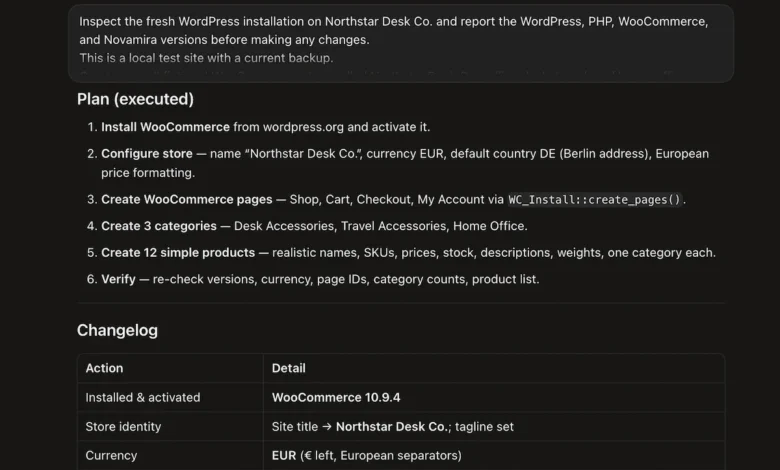
In a controlled experiment, an operator utilized Novamira Pro to build a fictional retail site, "Northstar Desk Co.," from the ground up. The process was completed in approximately one hour, broken down into five distinct phases:
- Initial Infrastructure Setup: The AI was prompted to inspect the WordPress and WooCommerce environment before generating a series of categories and 10 to 15 simple products. By consolidating the onboarding process into a single prompt, the time typically spent navigating the WooCommerce setup wizard was bypassed.
- Bulk Price Optimization: The AI analyzed the "Desk Accessories" category to implement a 9% price increase. The process involved a pre-execution verification step, where the AI generated a preview table of all affected products. This allowed for manual oversight before the AI applied the changes directly to the database.
- Strategic Sales Scheduling: The operator automated a 20% discount on the "Home Office" category, set for a specific seven-day window. While the AI initially identified a conflict regarding the interaction between the store’s timezone and sale duration fields, it provided an alternative logical path to resolve the scheduling, successfully implementing the sale.
- Data Auditing and Remediation: To test the AI’s error-correction capabilities, the operator deliberately corrupted several product entries, including missing SKUs and category assignments. The AI successfully audited the database, identified the gaps, and proposed repairs that aligned with the store’s existing naming conventions and data structure.
- Custom Feature Development: The final phase involved creating a custom front-end notice for sale items. The AI generated a standalone plugin that hooked into the WooCommerce product summary page to display a countdown or "Sale ends" message. This was executed without modifying the core theme files, adhering to best practices for WordPress development.
Technical Data and Operational Efficiency
The transition to AI-assisted management offers measurable efficiency gains. A manual bulk price update across a large category typically requires filtering through multiple pages in the WooCommerce dashboard, selecting items, and performing bulk actions. In contrast, the AI-driven approach allows for granular, conditional changes—such as rounding prices to a specific decimal point (e.g., .99)—across the entire catalog in a single operation.

However, the experiment highlighted critical limitations. Not all WooCommerce fields are currently accessible to the AI. When the AI encountered a data field it could not modify directly, it reported the limitation and suggested a workaround, demonstrating that while the agent can manage significant workloads, it currently operates best as an extension of, rather than a replacement for, human oversight.
Furthermore, the audit process revealed that AI agents possess a high degree of "probabilistic honesty." When reconstructing missing SKUs, the AI explicitly categorized its output as an inference rather than a confirmed value, a feature that provides users with the necessary transparency to perform manual verification.

Professional Implications and Safety Protocols
The integration of AI into live e-commerce environments necessitates strict adherence to standard development protocols. Expert consensus and developers of such tools emphasize that AI-driven site changes should not be performed directly on live, production environments without a comprehensive backup strategy.
The "fast facts" of this workflow suggest that while Novamira Free is capable of executing standard PHP and database tasks, the Pro version’s value proposition lies in "contextual memory." For store owners, this means the system remembers the store’s specific pricing conventions, product naming styles, and organizational hierarchies between sessions. This consistency reduces the "hallucination" risk—the tendency of AI to invent data—because the model is consistently anchored to the store’s existing database structure.

Broader Impact on E-commerce Management
The shift toward AI-orchestrated store management represents a broader trend in web administration. Historically, scaling a WooCommerce store required hiring developers to write custom scripts for bulk updates or purchasing expensive, high-maintenance plugins. The ability to issue a natural language command—such as "Prepare a sale for every product in this category"—democratizes technical control.
However, the reliance on these systems introduces new requirements for site administrators. The ability to write effective, clear prompts is becoming as critical as the ability to understand basic database architecture. Furthermore, the reliance on external AI providers to manage internal store data raises questions regarding data privacy and security. As these tools become more sophisticated, store owners must balance the convenience of automation with the necessity of maintaining a secure, stable, and verified retail environment.

Future Outlook and Conclusion
The experiment with Novamira Pro underscores that the current generation of AI tools is highly effective at handling repetitive, logic-based administrative tasks. The successful deployment of custom features and bulk data repairs indicates that AI is moving beyond simple text generation into the realm of functional site engineering.
For the WooCommerce ecosystem, this signifies a period of transition. As developers and store managers continue to experiment with these agents, the primary focus will likely shift from "how to build" to "how to audit." The speed at which a store can be modified is now limited only by the speed at which an administrator can review the AI’s proposed changes. As such, the role of the store manager is evolving from a manual laborer of the dashboard into an architect of AI-driven workflows.