AI Agents Versus Workflows: A Strategic Framework for Enterprise Architecture

In the rapidly evolving landscape of generative artificial intelligence, the distinction between AI workflows and autonomous agents has become a focal point for software engineers, product managers, and corporate CTOs. As organizations race to integrate Large Language Models (LLMs) into their operational infrastructure, the terminology surrounding these systems has grown increasingly ambiguous. Industry analysts note that the term "agent" is frequently misapplied to static automation scripts or basic RAG (Retrieval-Augmented Generation) pipelines. Distinguishing between a deterministic workflow and a dynamic agentic system is no longer merely a semantic exercise; it is a critical architectural decision that impacts cost, scalability, reliability, and regulatory compliance. Before committing resources to development, stakeholders must evaluate whether their objective requires the rigid predictability of a workflow or the emergent, exploratory capability of an autonomous agent.
The Evolution of Generative AI Implementation
The shift from simple chatbot interfaces to complex, integrated systems began in earnest following the release of foundational models capable of tool-use and function calling. In early 2023, the industry focused primarily on "chaining" prompts—a methodology where the output of one model served as the input for the next. This formed the bedrock of what we now classify as the AI workflow.
By mid-2024, the narrative shifted toward "agentic" frameworks, such as those popularized by frameworks like LangGraph, AutoGen, and CrewAI. These systems allow models to observe their environment, perform iterative reasoning, and modify their own execution paths. However, the maturation of these technologies has created a "hype cycle" effect. Recent data from enterprise software audits suggests that nearly 60% of projects labeled as "autonomous agents" could have been achieved with significantly lower latency and higher reliability using standard orchestration workflows. This trend highlights a recurring engineering pattern: the tendency to over-engineer solutions by introducing non-deterministic components where stable, rule-based logic is better suited.
Defining the Architectural Divide
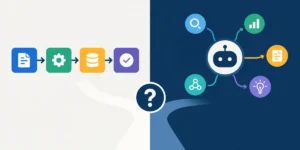
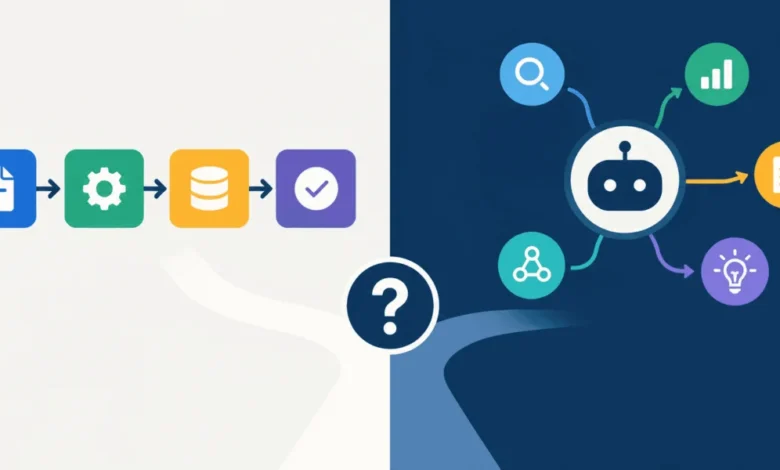
At its core, a workflow is defined by a pre-determined sequence of operations. Even if an LLM is utilized within that sequence to interpret data or generate responses, the control flow remains under the developer’s jurisdiction. The logic is explicit, the branching is finite, and the exit conditions are hard-coded. This approach prioritizes predictability. In a financial context, such as a loan application processor, the steps—verify identity, check credit history, analyze income, and issue a decision—must occur in a specific order. The developer dictates this sequence, ensuring that the system operates within strict compliance parameters at every turn.
Conversely, an agentic system represents a departure from fixed execution. In an agentic architecture, the LLM acts as the decision-maker for the "next best action." When given a goal—such as "diagnose the cause of a 30% drop in regional web traffic"—the agent evaluates the current state, selects from a suite of available tools (e.g., querying log databases, checking CDN status, or analyzing deployment history), and determines whether the current information is sufficient to reach a conclusion or if further investigation is required. The control flow is not designed; it is emergent.
The Practical Test: The Whiteboard Methodology
The most effective litmus test for choosing between these two architectures is the "Whiteboard Test." If a lead engineer can successfully sketch the entirety of the process on a whiteboard—including all conditional branches, error handling, and recovery steps—before a single line of code is written, a workflow is almost certainly the superior choice.
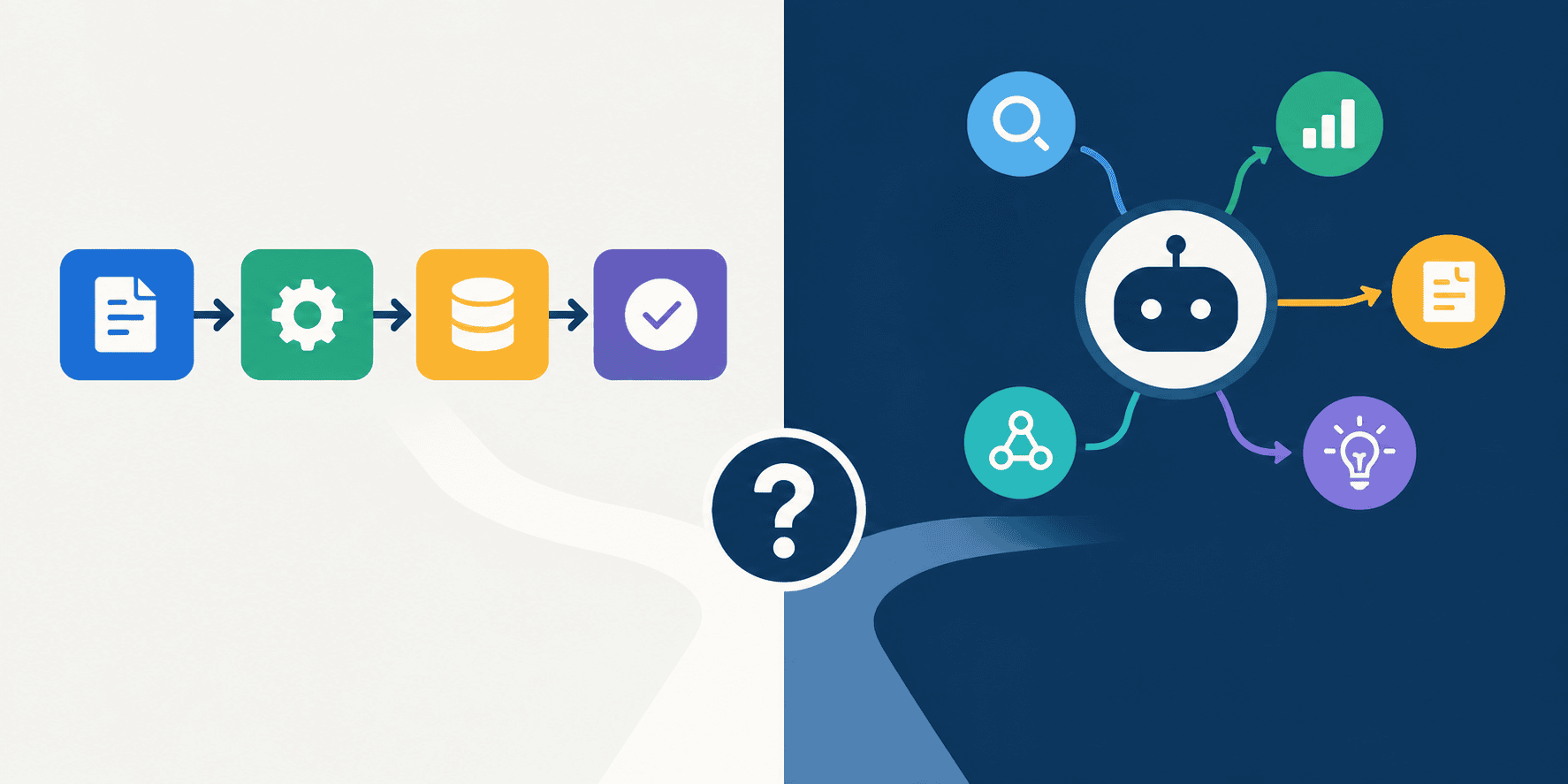
This is not a reflection of the task’s complexity, but rather its structure. A workflow can be highly sophisticated, incorporating multi-agent orchestration, complex RAG pipelines, and human-in-the-loop approvals. The defining characteristic is that the developer retains oversight of the logic path. If, however, the problem space is too volatile to map—where the path to resolution depends entirely on the data discovered during the process—then an agentic approach is required.
Comparative Analysis: Factors Influencing Selection
Choosing the wrong architecture can have significant business implications. Below are the primary variables that distinguish the two:
- Auditability and Compliance: In highly regulated sectors such as healthcare, legal, and finance, the ability to trace an exact execution path is mandatory. Workflows provide a deterministic audit log. Agents, due to their non-deterministic nature, can arrive at correct answers via varying, opaque reasoning paths, which complicates regulatory reporting and validation.
- Operational Costs and Resource Consumption: Agentic systems are inherently more expensive to operate. Because they rely on iterative reasoning loops, an agent will often generate thousands of additional tokens compared to a fixed workflow. For high-volume, low-margin applications, these costs can scale linearly, potentially rendering an agent-based product economically unviable.
- Latency Requirements: Workflow systems benefit from optimized paths and parallel execution where possible. Agents are subject to the "reasoning overhead" of the model, which must process the results of a tool call before deciding on the next step. This introduces cumulative latency that may be unacceptable for real-time customer-facing applications.
- Input Variability: When the input space is well-defined—such as processing invoices or routing support tickets—a workflow is highly effective. When the input is "open-ended," such as an open-ended research request or an unstructured creative brainstorming task, an agent’s ability to pivot its strategy becomes its greatest strength.
The Hybrid Approach: Starting with Constraint
Leading engineering organizations are increasingly adopting a "Workflow-First" development lifecycle. This strategy suggests starting with a well-defined workflow, even when the ultimate goal is autonomy. By implementing a fixed pipeline, teams can establish a baseline of reliability.
As the system matures, developers can identify specific nodes in the workflow that require greater flexibility. It is often at these specific junctions that an "agentic step" can be injected. This modular approach allows for "Agentic Workflows," where the system remains largely deterministic but employs agentic reasoning to solve specific, highly complex sub-tasks.
Strategic Implications for Future Deployment
The industry is currently moving toward a more nuanced understanding of AI deployment. As the initial excitement around "autonomous" systems begins to subside, the focus is shifting toward "reliable" systems. For the enterprise, the value of AI is not found in its ability to simulate human agency, but in its ability to augment human productivity with high consistency.
The long-term implication is a move away from the "black box" agent toward transparent, orchestratable systems. Future development environments will likely favor tools that allow for the seamless integration of both rigid, code-based logic and flexible, model-based reasoning. For the developer, the objective remains constant: reduce the surface area for failure. If a task can be successfully bounded by a flowchart, that boundary is a feature, not a limitation. By prioritizing workflows where possible and reserving agentic systems for truly exploratory tasks, organizations can build robust, cost-effective, and auditable AI systems that provide real-world utility without the operational risks associated with excessive, unguided autonomy.