The Myth of the AI-First World: Why Users Want Invisible Automation Rather Than Immersive Artificial Intelligence

The technology sector has long operated on a foundational industry assumption: that consumers and enterprise employees universally crave more artificial intelligence embedded into their daily lives. Over the past several years, corporate leaders, venture capitalists, and software developers have rushed to infuse generative AI models, chat interfaces, and autonomous digital agents into every conceivable product category. From productivity suites and customer service portals to consumer hardware and creative tools, the prevailing directive has been to build AI-first experiences that magically replace legacy workflows.
However, a growing body of industry research, user experience studies, and enterprise adoption metrics suggests a stark disconnect between boardroom ambitions and consumer reality. Rather than welcoming an endless cascade of generative features, large segments of the workforce and general public are exhibiting distinct signs of fatigue, skepticism, and resistance. Far from desiring standalone chatbots and experimental AI art generators, everyday users are increasingly signaling that they do not want more artificial intelligence—at least not in the intrusive, workflow-disrupting manner envisioned by tech executives.
The Rising Adoption Gap and Enterprise Realities
This friction between corporate strategy and user preference is manifested clearly in adoption metrics. Industry analyses, including recent benchmark studies from technology research firms and enterprise software monitors, highlight a persistent adoption gap. Despite billions of dollars in capital expenditure and high-profile product launches, retention rates for many standalone enterprise AI features remain low. The cost of delivery—both in terms of cloud computing infrastructure and potential reputational damage caused by erroneous outputs—continues to outpace the tangible value delivered to the end user.
A primary driver of this phenomenon is that "AI-powered" is frequently marketed as a standalone value proposition rather than an underlying capability. When companies introduce disconnected AI tools as bolt-on extras, they inadvertently force employees to navigate yet another fragmented interface. Instead of streamlining operations, these implementations frequently increase cognitive load, requiring workers to continuously hop on and off disconnected systems.
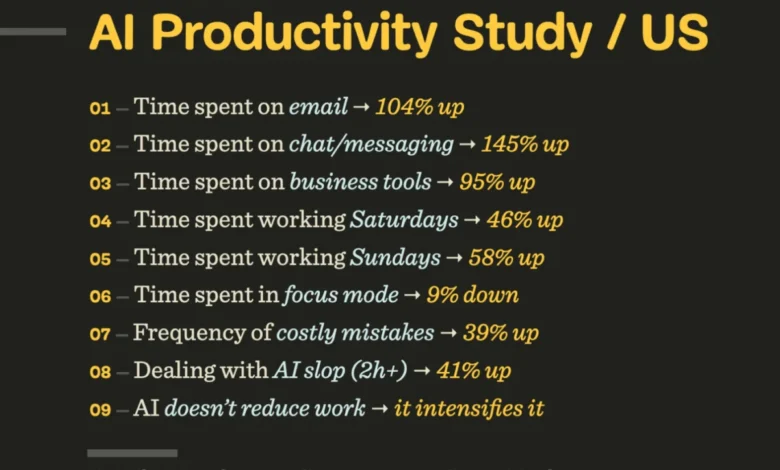
Furthermore, recent productivity analyses and workplace studies—drawing on data from labor economists and organizational researchers—paint a sobering picture of how generative tools impact daily routines. Rather than reducing working hours, the integration of poorly contextualized AI has often intensified workloads. Studies tracking corporate digital habits indicate spikes in time spent managing electronic correspondence, messaging channels, and business software, alongside a measurable rise in costly errors and time spent reviewing low-quality, AI-generated outputs, colloquially known as "AI slop." Employees find themselves spending valuable hours verifying facts and editing unpolished drafts, turning what was promised as a time-saving shortcut into a rigorous supervisory task.
The Psychological Toll of Unsolicited Technological Shifts

The resistance to ubiquitous AI is not merely functional; it is deeply psychological. For many consumers and professionals, new AI features do not arrive as tools chosen for exploration and mastery. Instead, they are deployed uninvited, dictated by corporate mandates or software updates that alter familiar user interfaces overnight.
This top-down implementation coincides with widespread public discourse surrounding automation and labor displacement. As headlines consistently warn of job automation across white-collar and creative sectors, the introduction of unpredictable artificial intelligence into daily workflows frequently generates anxiety rather than excitement. Unlike traditional software features, which are deterministic and reliable, generative AI introduces probabilistic variance. Users are acutely aware of the hidden tax of error-checking—the mental labor required to catch hallucinations, logical inconsistencies, and subtle errors before they propagate into critical business documents or public communications.
Consequently, public perception has shifted from naive enthusiasm to cautious skepticism. Consumers do not express a burning desire for AI-narrated children’s books, autonomous financial agents operating independently across banking accounts, or perpetual chat boxes embedded into household appliances. When given a choice, users consistently favor tools that are fast, accessible, predictable, and reliable above all else.
Redefining the Value Proposition: The Shift to AI-Second Design

As the initial wave of hype matures, product designers and enterprise strategists are beginning to reevaluate how artificial intelligence should be integrated into human environments. Rather than attempting to replace human creativity, judgment, and interpersonal connection, successful future implementations point toward an "AI-second" paradigm.
Under this framework, artificial intelligence recedes into the background. Rather than demanding constant attention through conversational interfaces or disruptive pop-ups, ambient and humble AI systems take over the most monotonous, repetitive, and mentally draining administrative tasks. By automating structured, low-level labor—such as data formatting, schedule coordination, and routine logistical sorting—properly integrated technology can free up human cognitive bandwidth for activities that require genuine intuition, emotional intelligence, and critical thinking.
This philosophy aligns closely with observations voiced by prominent technology and business leaders, who emphasize that individuals do not want algorithms to mimic human artistic expression, emotional counseling, or fundamental decision-making. Instead, they seek automation that handles the heavy lifting of physical and mental drudgery, preserving the integrity of human-led creation and social interaction.
Implications for Product Strategy and User Experience

The realization that users reject disruptive, poorly integrated AI forces a fundamental pivot in product development methodologies. Organizations are discovering that technology cannot serve as a band-aid for pre-existing operational deficiencies. AI famously amplifies existing organizational shortcomings—such as poor data hygiene, inconsistent communication, and broken internal workflows—rather than curing them. When messy internal structures are handed off to an unpredictable language model, the resulting inconsistencies are thrust directly onto the user.
Moving forward, successful product design must respect established human mental models. Users do not evaluate software by comparing it to the imperfections of other human beings; they compare software features directly against other software features. If an automated feature behaves unpredictably, users will swiftly abandon it in favor of deterministic tools that perform consistently every single time.
To bridge this gap, enterprises must focus on clear, demonstrable use cases where automation genuinely reduces friction without demanding workflow overhauls. Whether the underlying technology is branded explicitly as artificial intelligence or simply introduced as smart automation, its ultimate metric of success remains unchanged: it must serve the user reliably, quietly, and transparently, ensuring that technology adapts to human habits rather than forcing humans to alter their lives to accommodate the technology.