Interpretable Text Classification: Probing Scikit-LLM Embedding Spaces to Unveil the Black Box of Large Language Models

The rapid ascent of Large Language Models (LLMs) has fundamentally reshaped the architecture of modern natural language processing (NLP). By converting raw, unstructured text into high-dimensional vector representations—commonly referred to as embeddings—these models provide a rich semantic foundation for downstream applications. However, this transition toward deep learning-based text classification has introduced a significant hurdle: the “black-box” problem. As models become more complex, the transparency of how these systems arrive at specific decisions diminishes. To address this, data scientists are increasingly adopting diagnostic frameworks, specifically probing classifiers, UMAP visualization, and SHAP values, to peer inside the latent spaces of these powerful tools.
The Evolution of Text Classification
Historically, text classification relied on manual feature engineering, such as Bag-of-Words or TF-IDF, combined with traditional algorithms like Support Vector Machines or Naive Bayes. These methods were inherently interpretable; one could trace a classification decision back to specific keywords or n-grams. The advent of transformer-based LLMs changed this paradigm. By capturing nuanced context, sarcasm, and long-range dependencies, LLMs produce embeddings that vastly outperform older methods in accuracy. Yet, the cost of this performance is a loss of explainability. When an LLM generates a dense numerical vector for a review, it is often unclear which specific semantic features are driving the model to categorize that review as "positive" or "negative."
The Methodology of Probing
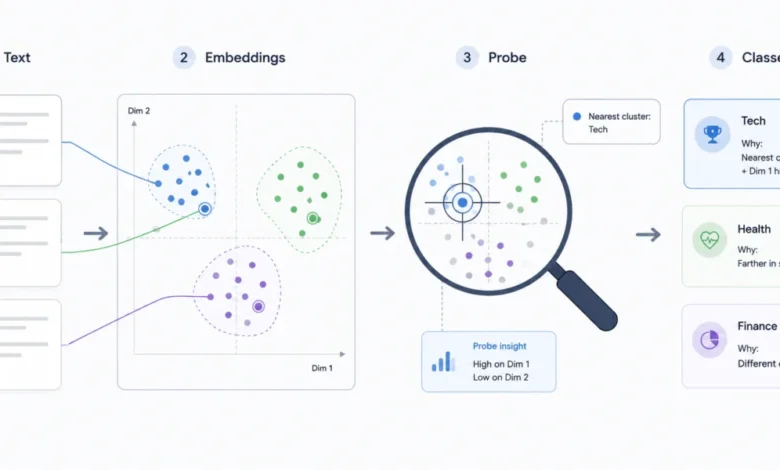
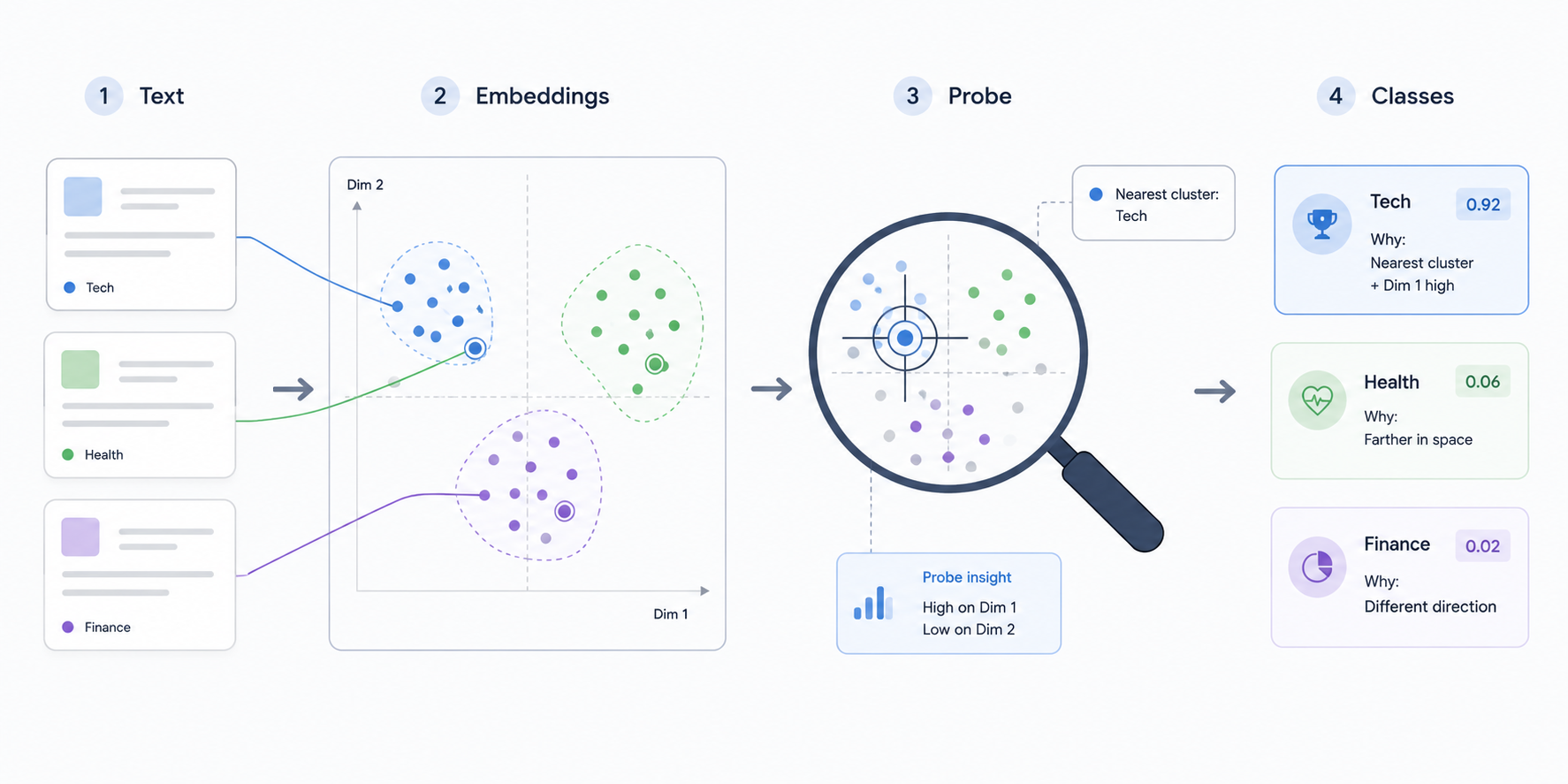
A probing classifier serves as a bridge between high-performance neural embeddings and human-readable logic. By training a simple, interpretable model—such as logistic regression—on top of frozen embeddings, researchers can determine the quality and linear separability of the information captured by the LLM. If a linear classifier can effectively distinguish between classes using these vectors, it confirms that the embeddings contain high-quality, task-relevant information.
The recent implementation of the Scikit-LLM framework has democratized this process. By providing an interface that adheres to the familiar scikit-learn API, it allows developers to integrate local LLMs—run via the Ollama distribution—into standard data science pipelines without the overhead of cloud API costs. This setup facilitates a repeatable, cost-effective workflow for auditing the internal knowledge of models like all-minilm.
Technical Implementation and Chronology
The process of auditing embedding spaces follows a structured technical workflow:
- Environment Initialization: The first step involves installing necessary libraries, including Scikit-LLM for model orchestration, UMAP for dimensionality reduction, and SHAP for feature attribution.
- Local Server Deployment: Utilizing tools like Ollama, engineers can run lightweight, open-source embedding models locally. This eliminates the latency and privacy concerns associated with third-party cloud providers.
- Dataset Preparation: Utilizing standardized datasets, such as the IMDB movie review archive, researchers create a balanced subset. Stratified sampling is applied to ensure that training and testing sets maintain equal proportions of sentiment, preventing bias during the probing phase.
- Embedding Generation: The raw text is passed through the embedding model. This phase transforms human-readable reviews into high-dimensional vectors, which serve as the input features for the downstream classifier.
- Probing and Evaluation: A Logistic Regression model is trained on the resulting vectors. High accuracy at this stage suggests that the LLM has successfully distilled the semantic essence of the reviews into a linearly separable format.
Visualizing Latent Spaces with UMAP
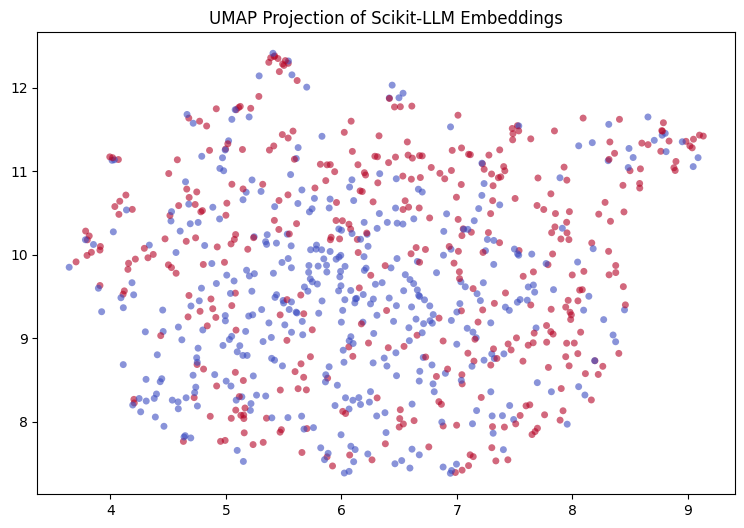
Once the classifier is trained, the next challenge is understanding the topology of the embedding space. High-dimensional data is inherently difficult for the human mind to process. Uniform Manifold Approximation and Projection (UMAP) serves as a critical visualization tool here. By projecting these vectors into two-dimensional space, UMAP maintains the global structure of the data, allowing researchers to see if the LLM has clustered "positive" and "negative" reviews in distinct regions of the vector space.
While perfect separation is rarely achieved—due to the ambiguity inherent in language—the presence of distinct density gradients provides visual confirmation that the model has learned the underlying sentiment distribution. This visualization is essential for debugging, as it allows developers to identify if specific subsets of data are causing the model to misclassify.
Decoding Decisions with SHAP Values
The final layer of interpretability involves SHAP (SHapley Additive exPlanations). Rooted in game theory, SHAP assigns each feature—in this case, each dimension of the embedding vector—a value representing its contribution to the final prediction.
In a practical application, this means identifying which latent dimensions are most indicative of sentiment. If dimension 208 consistently correlates with negative sentiment while dimension 139 points toward positive sentiment, developers gain a granular understanding of the model’s internal logic. This level of transparency is vital for industries where AI decisions must be audited, such as finance, healthcare, or legal technology.
Implications for AI Transparency
The movement toward interpretable AI is not merely a academic exercise; it is a regulatory and functional necessity. As the European Union’s AI Act and other global standards push for greater transparency in algorithmic decision-making, tools that can "open the black box" are becoming standard industry practice.
The ability to probe LLM embeddings provides several key advantages:
- Error Analysis: By identifying which embedding dimensions contribute to errors, developers can refine training data or prompt strategies.
- Bias Detection: If a probing classifier reveals that a model is relying on unintended features (such as gender-coded language in a neutral sentiment task), teams can intervene before deployment.
- Cost Optimization: Understanding which dimensions are essential allows for potential dimensionality reduction, leading to faster, cheaper inference in production environments.
The Path Forward
As LLMs continue to evolve, the distinction between high-performance "black-box" models and interpretable systems will likely blur. Integrating diagnostic tools like Scikit-LLM, UMAP, and SHAP into the standard machine learning lifecycle represents a shift toward more responsible AI development. By treating embeddings not as inscrutable outputs, but as measurable, interpretable features, the data science community can ensure that the next generation of AI is not only more accurate but also more transparent and accountable.
Future developments in this field will likely focus on automating these interpretability steps, allowing for real-time monitoring of model behavior. As the ecosystem matures, the combination of robust local infrastructure and rigorous diagnostic frameworks will remain the gold standard for organizations seeking to leverage the power of LLMs while maintaining full control over their decision-making processes. Through these methods, the veil of the black box is lifted, turning the complex internal workings of modern language models into a transparent, actionable map of human language and intent.