Single-Agent vs. Multi-Agent AI Systems: When the Complexity Is Worth It

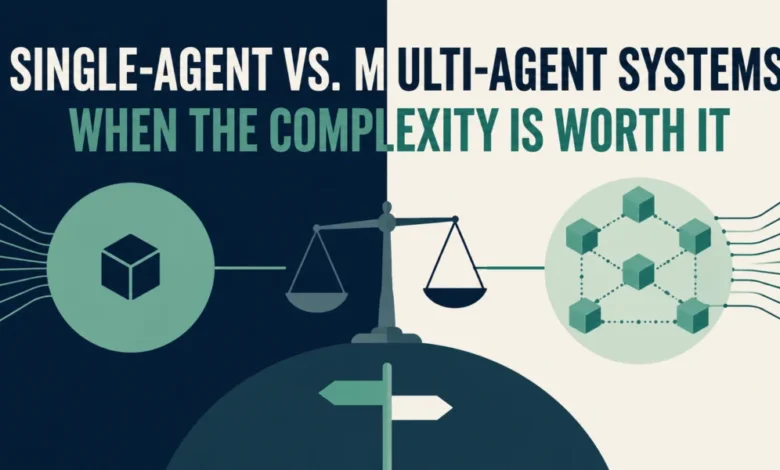
The rapid evolution of Large Language Models (LLMs) has moved the AI industry from simple prompt-response interactions to complex, autonomous workflows. As developers transition from experimenting with chatbots to deploying production-grade automation, they face a pivotal architectural crossroads: should they rely on a single, high-capability agent to manage an end-to-end task, or should they distribute the workload across a collaborative team of specialized agents? This decision carries profound implications for operational costs, system latency, and long-term maintainability.
Defining the Agentic Paradigm
To understand the architectural divide, one must first define what constitutes an "agent." Unlike a standard LLM that generates text based on a static prompt, an agentic system is characterized by its ability to deliberate, utilize external tools, and iterate toward a goal. An agent operates within a feedback loop: it evaluates a state, performs an action—such as querying a SQL database, executing Python code, or browsing the web—and observes the outcome to refine its next move.
While both single-agent and multi-agent architectures share this core operational loop, they diverge sharply in their management of complexity. A single-agent system relies on one primary "brain" to navigate a workflow, whereas a multi-agent system employs an orchestration layer to divide responsibilities among specialized entities.
The Case for Single-Agent Systems: Efficiency and Simplicity
The single-agent architecture remains the gold standard for many business applications, particularly those requiring low latency and cost-effectiveness. In this model, a generalist agent is granted a suite of tools and a clear mandate. For tasks such as customer support triage, simple data extraction, or summarizing internal documents, a single agent often provides the most robust return on investment.
Data from recent enterprise AI deployments suggest that for approximately 70% of standard business workflows, a well-engineered single-agent system achieves performance levels comparable to more complex architectures. The primary advantage is the reduced "cognitive load" on the model. Because there is only one agent in the loop, debugging is significantly more straightforward; developers have a single conversation history and a linear trace to analyze when an error occurs.
From a cost perspective, single-agent systems minimize redundant model calls. In cloud environments where latency is billed by the millisecond and token usage is the primary driver of cost, the "freelancer" model—where one agent completes the entire task—prevents the "chatter" that often occurs when multiple agents communicate with one another to coordinate simple tasks.
The Complexity Tax of Multi-Agent Orchestration
Multi-agent systems, while increasingly popular, introduce what architects refer to as a "complexity tax." This architecture typically involves an orchestrator that delegates sub-tasks to specialized agents. While this mimics a corporate structure, it brings systemic challenges that must be accounted for:
- Compounding Latency: Every handoff between agents adds overhead. If Agent A must wait for Agent B to finish a task before moving forward, the total execution time becomes the sum of all individual agent latencies plus the orchestration overhead.
- Escalating Costs: Each agent within a swarm makes its own model calls. In parallel workflows, token consumption can spike significantly, potentially rendering a project economically unviable if the return on investment does not scale linearly with the increased output.
- Propagation of Errors: In a single-agent system, an error is isolated. In a multi-agent system, a minor misinterpretation by one agent can cascade downstream, leading to a "hallucination chain" that is notoriously difficult to trace back to the original source.
- Orchestration Logic: Maintaining shared state and context across multiple agents is a non-trivial engineering task. Developers must build robust protocols for memory management, ensuring that Agent C has the necessary context from Agent A without being overwhelmed by irrelevant data.
When Multi-Agent Complexity Is Justified
Industry consensus suggests that the transition to a multi-agent system should be driven by necessity rather than the novelty of the architecture. There are four specific scenarios where the added complexity is empirically justified:
The Adversarial or Critic Workflow
LLMs often struggle to identify their own errors. In tasks like code generation or complex financial reporting, a "self-correction" loop is rarely effective because the model remains biased toward its initial logic. By employing a separate "Critic" agent—specifically prompted to identify vulnerabilities, logical gaps, or compliance risks—the system creates an adversarial check-and-balance. This dual-agent approach is common in high-stakes environments where output accuracy is the primary performance metric.
Specialized Tooling and Performance Degradation
Research indicates that "context window saturation" occurs when an agent is given too many tools. If an agent must choose between twenty different APIs, its performance in tool selection often degrades. Specialization allows developers to assign a specific subset of tools to a specific agent, thereby sharpening the agent’s focus and improving the precision of tool invocation.
Leveraging Parallelism
If a workflow involves independent tasks, such as gathering market data from three different regional databases, a multi-agent approach can collapse the timeline. By running these tasks concurrently, the system achieves a performance gain that a sequential single-agent system cannot match.
Contextual Persona Shifts
When a process requires drastically different "mindsets," such as moving from a creative marketing copywriter to a rigid legal compliance officer, multi-agent systems excel. Using separate agents with distinct system prompts ensures that the "persona" of the agent is strictly enforced throughout the relevant portion of the task, reducing the risk of tone drift.
A Framework for Architectural Decision-Making
When determining the appropriate architecture, developers should apply a "Human Analogy" heuristic. If a human professional would need to switch software, consult a different department, or drastically change their mindset to complete the task, it is likely that a multi-agent system is the correct approach. If a single person could complete the task at one desk, using one computer, without needing to pause for a change in role, a single-agent architecture is almost certainly the more efficient choice.
Comparative Analysis: Key Metrics
| Metric | Single-Agent System | Multi-Agent System |
|---|---|---|
| Latency | Low (Linear) | High (Compounding) |
| Operational Cost | Predictable/Low | Variable/High |
| Debugging Complexity | Low | High (Requires trace analysis) |
| Primary Utility | Focused, linear tasks | Specialized, parallel workflows |
| Error Risk | Localized | Propagative |
Strategic Recommendations: Start Simple, Scale Later
The most successful AI implementations in the current enterprise landscape follow a policy of "delayed complexity." Teams that start by building a robust single-agent system often find that it solves the vast majority of their requirements. By observing where the single agent fails—whether it is a struggle with tool selection, an inability to self-critique, or unacceptable latency—developers can identify the precise point at which a multi-agent architecture becomes necessary.
Building a multi-agent system should be a response to observed limitations rather than an architectural starting point. By maintaining a modular design, teams can start with one agent and "spin off" sub-tasks into specialized agents only when the complexity of the task demands it. This evolutionary approach minimizes wasted development effort and ensures that the system’s architecture remains aligned with the actual needs of the business, rather than the shifting trends of the broader AI development community. As the field matures, the ability to balance the raw power of LLMs with the pragmatic constraints of software engineering will be the defining factor in successful AI deployment.
Related posts: