The landscape of digital publishing and website administration has long been defined by the tedious, repetitive maintenance cycles required to keep content management systems secure and operational. For agencies, freelancers, and enterprise web administrators overseeing portfolios of multiple WordPress installations, routine maintenance tasks such as updating core software, themes, and plugins consume countless hours of manual labor. Traditional multi-site management platforms have attempted to alleviate this friction, but they frequently introduce rigid site thresholds, escalating cost structures, and isolated dashboard environments that separate administrators from their primary analytical and creative workflows. Addressing this persistent operational bottleneck, software developer Awesome Motive has officially announced the launch of WPVibe Fleet Management, an innovative extension of its conversational artificial intelligence ecosystem designed to streamline multi-site administration directly through leading AI assistants.
Background Context and Evolution of the WPVibe Ecosystem
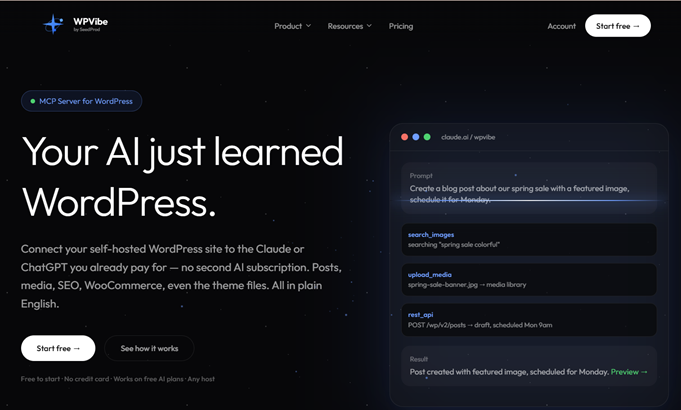
To understand the strategic significance of WPVibe Fleet Management, one must examine the rapid trajectory of the underlying platform. Earlier this year, the developers behind WPBeginner introduced WPVibe to bridge the gap between decentralized WordPress architecture and advanced conversational intelligence models such as OpenAI’s ChatGPT and Anthropic’s Claude. Utilizing the Model Context Protocol (MCP)—an open standard developed to connect AI models safely to secure data sources and developer tools—WPVibe enabled web managers to execute administrative workflows via natural language processing.

Within months of its initial release, the plugin achieved notable adoption milestones, securing over 20,000 active installations and maintaining a stellar 4.9-out-of-5-star rating on the official WordPress.org repository. Initially engineered for single-site utility, the tool allowed users to generate content within the block editor, construct optimized landing pages, produce missing image alternative text, remediate broken hyperlinks, and optimize bloated database tables simply by conversing with an AI agent. However, as the user base expanded, administrators managing extensive portfolios of client domains highlighted a critical limitation: while conversational management transformed single-site operations, scaling those actions across dozens or hundreds of independent installations required repetitive, manual prompts. WPVibe Fleet Management was conceived to bridge this operational divide, translating conversational single-site control into synchronized, fleet-wide automation.
Core Architecture and Functional Capabilities
WPVibe Fleet Management functions as a centralized command layer integrated seamlessly into conversational AI interfaces, positioning itself as a streamlined, AI-native alternative to legacy multi-site management suites like ManageWP. Rather than navigating away from an active AI session to inspect remote dashboards, administrators can query their entire portfolio of connected websites using plain language.
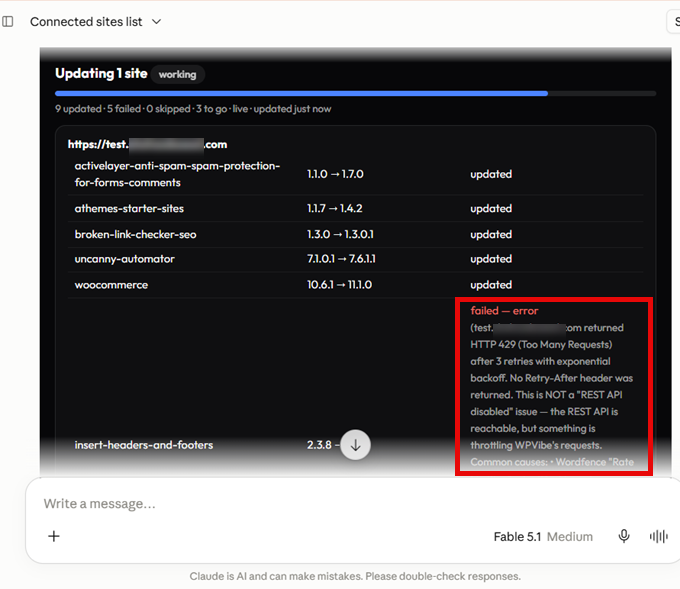
Upon request, the system aggregates pending maintenance items into a unified, live-updating interface embedded directly within the chat window. This display details every connected property alongside itemized lists of pending updates for themes, plugins, and core software, complete with precise version numbers. Users can selectively approve updates across specific subsets of their digital infrastructure or execute batch commands across an entire portfolio with a single directive.
To ensure stability and mitigate the inherent risks associated with automated updates, the platform incorporates rigorous pre- and post-execution verification protocols. Prior to deploying any software package, the system performs an automated health check to confirm that target environments remain stable and that no conflicting package updates have been introduced in the interim. Following execution, secondary verification routines validate that the intended versions have been successfully installed and that the target websites continue to render correctly.
Strategic Safeguards for Enterprise and Agency Deployments
Managing large fleets of independent websites introduces significant risk profiles, primarily regarding catastrophic update failures that can render a web property inaccessible. WPVibe Fleet Management addresses these vulnerabilities through sophisticated error isolation and selective authorization logic.
If an update operation fails on a specific website within a broader batch deployment, the system is engineered to isolate the failure, log the precise cause of the error, and independently continue executing pending tasks across the remainder of the portfolio. This compartmentalization ensures that a single compromised plugin on one auxiliary site does not halt maintenance routines across an entire enterprise network. Furthermore, comprehensive failure reports provide administrators with actionable diagnostic data to expedite remediation.
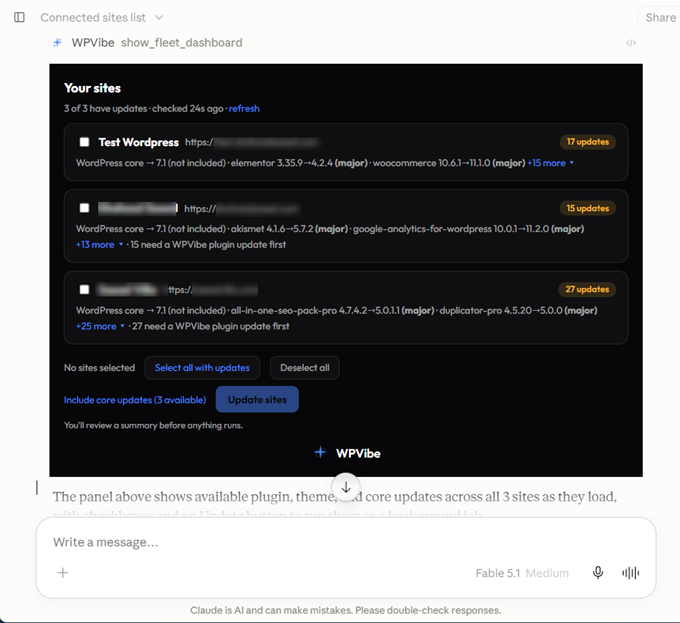
In recognition of the critical nature of core software modifications, the platform enforces mandatory human-in-the-loop verification for all WordPress core updates. While minor plugin and theme patches can be rolled back effectively in the event of an incompatibility, major core updates carry elevated risks of structural disruption. WPVibe Fleet Management pauses multi-site workflows when core upgrades are queued, requiring explicit, manual confirmation from the administrator before proceeding, while simultaneously permitting background tasks on unaffected sites to continue uninterrupted.
Asynchronous Task Execution and Resource Management
Web administrators frequently encounter server timeout limitations and execution bottlenecks when performing resource-intensive maintenance operations across large-scale web installations. WPVibe Fleet Management introduces asynchronous background processing designed to decouple administrative tasks from active browser sessions.
Users are no longer required to maintain an active browser tab or open chat window while bulk operations—such as comprehensive plugin updates, extensive database cleanups, or large-scale search-and-replace queries—are underway. Administrators can initiate complex fleet-wide procedures, close their browser windows, and subsequently review automated audit logs detailing the final disposition of each task. Additionally, the platform intelligently handles daily execution limits imposed by underlying AI API providers; if a user approaches their daily threshold mid-operation, the system automatically pauses active jobs and resumes them seamlessly once resource quotas reset.
Deployment, Pricing Models, and Market Implications
Getting started with WPVibe Fleet Management requires a straightforward configuration process that connects individual WordPress installations to the centralized AI framework using secure authorization tokens. In scenarios where an AI assistant interface is unable to render complex graphical fleet management panels natively, the system generates secure read-only URIs accompanied by pre-formatted conversational prompts, enabling administrators to resume operations effortlessly within alternative chat environments.
Significantly, the platform’s pricing strategy diverges from traditional software-as-a-service models by decoupling site volume from subscription tiers. All WPVibe plans—including the complimentary entry-level tier—permit an unlimited number of connected websites. Instead of charging incrementally per domain as a portfolio expands, subscription tiers scale based on daily action limits and advanced operational features. For professional web development agencies and digital marketing firms managing extensive client rosters, higher-tier plans introduce granular client sub-accounts and detailed per-client usage reporting.
Industry analysts observe that the integration of generative artificial intelligence with infrastructure management tools marks a significant maturation phase in web administration software. By abstracting routine maintenance behind natural language interfaces and robust automated safety protocols, tools like WPVibe Fleet Management are poised to redefine efficiency standards for web professionals, shifting the focus of digital management from reactive troubleshooting to proactive architectural oversight.