The Death of the Button: Why the Web is Shifting from Menus to Intent-Driven AI Experiences

For decades, the digital landscape has been anchored by a familiar architecture: point-and-click interactions governed by graphical user interfaces. Ever since the commercialization of the GUI—pioneered by systems like the Xerox Star and popularized by the original Apple Macintosh—software has expected users to navigate complex labyrinths of menus, range sliders, multi-step forms, and cookie pop-ups. Whether booking a flight, researching medical symptoms, or purchasing retail goods, consumers have routinely spent more time managing software interfaces than achieving their actual objectives.
However, accelerated by breakthroughs in artificial intelligence and large language models, the underlying contract of web design is undergoing a fundamental transformation. A growing coalition of tech platforms is pioneering Intent-Driven Design, a paradigm that replaces manual navigation with high-level goal execution. Rather than forcing users to learn intricate sales funnels or manually cross-reference dozens of browser tabs, modern web tools are designed to capture human intent and silently execute heavy computational workloads in the background.
This movement represents a realization of long-standing human-computer interaction (HCI) concepts, most notably Golden Krishna’s premise that "the best interface is no interface" and Don Norman’s foundational principles of human-centered design. For user experience (UX) designers, the rapid maturation of generative technologies requires a total re-evaluation of their craft. The industry is pivoting away from designing static, visible interfaces toward guiding transparent, intent-driven AI experiences.

The Evolution of Interface Design: A Chronological Overview
To understand the magnitude of the current shift, it is helpful to examine the historical trajectory of digital interfaces over the past half-century:
1970s–1980s: The GUI Revolution
The introduction of the Graphical User Interface transformed computing from text-based command lines into visual environments utilizing desktops, windows, icons, and pointers (WIMP). Systems like the Xerox Star and Apple Macintosh established the mouse click and dropdown menu as the universal standard for human-computer interaction.
1990s–2010s: The Multi-Step Web Paradigm
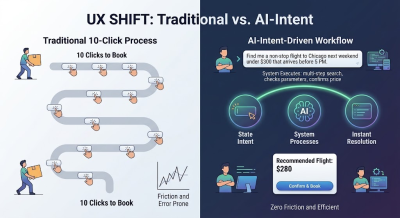
With the commercialization of the internet, early websites emulated physical catalogs and filing systems. The user journey became heavily procedural. Booking a vacation, for example, evolved into a rigid, multi-step pipeline: navigating to an aggregator, filtering by price, selecting dates, deselecting travel insurance add-ons, entering passenger details, navigating payment gateways, and managing confirmation screens. This point-and-click model treated the computer as a passive container of data, requiring the human to act as the tireless manual orchestrator.
2020s: The Rise of Generative UI and Autonomous Agents
As large language models matured, the web began moving away from static layouts. Platforms started adopting generative user interfaces that render dynamic components on the fly. Autonomous background agents began taking over multi-step workflows, transforming software from an interactive tool into a proactive problem-solver.
Deconstructing the "10-Click" Process
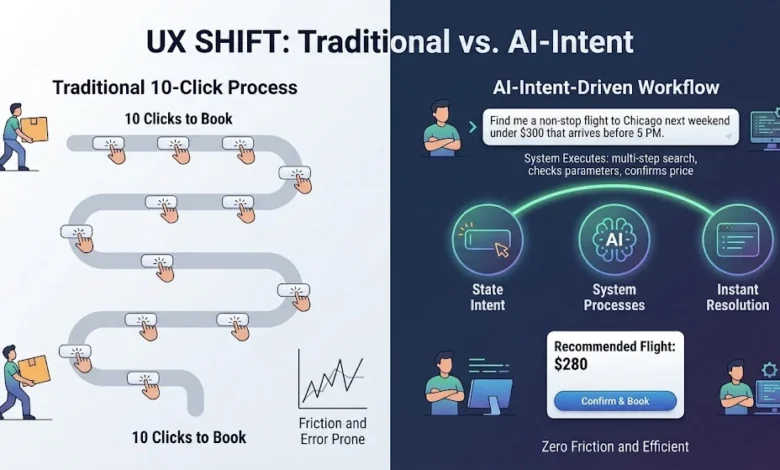
The inefficiency of legacy digital design is perhaps best illustrated by routine consumer transactions. Under traditional web paradigms, a standard online purchase or booking workflow relies on hyper-interactive micro-actions. Users must manually input parameters, interpret raw database outputs, and execute every micro-step along the way.
Intent-driven design flips this dynamic entirely. Instead of asking a user to master the mechanics of how to find a service, an intent-driven platform asks a singular question: What are you trying to accomplish?
When a user inputs a natural language prompt—such as "Find me a non-stop flight to Chicago next weekend under $300 that arrives before 5 PM"—the software parses the overarching goal, executes the complex search query behind the scenes, cross-references pricing matrices, and presents a single, actionable resolution. Ten distinct clicks dissolve into one clear intent outcome.
Early Industry Adopters: Replacing Buttons with Intent
This philosophical shift is no longer confined to theoretical computer science papers; it is actively reshaping consumer-facing web platforms. Several prominent applications are already demonstrating how traditional buttons and sidebars can be replaced by intent-capturing workflows.
Perplexity AI: Search Without Open Tabs
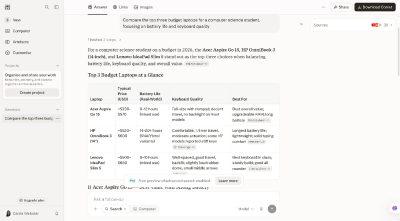
Traditional search engines were historically engineered as directories. Users entered keywords, and the interface rewarded them with a list of blue links, leaving the arduous work of opening multiple tabs, skimming long-form articles, and synthesizing answers to the human. Platforms like Perplexity AI bypass this friction by synthesizing comprehensive answers in real-time, pulling from multiple verified sources and presenting structured data tables or summaries instantly.
Vercel v0: Generative Interface Building
Historically, web design and software prototyping required drag-and-drop builders or manual coding environments like Figma, where creators spent hours drawing rectangles, defining hex codes, and adjusting CSS padding. Generative web platforms like Vercel v0 allow creators to build functional user interfaces directly from natural language prompts, instantly rendering production-ready code components without manual layout assembly.
Goblin.tools: Micro-Task Decomposition
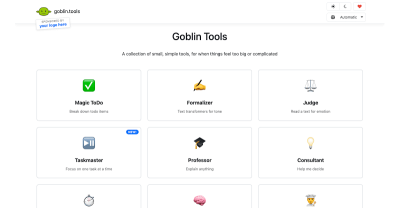
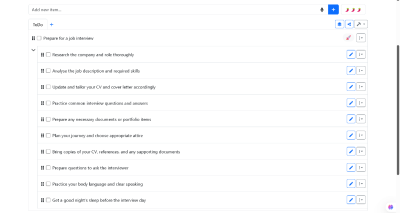
Conventional productivity applications require users to manually construct Kanban boards, assign deadlines, and sort sub-tasks. Niche AI utilities like Goblin.tools offer single-page, zero-config interfaces designed to break overwhelming, high-level objectives—such as preparing for a job interview or organizing a household move—into manageable, step-by-step checklists instantaneously.
Core Pillars of Intent-Driven Web Design
Industry analysts and human-computer interaction researchers emphasize that removing traditional menus and sidebars requires a new framework of usability standards. Intent-driven web platforms typically rely on three foundational pillars:
-
High-Level Goals Over Micro-Actions
Ambient design principles dictate that modern software should not always wait for explicit commands. By leveraging contextual metadata—such as device states, geographic locations, and historical interaction patterns—systems can anticipate needs and trigger proactive interventions. -
Generative UI Layouts
In traditional web architecture, every visitor encounters the exact same static layout. Conversely, generative UI dynamically renders interface components based on immediate user intent. If a user needs to compute complex financial projections during a casual browsing session, a temporary calculator widget is generated on the fly, dissolving once the objective has been fulfilled. -
Autonomous Execution with Easy Reversibility
Legacy interfaces are often saturated with defensive design elements, such as repetitive confirmation pop-ups asking users if they are sure they want to delete a file or proceed with an action. Intent-driven design replaces intrusive warning modals with frictionless rollback mechanisms. Because autonomous agents operate on behalf of the user, platforms prioritize prominent "Undo" buttons, straightforward revision prompts, and transparent audit logs.
The Hidden Risks: Control and the Black Box Problem
While stripping away interface friction offers significant productivity advantages, delegating control to automated systems introduces notable technical and ethical challenges.
The Illusion of Control
When software makes decisions autonomously, users can easily experience feelings of alienation or loss of agency. Stanford University’s Human-Computer Interaction Group has repeatedly emphasized that automation must maintain strict operational boundaries to prevent frustration. Design frameworks from organizations like the Center for Humane Technology warn that platforms must guard against manipulative defaults, ensuring that routine tasks are automated while high-stakes decisions—such as financial transactions or data privacy adjustments—explicitly require human verification.
The Black Box Problem
In traditional user interfaces, unexpected outcomes are easily diagnosed; a user can quickly identify if they checked the wrong filter box or entered an incorrect date. In intent-driven platforms, troubleshooting is more complex due to the opacity of AI processing. To mitigate this "black box" challenge, the Google People + AI Research (PAIR) Guidebook advocates for transparent feedback loops. Systems must explicitly state their interpretation of a user’s prompt—such as displaying the text "Searching for non-stop flights to Chicago under $300"—allowing users to calibrate trust and correct misinterpretations instantly.
Implications for UX Professionals and the Future of the Web
For decades, the digital economy evaluated software success through metrics rooted in engagement volume: time spent in-app, click-through rates, and page views per session. Websites were intentionally structured to maximize visual stickiness and interaction frequency.
The philosophy championed by advocates of intent-driven design—aligned with the broader "Time Well Spent" movement—radically inverts these success metrics. The ultimate benchmark of a modern digital product is no longer how visually captivating its buttons are, but rather how effectively the software solves a problem and gets out of the user’s way.
As the web continues to evolve, designers must master emerging patterns such as ambient feedback, inline conversational prompts, and transparent status indicators. The ultimate destination of modern web design is clear: the future of digital interaction will not be measured by the complexity of its menus, but by the seamless, invisible completion of human intent.