The Paradox of Artificial Intelligence Adoption Why Users Are Resisting the Push for More AI Features

The global technology sector is currently navigating a significant disconnect between corporate strategy and consumer sentiment regarding the integration of Artificial Intelligence (AI). While executive leadership teams across the Fortune 500 have prioritized the rapid deployment of AI-driven features, market data and user experience research suggest a growing "AI adoption gap." Contrary to the prevailing industry assumption that consumers and employees are eager for more AI-enabled workflows, evidence indicates a rising preference for reliability, predictability, and human-centric design over the "black box" automation currently being offered by major software providers.
The Misalignment of Value Propositions
At the core of the current tension is a fundamental misunderstanding of what constitutes a value proposition. In many organizations, "AI-powered" has become a marketing label rather than a functional benefit. According to industry analysis, including frameworks like the Business Model Canvas, AI should logically be categorized under "Key Activities" or "Key Resources." However, many companies are mistakenly attempting to position AI as the "Value Proposition" itself.
This strategic error has led to the development of "bolt-on" features—tools that are added to existing software suites without deep integration into the user’s natural workflow. Instead of streamlining tasks, these features often force users to exit their established routines to interact with a separate, often unpredictable, interface. For employees, this creates a "system-hopping" effect, where the introduction of a new AI tool adds another layer of administrative overhead rather than reducing the total workload.
A Chronology of the Generative AI Hype Cycle
To understand the current state of resistance, it is necessary to examine the timeline of the current AI boom:
- November 2022: The public launch of ChatGPT by OpenAI marks the beginning of the "Generative AI Era," triggering a race among tech giants like Microsoft and Google to integrate Large Language Models (LLMs) into consumer products.
- Early 2023: The "Feature Rush." Software-as-a-Service (SaaS) providers begin rapidly deploying "AI Assistants" and "Copilots," often bypassing traditional user testing phases to satisfy investor demand for AI roadmaps.
- Late 2023: Early reports of "AI Fatigue" emerge. Organizations start noticing that while initial trial rates for AI features are high, long-term retention is significantly lower than expected.
- 2024: The "Reality Check." Major studies, including those by IBM and the Nielsen Norman Group, highlight the high cost of delivery and the reputational risks associated with AI hallucinations and "slop" (poorly generated AI content).
- 2025 (Projected): A shift toward "AI-Second" design, where the focus moves from visible AI interfaces to background automation that enhances existing features without requiring direct user interaction with a chatbot.
Supporting Data The Hidden Cost of AI Productivity
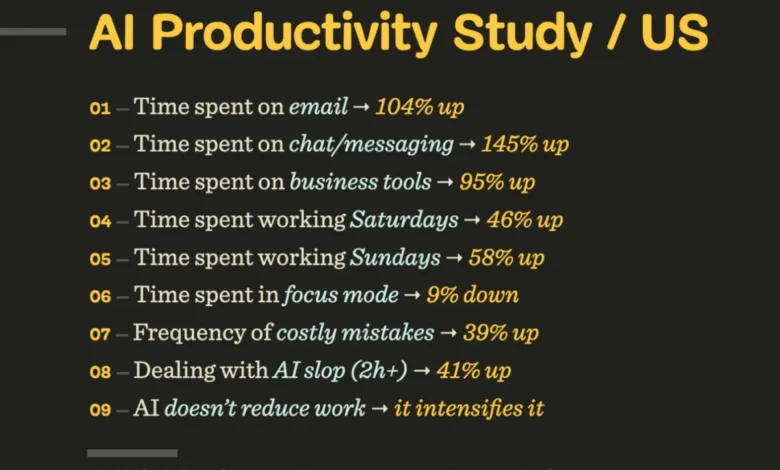
While AI is often marketed as a tool for extreme efficiency, recent productivity studies suggest a more complex reality. Data compiled from sources including NBC News, Harvard Business Review, and Activtrak indicates that the introduction of AI has, in some sectors, intensified work rather than reducing it.

Key findings from recent US-based productivity studies include:
- Communication Overload: Time spent on email has increased by 104% in some AI-enabled environments, while chat and messaging volumes have risen by 145%.
- Administrative Friction: Usage of business tools has increased by 95%, suggesting that users are spending more time managing their software than performing core tasks.
- The "Checking" Penalty: Costly mistakes attributed to AI-generated errors have risen by 39%. The time required to find and fix "hallucinations" often negates the time saved during the initial generation phase.
- Work-Life Erosion: The data shows a 46% increase in Saturday work and a 58% increase in Sunday work among certain cohorts using AI tools to "keep up" with the accelerated pace of delivery.
These statistics suggest that AI is currently amplifying existing organizational shortcomings. Rather than fixing broken cultures or technical debt, AI often makes these inconsistencies more visible to the end-user, who is then tasked with reconciling the "mess" created by automated systems.
Workforce Sentiment and the Threat of Displacement
The resistance to AI is not merely a matter of technical friction; it is deeply rooted in psychological and economic concerns. Research published by the Brookings Institution and The Washington Post has mapped the vulnerability of various professions to AI automation.

Jobs most exposed to AI include software developers, public relations specialists, and legal researchers—roles that require high levels of data synthesis. Conversely, physical-labor-intensive roles, such as firefighters and healthcare providers, remain the least vulnerable. This exposure has created a climate of deep anxiety. For many workers, AI is an "uninvited guest" arriving at a pace dictated by corporate interests rather than human readiness.
The sentiment expressed by Bo Young Lee, a prominent voice in the human-centric design movement, encapsulates the public’s growing skepticism: "I don’t want AI to write books or make art; I want AI to do the physical and mental labor that taxes me so I can engage with art made by humans." This highlights a critical divide: the industry is focusing on automating creative and social tasks that people actually enjoy, while often ignoring the mundane, "invisible" tasks that people would gladly delegate.
Official Reactions and Industry Shifts
In response to low adoption rates, some technology leaders are beginning to pivot their design philosophies. The "AI-First" mantra is being challenged by a "Humble AI" or "Ambient AI" approach.

Industry experts suggest that for AI to be truly useful, it must:
- Match Mental Models: AI must adapt to how people already think and make decisions, rather than forcing users to learn "prompt engineering."
- Ensure Predictability: Unlike traditional software, AI is non-deterministic. Users who value reliability are often frustrated by a tool that provides different answers to the same question.
- Integrate Deeply: Successful AI should be invisible, working in the background to clean data, organize files, or automate "boring" tasks without requiring a separate chat interface.
Market analysts from firms like Gartner have noted that "AI-powered" is losing its luster as a selling point. Customers are increasingly comparing "features with features." If a traditional, non-AI feature works consistently and an AI-enabled version does not, the user will invariably choose the former.
Broader Impact and Implications for the Future
The implications of the "AI adoption gap" are significant for the global economy. If companies continue to invest billions into AI features that users do not want or need, the industry risks a "bursting bubble" scenario. Furthermore, the environmental and financial costs of delivering these high-compute features are substantial. If the return on investment (ROI) remains low due to poor user retention, the sustainability of the current AI-centric business model will be called into question.

The path forward likely involves a return to fundamental User Experience (UX) principles. The goal of technology has historically been to augment human capability, not to replace the human element. The most successful AI implementations of the next decade will likely be those that are branded as "smart automation" or simply "enhanced features," focusing on solving specific user pain points rather than showcasing the technology’s novelty.
Ultimately, the human desire for connection and authentic experience remains a barrier to total AI integration. As the article’s source content suggests, people do not dream of AI art museums or AI-narrated stories for their children. They dream of having more time to spend with other humans. If AI can truly provide that time by handling the "drudgery" of modern work, it will be embraced. If it continues to be a source of "slop," distraction, and anxiety, the resistance from the global workforce and consumer base will only intensify.
The current era of AI development is at a crossroads. To move from hype to utility, the tech industry must listen to the silent majority of users who are not asking for "more AI," but for tools that are fast, accessible, reliable, and—most importantly—useful in the context of a human life.