AMD Challenges Nvidia Dominance with Helios AI Rack System and Bold 1.4 Trillion Market Forecast

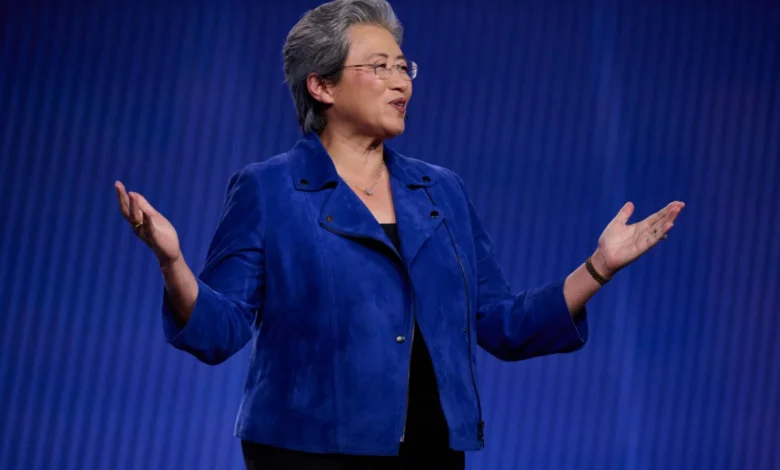
Advanced Micro Devices (AMD) has officially intensified its rivalry with Nvidia, unveiling a sophisticated rack-scale computing system designed to meet the massive processing requirements of the world’s most prominent artificial intelligence laboratories. At the company’s high-profile Advancing AI conference in San Francisco, AMD Chair and CEO Dr. Lisa Su introduced the "Helios" AI rack system to a sold-out audience of industry leaders, developers, and investors. The announcement marks a pivotal shift in AMD’s strategy, moving beyond individual chip sales to providing fully integrated, large-scale infrastructure solutions for the "agentic AI" era.
The Helios system represents AMD’s most aggressive attempt to date to capture market share in the high-end data center segment, a space historically dominated by Nvidia’s proprietary architectures. During her keynote address, Dr. Su positioned Helios as the premier hardware solution for training and deploying "frontier models"—the highly complex, large-scale AI systems developed by organizations like OpenAI and Anthropic. As the AI industry shifts from simple chatbots to autonomous agents capable of complex reasoning, the demand for integrated compute power has reached unprecedented levels, prompting AMD to accelerate its hardware roadmap.
The Helios Architecture: A New Standard for Rack-Scale Compute
In the modern data center landscape, the fundamental unit of compute is no longer the individual processor but the rack. A rack-scale system like Helios integrates hundreds of processors, high-speed networking, and advanced cooling into a single, cohesive unit. This integration is critical for reducing latency and managing the immense heat generated by AI workloads.
According to technical specifications highlighted during the conference, Helios is engineered to outperform existing market leaders in several key performance metrics. While Nvidia has set the industry standard with its Grace Blackwell and Vera Rubin architectures, early benchmarks suggest that Helios offers competitive, and in some cases superior, throughput for specific training and inference tasks. The system is designed for "gigawatt-scale" deployment, meaning it can be scaled across massive data center campuses to provide the raw power necessary for the next generation of generative AI.
The development of Helios has been a multi-year effort. Initially teased in late 2025 and showcased at the Consumer Electronics Show (CES) in January 2026, the system is now entering the final stages of its rollout. AMD confirmed that shipping will begin later this year, with several "hyperscaler" customers already integrated into the early-access program.
Strategic Partnerships and Customer Adoption
The success of any new hardware platform depends heavily on its adoption by major cloud service providers and AI developers. AMD demonstrated significant momentum in this area by announcing a roster of blue-chip partners committed to the Helios ecosystem.
Microsoft, a long-time partner of both AMD and Nvidia, is among the first to integrate Helios into its Azure cloud infrastructure. Microsoft CEO Satya Nadella confirmed that the addition of Helios would provide Azure customers with more choices and higher performance for AI-driven applications. This move is seen as a strategic hedge for Microsoft, allowing it to diversify its supply chain and reduce its total dependence on Nvidia’s hardware.
Perhaps the most significant announcement of the event was a strategic partnership between AMD and Anthropic, the AI safety and research company behind the Claude model family. The two companies have entered into an agreement to deploy up to two gigawatts of GPU capacity via the Helios rack system. This scale of deployment is virtually unprecedented and underscores the massive capital expenditures currently being funneled into the AI sector.
Other major tech entities, including Meta, Oracle, and OpenAI, have also signaled their intent to deploy Helios systems. For Meta, which operates one of the largest private AI infrastructures in the world, the inclusion of AMD hardware provides a vital alternative as it continues to build out its Llama series of open-source models.
The Venice-X CPU and the Roadmap to 2027
While Helios was the centerpiece of the conference, AMD also provided a glimpse into its future silicon roadmap with the introduction of the Venice-X CPU. Designed for data centers and high-performance computing (HPC), Venice-X is built on the upcoming Zen 6 architecture.
The Venice-X processor is optimized for workloads that require massive amounts of memory bandwidth and cache. It features an impressive 1,152 MB of 3D V-Cache and 96 cores, with boost clocks reaching up to 5.15 GHz. By integrating such a large amount of cache directly onto the processor, AMD aims to eliminate the "memory wall"—the bottleneck that occurs when data cannot move quickly enough between the processor and the system memory.
The Venice-X is slated for a 2027 launch. This timeline suggests that AMD is looking to maintain a steady cadence of hardware releases to ensure it stays ahead of evolving AI model architectures. As AI models become more "agentic"—meaning they can perform multi-step tasks and interact with external tools—the demands on the central processor to manage data flow and logic increase, making high-performance CPUs like Venice-X a necessary complement to GPU-heavy racks.
The $1.4 Trillion Market: A Shift to Agentic AI
Dr. Lisa Su’s remarks extended beyond hardware specifications to provide a broader vision of the global semiconductor market. She projected that the market for AI accelerators—the chips used specifically to speed up AI processing—will reach a staggering $1.4 trillion by the year 2030.
"What that means is, by the end of the decade, the AI accelerator market is going to approach the size of the entire semiconductor market today," Su stated. This bullish forecast is rooted in the belief that AI is not a fleeting trend but a foundational shift in how computing is performed.
The primary driver for this growth is the rise of "agentic AI." Unlike current AI models that provide static answers to prompts, agentic AI systems are designed to solve problems autonomously. Su explained that when a user asks an AI agent to complete a complex task, the agent must engage in a multi-step process: reasoning through the problem, accessing databases, calling external software tools, and iterating until a solution is found. Each of these steps requires significant compute cycles, leading to a "step change" in demand for high-end GPUs.
Su emphasized that GPUs will continue to represent the vast majority of this trillion-dollar market. The inherent programmability of GPUs makes them ideal for an industry where algorithms are still in their infancy and workloads are constantly changing.
Fact-Based Analysis: The Implications of the Helios Launch
The launch of Helios and the accompanying market projections carry several significant implications for the technology sector and the global economy:
1. Challenging the Nvidia "Moat":
For years, Nvidia’s primary advantage has not just been its chips, but its "full-stack" approach, including the CUDA software platform and its integrated rack systems like DGX. By moving into the rack-scale business with Helios and strengthening its ROCm software ecosystem, AMD is directly attacking Nvidia’s competitive moat. This competition is likely to drive down costs for AI startups and enterprises.
2. The Energy Crisis in Computing:
The mention of "gigawatt-scale" deployments highlights the growing concern over the energy consumption of AI data centers. Two gigawatts of power is roughly equivalent to the output of two large nuclear power plants. As AMD and its partners scale these systems, the industry will face increasing scrutiny regarding its environmental impact and the strain placed on national electrical grids.
3. The Sovereign AI Trend:
The ability to purchase integrated, high-performance racks like Helios makes it easier for nation-states to build "Sovereign AI" infrastructure. Governments looking to maintain data privacy and develop localized AI models can now purchase turn-key solutions to jumpstart their domestic AI capabilities.
4. Supply Chain Diversification:
By securing major commitments from Microsoft and Anthropic, AMD is proving that it can be a reliable second source of high-end AI silicon. This diversification is essential for the stability of the global tech economy, which has suffered from supply constraints and long lead times for Nvidia hardware over the past two years.
Chronology of AMD’s AI Evolution
To understand the significance of the Helios announcement, it is helpful to look at the timeline of AMD’s recent advancements:
- Late 2023: AMD launches the Instinct MI300 series, its first major challenge to Nvidia’s H100 GPUs.
- 2024: Rapid adoption of the ROCm software stack begins as developers look for alternatives to Nvidia’s CUDA.
- Late 2025: Initial internal reveals of the Helios architecture.
- January 2026: Helios is showcased at CES, demonstrating the physical scale of the rack system.
- July 2026: The Advancing AI conference in San Francisco sees the formal launch of Helios and the announcement of the 2GW Anthropic partnership.
- Late 2026: Scheduled initial shipping of Helios systems to hyperscale customers.
- 2027: Expected launch of the Venice-X CPU, further integrating the data center stack.
- 2030: AMD’s projected milestone for a $1.4 trillion AI accelerator market.
As the conference concluded, the consensus among industry analysts was that AMD has successfully transitioned from a "fast follower" to a primary innovator in the AI space. While Nvidia remains the market leader in terms of total revenue and installed base, the introduction of Helios proves that the race for AI supremacy is far from over. The coming years will determine whether AMD’s integrated approach can erode Nvidia’s dominance or if the market is large enough to support two trillion-dollar titans in the semiconductor industry.
Related posts: