OpenAI Broadens Strategic Focus to Families and Caregivers with New Product Leadership Role

OpenAI is pivoting its long-term product strategy to encompass a wider demographic, signaling a transition from individual productivity tools toward a comprehensive ecosystem designed for households, families, and older adults. More than three years after the debut of ChatGPT sparked a global surge in generative artificial intelligence, the San Francisco-based company has begun recruiting for a dedicated Product Manager for Families. This move marks a significant maturation for the organization as it seeks to address the unique needs, safety requirements, and trust-sensitive nature of multi-generational technology use.
The new role, based at the company’s San Francisco headquarters, is tasked with building experiences specifically tailored for parents, caregivers, and the elderly. According to the official job description, OpenAI is seeking a candidate with a proven track record in developing products for families and managing "trust-sensitive" consumer experiences. This strategic hire suggests that OpenAI is no longer viewing its flagship chatbot as merely a digital assistant for the individual professional or student, but as a utility that must navigate the complexities of shared household dynamics.
The Evolution of ChatGPT: From Productivity Tool to Household Essential
The shift in OpenAI’s focus comes at a time when the user base for generative AI is undergoing a profound demographic transformation. While early adopters of ChatGPT were predominantly younger, tech-savvy individuals and students, recent data indicates that the technology is rapidly permeating older age brackets and parental demographics.
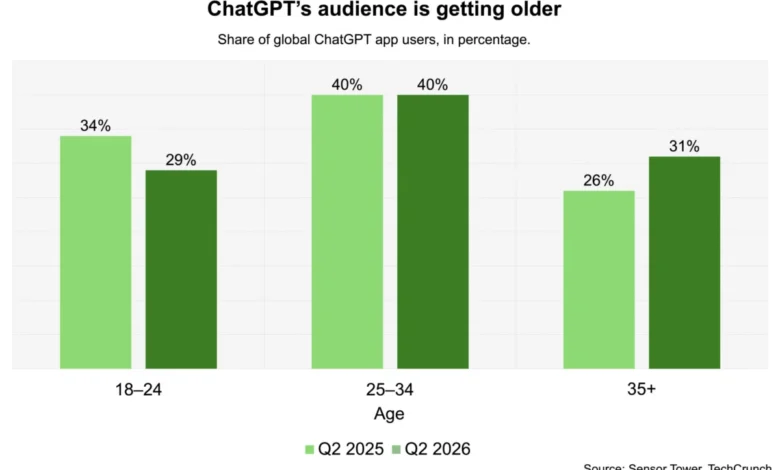
According to exclusive estimates from market intelligence firm Sensor Tower, the global share of ChatGPT users aged 35 and older rose to 31% in the second quarter of the current year, up from 26% during the same period in the previous year. Conversely, the share of users in the 18-to-24 age range—the cohort that initially drove the platform’s viral growth—fell from 34% to 29%. This inversion suggests that while the "hype" phase among younger users may be stabilizing, the "utility" phase among heads of households and professionals is accelerating.
In the United States specifically, the penetration of ChatGPT among parents is reaching a critical mass. Sensor Tower estimates that nearly one in four smartphone users who are parents used ChatGPT during the most recent quarter, a significant increase from the 16% reported a year earlier. This suggests that parents are increasingly relying on AI for tasks ranging from meal planning and bedtime story generation to navigating complex educational and developmental questions for their children.
Analyzing the Demographic Pivot: The Rise of the 35+ User Base
The aging of the ChatGPT audience is not an isolated phenomenon, but OpenAI’s growth in this sector is outpacing its primary competitors. While users aged 25 to 34 remain the largest single block for most AI platforms—accounting for approximately 40% of the audiences for OpenAI’s ChatGPT, Anthropic’s Claude, and Google’s Gemini—the 45-and-above demographic is where the next frontier of growth lies.
Microsoft’s Copilot currently skews the oldest among the major AI assistants, with 20% of its users aged 45 and above. This is likely due to Microsoft’s deep integration into corporate environments and the Windows operating system. However, OpenAI is closing the gap rapidly. The share of ChatGPT users aged 45 and older increased by three percentage points year-over-year in the second quarter. In contrast, Microsoft Copilot saw a two-point increase, while both Claude and Gemini experienced slight declines in this age bracket.
Among U.S. parents, Google’s Gemini currently holds the widest reach at 32%, likely due to its integration with the Android ecosystem and Google Workspace. ChatGPT follows at 24%, with Anthropic’s Claude at 4% and Microsoft Copilot at 2%. By hiring a dedicated family product manager, OpenAI appears to be positioning itself to challenge Google’s dominance in the parental and household market.
Safety by Redesign: Addressing the Generational Usage Gap
As AI becomes a household staple, the risks associated with younger users have moved to the forefront of the public discourse. Stephen Balkam, Chief Executive of the Family Online Safety Institute (FOSI), describes OpenAI’s recent moves as "safety by redesign." This philosophy suggests that the original iterations of generative AI were not built with children or vulnerable populations in mind, and the company is now retroactively engineering safeguards into the core product experience.

A critical challenge for OpenAI is the "perception gap" between parents and children regarding AI usage. Recent research published by FOSI, involving a survey of over 4,000 families in the United States and Australia, revealed that parents consistently underestimate how often their children engage with generative AI. While only 27% of U.S. parents believed their child had used generative AI in the past week, 38% of the children themselves reported doing so.
This discrepancy highlights the urgent need for parental oversight tools and age-appropriate interfaces. Industry experts argue that AI companies must avoid the historical mistakes of social media platforms, which often implemented safety features only after facing intense regulatory pressure or public outcry. By creating a dedicated role for family products, OpenAI is signaling an intent to be proactive rather than reactive.
A Chronology of OpenAI’s Safety and Family-Centric Features
OpenAI has already begun rolling out a series of features aimed at protecting younger users and providing caregivers with more control. This timeline reflects the company’s gradual shift toward a family-oriented model:
- Late 2023: OpenAI began refining its content filters to better detect and block age-inappropriate material, specifically targeting prompts that could lead to harmful advice for minors.
- September 2024: The company introduced parental controls for teenage accounts, allowing parents to view (though not necessarily read) their child’s activity levels and set boundaries.
- Late 2024: OpenAI implemented a "safety routing" system. Sensitive conversations—particularly those involving mental health or distress—are automatically routed to more advanced reasoning models (such as the o1 series) designed to handle nuanced topics with greater caution and provide resources for professional help.
- May 2025: The introduction of the "Trusted Contact" feature. This allows users to designate a family member or caregiver who can be alerted if the AI detects patterns of conversation that suggest potential self-harm or severe emotional crisis.
These features represent a move away from a "one-size-fits-all" model. As Ben Bajarin, CEO of Creative Strategies, noted, the AI assistant is no longer just mediating content or managing devices; it is acting as a mediator for human experience, which necessitates a higher standard of trust.
Legal Scrutiny and the Ethical Imperative of Teen Protection
The push for family-focused leadership is also a response to a mounting legal and regulatory landscape. OpenAI has been named in several lawsuits brought by parents who allege that interactions with ChatGPT contributed to psychological harm, and in some tragic instances, the suicide of their children. These lawsuits often argue that the "human-like" nature of AI interactions can create a dangerous emotional dependency in teenagers who may not fully grasp that they are speaking to a machine.
Legal experts point out that the "hallucination" problem in AI—where the model confidently states false information—becomes a life-safety issue when the information pertains to health, safety, or emotional well-being. By focusing on "trust-sensitive" experiences, OpenAI’s new product manager will likely be tasked with ensuring the AI maintains a clear boundary between its role as a tool and its perception as a "friend."
The Future of the AI-Integrated Home: Shared Memory and Parental Oversight
Looking forward, the hiring of a family-focused product manager suggests several potential innovations for the ChatGPT ecosystem. Industry analysts expect OpenAI to move toward "Family Plans," similar to those offered by Spotify, Netflix, or Apple. These plans could include:
- Shared Household Memory: An AI that understands the collective context of a family—such as the family calendar, dietary restrictions, and shared goals—while maintaining individual privacy for each member.
- AI Tutoring and Coaching: Specialized modes for children that act as educational scaffolds rather than just providing answers, aligned with school curricula and parental preferences.
- Caregiver Dashboards: Tools for those caring for older adults that can monitor for signs of cognitive decline or assist with medication scheduling and social engagement through the AI interface.
- Age-Appropriate Personas: Interfaces that automatically adjust their vocabulary, tone, and safety parameters based on the age of the user logged in.
OpenAI’s recent engagement with community organizations, such as the workshop held with the San Antonio Spurs Community Impact organization and the Positive Coaching Alliance, underscores this interest in youth engagement and learning. The company is exploring how AI can be a positive force in coaching and youth development, provided the right guardrails are in place.
Conclusion: A Maturing Giant
OpenAI’s decision to dedicate leadership to the family segment is a landmark moment in the evolution of consumer AI. It marks the end of the "Wild West" era of generative AI, where products were released to the general public with little differentiation between a software developer and a twelve-year-old student.
As AI becomes embedded in the fabric of everyday life, the stakes for safety, privacy, and age-appropriateness have never been higher. By following the path of tech giants like Apple and Google—but with the added complexity of a technology that can think, reason, and converse—OpenAI is attempting to build a future where the AI assistant is a trusted, safe, and helpful presence for every member of the household, from the youngest child to the oldest adult. The success of this initiative will likely determine whether OpenAI can maintain its lead in an increasingly competitive and scrutinized global market.