Beaver Builder Co-Founder Robby McCullough Navigates AI’s Transformative Impact on Web Development and WordPress

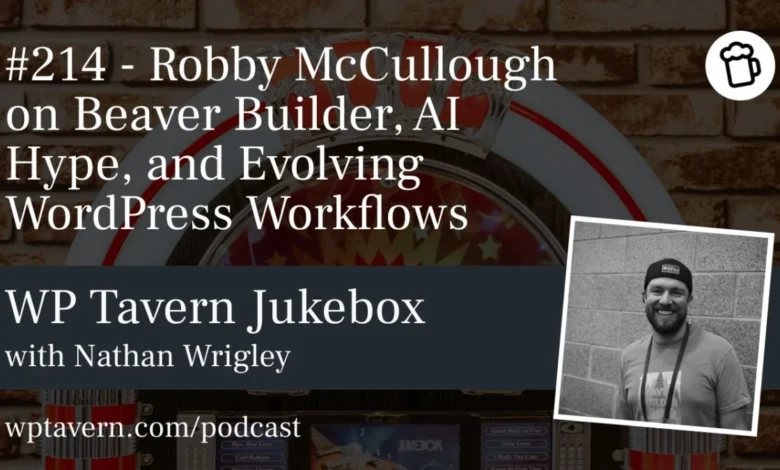
The landscape of web development is undergoing a profound transformation, driven by the rapid advancements in artificial intelligence. This shift is particularly impactful for established players in the WordPress ecosystem, such as Beaver Builder, a pioneering page builder plugin. In a recent episode of the Jukebox Podcast from WP Tavern, co-founder Robby McCullough offered insights into steering a long-standing product through this evolving technological tide, balancing innovation with the core values of accessibility and human craftsmanship. The discussion, hosted by Nathan Wrigley, explored Beaver Builder’s journey, its measured approach to AI integration, and the broader implications for web design, business, and community in an increasingly automated world.
A Decade of Innovation: Beaver Builder’s Foundation
Beaver Builder, founded nearly 12 years ago, emerged during a pivotal era for WordPress. Before the advent of sophisticated page builders, creating a website often demanded extensive coding knowledge—proficiency in HTML, CSS, and PHP for WordPress templating. This barrier to entry meant that professional web development was largely confined to those with specialized technical skills. The arrival of page builders, including Beaver Builder, revolutionized this process by offering intuitive drag-and-drop interfaces. This visual editing paradigm significantly reduced friction, enabling a wider demographic of users—from small business owners to non-technical marketers—to build and manage their own websites.
McCullough reflected on this initial "page builder revolution," noting its instrumental role in WordPress’s exponential growth. "It opened up, probably the fact that WordPress took that sort of massive rise from, I don’t know, 10, 15, 20, 30% of the market share, right up to where we are at the minute, sort of 40 plus," observed Nathan Wrigley, highlighting the democratizing effect of these tools. Beaver Builder quickly established itself as a "staple of the WordPress ecosystem," as Wrigley described, earning a reputation for reliability and user-friendability, which allowed its founders to balance product development with significant personal milestones, such as McCullough welcoming a new baby and moving house.
The AI Inflection Point: From Hype to Agentic Tools
The conversation naturally gravitated towards artificial intelligence, a dominant force reshaping nearly every industry. McCullough admitted that Beaver Builder initially adopted a cautious stance, consciously avoiding the "AI hype train" that swept through the tech world approximately a year prior. At that time, many software products rapidly integrated rudimentary AI features—often simple GPT wrappers for text generation—primarily to "say they did" and appease stakeholders.
"We didn’t jump on that bandwagon," McCullough stated. "I’m excited that we didn’t because now I feel like AI has kind of reached another evolution, or like inflection point where some of the stuff that you can do with these LLMs and like agentic coding tools, it’s like good now. It’s really good and it’s a lot more exciting." This shift from superficial AI integrations to genuinely "agentic tools" capable of autonomously coding and assisting in complex web development tasks has dramatically lowered the "friction to build new features," according to McCullough. These advanced AI systems are not merely buzzwords; they represent a fundamental change in how software can be developed and how users can interact with creative processes.
Navigating AI Integration: A Dual Approach for Beaver Builder
McCullough shared insights into Beaver Builder’s current experimental roadmap for integrating AI, emphasizing a dual approach. The first involves enabling users to import AI-generated web pages directly into the Beaver Builder interface. This means a user could "vibe code up a landing page separate from WordPress, just, you know, using Claude or Codex or whatever," and then seamlessly drag and drop that page into Beaver Builder for conversion into an editable format. This addresses a common challenge with AI-generated content: while creation is fast, customization and ongoing maintenance can be difficult without an underlying editable structure.
The second approach focuses on developing an "agentic chat based tool" within the Beaver Builder environment itself. This would allow users to interact with an AI agent to refine existing elements or generate new ones, such as updating a pricing table or rephrasing copy, all within the visual editing context. McCullough underscored the importance of maintaining transparency and control, aiming to "expose more of the front end code, both like the markup and the CSS in future versions." The goal is not to create a "closed black box" but to offer a system where users can "bring your own key, bring your own agent, give it access to Beaver Builder, but then also give you access as the developer to go in and tweak things, play with the code, learn from the code."
This strategy reflects a nuanced understanding of AI’s role—as a powerful accelerator for creation, but one that still benefits from human oversight and the structured editing capabilities of a page builder. It acknowledges that while AI can rapidly generate designs, the ongoing process of refinement, adaptation, and troubleshooting often requires a more direct, visual, and customizable interface.
Business Anxieties and the Rapid Pace of Change
The advent of AI, while offering unprecedented opportunities, also introduces significant anxieties for product businesses like Beaver Builder. Nathan Wrigley probed McCullough on the "utter wasted time" and "anxiety" that such a fast-changing technological landscape brings. Running a successful business already entails managing payroll, marketing, development, support, and product roadmaps. The unpredictable nature of AI’s evolution adds an entirely new layer of complexity, making long-term planning incredibly challenging.
McCullough, however, maintains a "hopeless optimist" outlook, citing Beaver Builder’s history of overcoming previous "existential threats." He recalled the initial skepticism surrounding page builders, which were often associated with the "spaghetti code" produced by earlier visual tools like Dreamweaver. He also pointed to the widespread predictions that page builders would become obsolete following the release of Gutenberg, WordPress’s block editor. Despite these challenges, page builders not only persisted but thrived, adapting to new realities.
The current wave of AI presents another such challenge, but McCullough believes in the enduring value of WordPress itself. With over 40% of the web powered by WordPress, the sheer volume of existing sites ensures a long tail of maintenance and customization needs. "40% of the web, all those millions and millions of sites, aren’t just going to decide to update overnight because there’s a new, cool tool on the block to play with," he asserted, suggesting that "there will be legacy WordPress forever." This implies a continued demand for tools that can interface with and manage these established platforms, regardless of how new sites are initially generated.
The Enduring Value of Human Craft and Editing
A recurring theme in the discussion was the potential erosion of foundational web development skills and the "craftsmanship" involved in building websites by hand. Wrigley expressed concern about a future where users "don’t really know how anything got on the page other than, well, I typed this sentence and there it was on the page." He drew an analogy to buying "furniture from Ikea, as opposed to getting it from a carpenter," highlighting a potential loss of understanding and connection to the underlying mechanics.
McCullough acknowledged this "melancholy" but also recognized the undeniable efficiency gains offered by AI. He confessed that he no longer sees himself "going into Figma or Photoshop anymore and like building out a colour palette by hand and like going to Google Fonts and looking at all the options of fonts and selecting one that I like." AI’s ability to rapidly iterate and refine designs, particularly for someone who designs by knowing "when something looks wrong before you know when something looks right," is too compelling to ignore.
However, both agreed on the continued importance of editing and maintenance. While AI can create a page in seconds, the ongoing need to modify, update, and customize a site over its lifespan remains critical. "I still think there’s always going to be a place to go back in and edit, and find the thing with the mouse, and click on it, and modify it, and move it around," Wrigley contended. This suggests a future where page builders might evolve into primary "maintenance tools" for AI-generated content, offering the visual control and granular editing capabilities that purely prompt-driven AI might lack. Beaver Builder’s commitment to exposing front-end code and integrating chat agents within the visual editor aligns with this vision, aiming to blend AI’s generative power with human-centric control.
Broader Societal Implications and Human Connection
Beyond the technical and business challenges, the conversation touched upon the broader societal implications of pervasive AI, particularly concerning human interaction and community. McCullough expressed a poignant concern: "Ultimately what these chat agents do is mimic being human. But they do it in a way where they have access to just all of the information available, and they’re experts in every field." He pondered if this "faux human experience" could lead to a decline in genuine human collaboration, especially for those who work remotely.
"Am I losing opportunities to collaborate with real people? Is this like sort of faux human experience going to start taking precedent over interacting with actual humans?" he asked, underscoring a critical ethical and social dimension of AI adoption. Wrigley echoed this sentiment, noting the "slow inexorable sort of deterioration" of meaningful human interaction if productivity becomes the sole focus.
This concern extends to community engagement, particularly within the WordPress ecosystem. Both speakers lamented the decline of in-person WordPress events like WordCamps, especially post-pandemic. McCullough fondly recalled the "fun travel I got to do going to WordCamps all over the world, and having this, you know, built in friends," emphasizing the irreplaceable value of face-to-face connections. The hope is that as AI reshapes work, there might be a "revitalization of things which are… the sewing club, and the canoeing club, and the mountaineering club," as people seek out more real-world interactions to counteract the digital isolation.
Looking Ahead: The Unpredictable Future
The discussion concluded with a recognition of the breathtaking pace of technological change. What was sci-fi fantasy just a couple of decades ago—ubiquitous video calls, instant access to global information, and increasingly human-like AI interactions—is now reality. The acceleration of AI, with the goal of AIs creating subsequent AI features, points to a future of potentially "logarithmic infinite curve" growth in capabilities, making long-term predictions increasingly difficult.
McCullough and Wrigley agreed that the next generation, exemplified by McCullough’s young daughter, will likely perceive these advancements as entirely normal, a "modus operandi" rather than something "sci-fi and a bit creepy." The challenge for current generations, therefore, is to adapt while preserving what is valuable—be it the understanding of underlying technologies or the necessity of human connection.
In this rapidly shifting landscape, Beaver Builder stands as an example of a product striving to bridge the past and future. By embracing advanced AI while retaining its core commitment to accessible visual editing and developer control, it aims to empower users in the new era of web creation. The future of web development, while undeniably AI-infused, will likely continue to value tools that allow for nuanced human intervention, ensuring that the "art and craftsmanship" of building a webpage remains a vital, albeit evolving, discipline.