Measuring the ROI of Sports Marketing: A Multi-Level Framework for Quantifying Business Impact

The landscape of modern media consumption has undergone a radical transformation, yet one sector remains a steadfast pillar of live viewership: sports. In the United States, recent data indicates that nearly all of the top 50 telecasts over the past year were directly tied to sporting events. Notable exceptions to this dominance were few, including the 97th Academy Awards, the 50th-anniversary special of Saturday Night Live, a high-profile 60 Minutes interview, an episode of the game show The Floor, and the 67th Annual Grammy Awards. This trend highlights a cultural phenomenon where sports serve as the final bastion of synchronous, live television viewership, a reality that has prompted global streaming giants to invest billions in acquiring broadcast rights.
As traditional cable subscriptions decline, the "appointment viewing" nature of sports has made it the most valuable asset in the media ecosystem. This shift has triggered an unprecedented influx of capital from corporate marketers. Companies are no longer content with simple commercial spots; they are aggressively pursuing multi-faceted sponsorships involving team branding, jersey logos, equipment placements, and naming rights for stadiums. However, as investment levels reach tens of millions of dollars per contract, senior executive leadership is increasingly demanding rigorous proof of business impact. The era of "handshake marketing"—where hospitality suites and proximity to celebrity athletes were sufficient justification for spending—is being replaced by a demand for data-driven accountability.
The Chronology of Sports Sponsorship and the Measurement Gap
The evolution of sports marketing has moved through several distinct phases. Historically, sponsorships were viewed as local philanthropic efforts or "ego plays" for company owners. By the 1990s and 2000s, this shifted toward global brand awareness, as seen with the rise of massive apparel deals and stadium naming rights. In the current era, the integration of digital tracking and advanced analytics has created a paradox: while marketers have more data than ever, the ability to isolate the specific impact of a sports sponsorship remains a significant challenge.
The fundamental laws of marketing apply to sports with the same rigor as any other channel. If a creative message fails to capture attention on a digital platform within seconds, it will likely suffer the same fate when placed on a racing car or an athlete’s jersey. Industry experts note that sports environments are often hyper-cluttered, meaning that brand placements receive even less focused attention than traditional advertisements. Furthermore, the "spike and silence" phenomenon—where a brand sees a temporary surge in visibility during a major event followed by total obscurity—is particularly detrimental in the sports world. Establishing a lasting "halo effect" from a team or player requires a "spike and sustain" strategy, which often necessitates five times the effort and budget of standard marketing campaigns.
A Multi-Level Framework for Impact Assessment
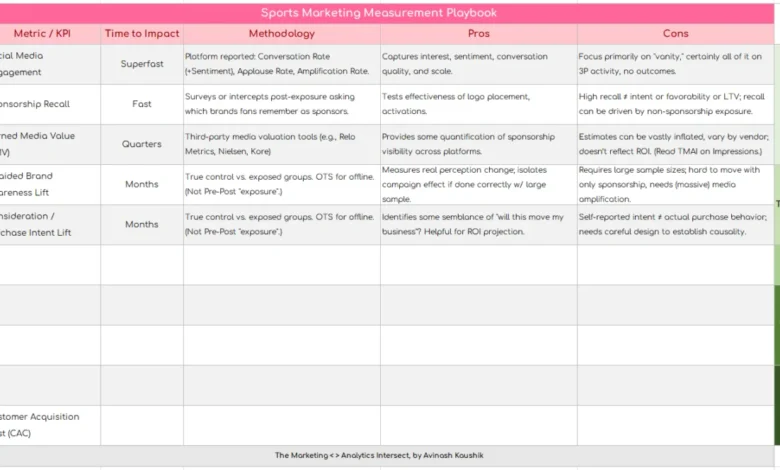
To address the complexities of sports marketing, analysts have developed a hierarchical measurement playbook. This framework, categorized from Level 5 (pre-basic) to Level 1 (the gold standard), allows organizations to rate their "Impact Intelligence Score" (IIS) on a scale of 1 to 10.
Level 5: Vanity Metrics and the Illusion of Success
At Level 5, the focus is on activity rather than outcomes. This is the realm of "Big Numbers," where reports highlight hundreds of millions of impressions. While these metrics are easy to gather and report quickly, they often lack a causal link to financial performance.
- Social Media Engagement: This includes conversation rates, applause rates (likes), and amplification rates (shares). While these provide immediate feedback on how a campaign is being received on platforms like TikTok or X (formerly Twitter), they do not necessarily translate to sales.
- Sponsorship Recall: Often measured through post-exposure surveys, recall identifies whether fans remember seeing a brand during a match. However, "aided" recall—asking a fan if they noticed a specific brand—often produces low-quality signals. Analysts recommend "unaided" recall tests to gauge true brand penetration.
- Earned Media Value (EMV): Also known as Ad Value Equivalency (AVE), this metric calculates the cost of every logo appearance as if it were a paid advertisement. Many major marketing associations now discredit EMV because it assumes all exposure is of equal quality and ignores the lack of a specific marketing message.
The Impact Intelligence Score for Level 5 is typically 1/10. It measures the "noise" of the campaign but offers little insight into actual value or decision readiness.
Level 4: Quantifying Brand Sentiment and Intent
Level 4 represents a significant upgrade in sophistication, moving from measuring activity to measuring human impact. This stage utilizes test-and-control methodologies rather than simple pre-and-post-event analysis.
- Unaided Brand Awareness (UBA) Lift: This measures whether a sponsorship has successfully moved a brand into the consumer’s "top of mind" consciousness. UBA is a long-term driver of revenue, though it often takes months or years of consistent investment to move the needle.
- Consideration and Purchase Intent: This is where the financial implications begin to surface. If a consumer identifies a brand as their "number one choice" for a future purchase after exposure to a sports sponsorship, the medium-term revenue impact is high.
To achieve an IIS of 4/10 at this level, companies use propensity score matching to ensure that their test and control groups are comparable. This level of measurement is particularly vital for B2B companies with long sales cycles, where the goal is to influence decision-makers over a period of several quarters.
The Role of Creative Strategy in Sports Environments
A critical finding in sports marketing analytics is that creative content is responsible for 60% to 70% of a brand’s success. Many brands struggle because they treat sports placements as passive logos rather than opportunities for storytelling. When a brand successfully "inherits" values from a sport or an athlete—such as Rolex’s long-standing association with the precision and tradition of tennis—the marketing becomes exponentially more effective.
However, relying on "organic" placement is a common mistake. For a sports sponsorship to be effective, it must be supported by paid media. This ensures that the creative message reaches the audience with a frequency of at least three exposures per user per week. Without this reinforcement, even the most expensive jersey placement risks being ignored by fans focused on the game itself.
The Higher Tiers: From Influence to Incrementality
While Levels 5 and 4 provide a foundation, the most sophisticated organizations strive for Levels 3, 2, and 1. These tiers focus on the "Heart and Mind Influence," "The Digital Trace," and "Incrementality."
Level 2 involves tracking the first digital interactions—such as search lift or direct website traffic—that occur immediately following a sports broadcast. Level 1, the "Gold Standard," utilizes Marketing Mix Modeling (MMM) to prove incrementality. This involves statistical analysis to determine what percentage of sales would have occurred regardless of the sports investment. By isolating the sponsorship variable, companies can finally answer the "CFO question" regarding the exact return on every dollar spent.
Broader Implications and Industry Reactions
The shift toward rigorous measurement is causing a ripple effect throughout the industry. Sports agencies are being forced to move away from selling "eyeballs" and toward selling "outcomes." On the corporate side, the relationship between CMOs and CFOs is evolving. When marketing leaders can present a Level 4 or Level 1 analysis, they move from being seen as a "cost center" to a "growth engine."
Furthermore, the rise of niche sports and women’s sports—such as the WNBA or professional soccer—is providing new opportunities for brands to achieve high Impact Intelligence Scores at a lower entry cost. These environments often have less "clutter" than major leagues like the NFL, allowing for better creative storytelling and higher brand recall.
Conclusion: Turning the Lights On
The sheer scale of sports viewership ensures that it will remain a primary target for global marketing budgets. However, the days of blind investment are coming to an end. As streaming platforms integrate more deeply with sports—bringing with them the tracking capabilities of the digital world—the pressure to measure impact will only intensify.
Organizations that remain at Level 5 measurement risk wasting millions on vanity metrics that do not drive business growth. Conversely, those that move toward Level 4 and Level 1 can transform their sports marketing from a luxury expense into a strategic, profitable asset. By applying the laws of creative excellence and rigorous causal analysis, brands can finally bridge the gap between the excitement of the stadium and the cold reality of the balance sheet. In the words of industry analysts, it is time for marketers to "stop sponsoring in the dark and turn the lights on."
Related posts: