The modern evolution of CSS has introduced powerful features that allow developers to achieve outcomes previously reserved for JavaScript. Capabilities like container queries, the :has() pseudo-class, and native nesting have transformed stylesheets from static styling documents into dynamic logic layers. However, transitioning logic from JavaScript to native CSS frequently reduces code volume while inadvertently increasing system-level complexity. This architectural friction often manifests as unpredictable cascading bugs, altered block formatting contexts, and performance bottlenecks that complicate application maintenance.
The Illusion of Local Simplicity and System Complexity
In contemporary web development, a common workflow involves replacing dozens of lines of JavaScript—such as ResizeObservers used to toggle layout classes—with a concise CSS rule. A pull request showcasing a net-negative code diff is often approved quickly, as smaller codebases are intuitively associated with higher quality. Yet, this local simplicity can conceal broader architectural complications.
When developers migrate component logic to native CSS features without thoroughly analyzing existing dependencies, they risk introducing unintended side effects. A layout breakpoint updated in a container query might conflict with legacy JavaScript event listeners that were never decommissioned. Consequently, elements can enter intermediate states—such as mismatched font sizes and grid columns—that were never explicitly coded by the engineering team.
This phenomenon highlights a broader debate within the front-end community regarding essential versus accidental complexity. Discussions across developer platforms and engineering forums frequently contrast the benefits of native browser capabilities against the maintenance burdens they introduce. While modern CSS significantly enhances styling interactivity, reducing code length on paper does not automatically equate to reduced maintenance complexity in practice.

Navigating Multi-Owner Behavior and Layout Contexts
One primary source of friction occurs when component behavior has multiple owners. During phased migrations, legacy JavaScript handlers often survive alongside new CSS rules. If a design requirement changes—such as shifting a responsive breakpoint—and a developer updates only the CSS container query while leaving an orphaned JavaScript observer intact, the component’s state becomes fragmented. Resolving these issues requires debugging across two distinct execution domains simultaneously.
Furthermore, introducing modern CSS features can fundamentally alter layout calculations without explicit intent. For example, applying container-type: inline-size to enable container queries does more than just allow child elements to query width; it also applies style and inline-size containment. This single declaration establishes a new block formatting context, which can trigger significant layout shifts:
- Margins Stop Collapsing: Containing elements trap internal margins that previously collapsed with surrounding block elements, altering vertical spacing across the document tree.
- Floats Intersect Differently: Elements that previously flowed around floated images may be pushed entirely outside the float boundary, shrinking available container widths.
- Content-Sized Elements Collapse: Elements relying on their contents to determine width can collapse to zero pixels when size containment is applied unless explicit dimensions are provided.
Specificity Battles and the CSS Cascade
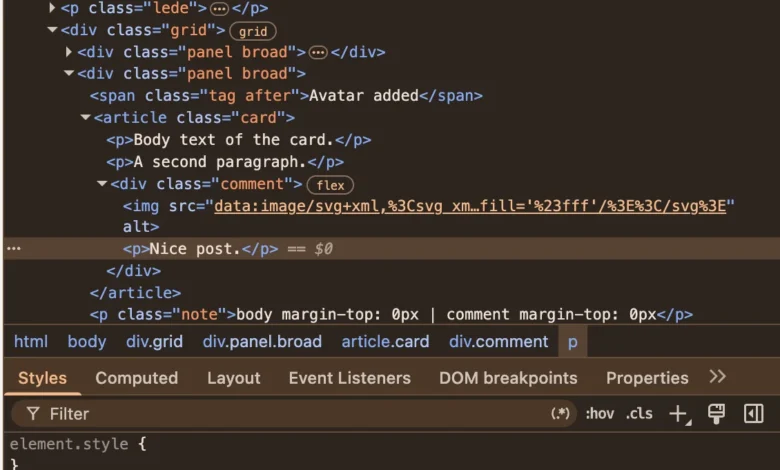
The integration of advanced selectors like :has() and native nesting similarly expands the blast radius of standard CSS rules. Short, expressive selectors can unintentionally target elements far outside their intended component boundaries. For instance, a rule targeting paragraphs within a card based on the presence of an image can inadvertently strip margins from nested child components, such as user comments, that happen to share the same descendant structure.
While native nesting improves developer ergonomics, it inherits complex specificity rules governed by the & selector, which evaluates to the highest specificity within an associated selector list. Unless developers proactively utilize scoping tools like :where() to neutralize specificity weights, they risk triggering unintended cascading overrides. Furthermore, introducing layered styles via @layer alongside unlayered legacy stylesheets can create unexpected precedence hierarchies, complicating debugging efforts when production builds deviate from local environments.
Performance Implications and Rendering Engine Costs
A frequent justification for migrating logic to CSS is the assumption that native browser implementation inherently guarantees superior performance. While moving reactive layout logic from JavaScript to the browser’s native rendering engine can eliminate script execution overhead, it introduces new performance considerations.

Performance tracing of complex DOM trees reveals that certain uses of native selectors can force the browser to restyle thousands of elements on a single state change. While individual rules may execute within acceptable frame budgets, combining multiple generalized selectors can compound rendering costs, particularly as application lists scale. Just as animating layout properties like width or top forces continuous reflows compared to transform properties, poorly scoped CSS queries can demand excessive computational effort from the browser’s rendering engine.
Strategic Framework for Modern Migrations
Addressing these systemic challenges requires a systematic approach to code migration. Engineering teams moving logic from JavaScript to CSS must evaluate proposed changes beyond immediate line-count reductions. Best practices for managing this transition include:
- Inventorying existing JavaScript observers and event listeners associated with the target component before introducing native CSS rules.
- Verifying block formatting context implications prior to applying size or style containment properties.
- Constraining advanced selectors with direct child combinators to prevent unintended style leakage across component boundaries.
- Managing selector specificity explicitly through the use of scoping wrappers like
:where(). - Profiling rendering performance using browser developer tools to measure actual DOM restyling impact under load.
- Ensuring all legacy classes and scripts are fully removed post-migration to prevent split-ownership bugs.
Ultimately, modern CSS features provide unprecedented capabilities for front-end architecture, reducing reliance on external libraries and complex scripts. However, maintaining long-term application stability requires recognizing that native styling features operate within an interconnected system. Sustainable codebases depend not only on writing concise syntax, but on carefully managing the relationships between CSS, JavaScript, the cascade, and the rendering engine.