Tech Stocks Stage Measured Recovery on Friday Following Worst Market Rout in Years Driven by Midterm Political Shifts and AI Scrutiny

The technology sector attempted a cautious stabilization on Friday, mounting a modest recovery following one of the most severe single-day sell-offs recorded in recent years. Investors stepped in to buy the dip, offering a temporary reprieve to major indices that had plunged drastically in the wake of significant political shifts. While the rebound provides a welcome psychological milestone for traders navigating heightened market volatility, analysts emphasize that Friday’s gains represent only a fraction of the heavy losses sustained earlier in the week.
The sudden market turbulence stems directly from the outcomes of the United States midterm elections, which have fundamentally altered the political landscape in Washington and injected a profound sense of regulatory uncertainty into the tech industry. For months, major technology executives and high-profile industry leaders—most notably figures like Elon Musk—have publicly aligned themselves with President Donald Trump and the Republican Party. This strategic positioning was widely viewed by Wall Street as a hedge against progressive antitrust actions and aggressive federal oversight, particularly regarding the booming artificial intelligence sector.
However, the resounding victories racked up by Democratic candidates across the country have abruptly shifted the balance of power. The return of a shifting congressional majority has immediately stoked widespread fears among institutional investors regarding potential legislative blowback. Democratic campaigns heavily emphasized criticisms of unchecked technological expansion, data privacy violations, and, most prominently, the rapid, resource-heavy proliferation of artificial intelligence technologies.
The political ripple effects were swift. Just one day after the midterm election results confirmed sweeping Democratic gains, Senator Bernie Sanders publicly called for a national moratorium on the construction of new data centers. The proposal, aimed at curbing the immense energy and water consumption required to fuel large-scale AI infrastructure, sent an immediate chill through the market. For an industry that has staked its immediate financial future and astronomical market valuations on the perpetual expansion of generative AI capabilities, the prospect of federal freezes or stringent environmental constraints represents an existential regulatory threat.
Market Chronology and Immediate Impact
The sequence of events over the trading week highlights the sensitivity of modern equity markets to political catalysts. The trouble began brewing late Monday evening as early election returns pointed toward a strong Democratic showing. By Tuesday, as the magnitude of the midterm results became clear, technology stocks began to experience notable downward pressure.
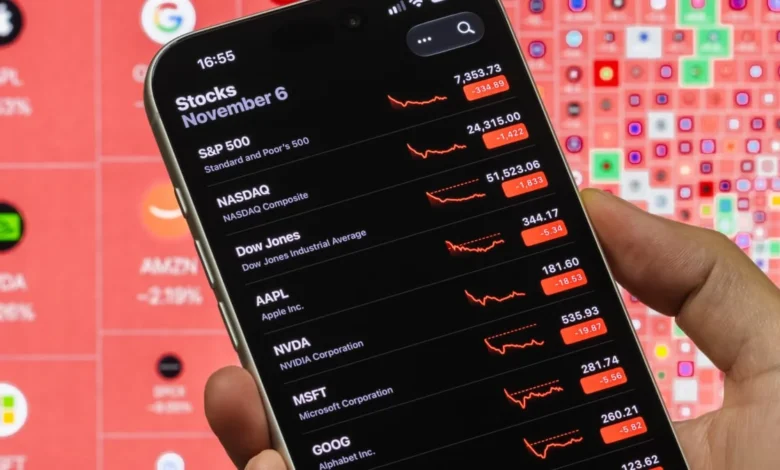
The culmination of these anxieties arrived on Thursday, resulting in a historic market rout. The tech-centric Nasdaq 100 plummeted 6.3 percent in a single session, marking its worst single-day performance in six years and erasing billions of dollars in market capitalization. Broad-based indices suffered alongside heavyweights as panic selling rippled through supply chains, semiconductor manufacturers, and software conglomerates alike.
As the trading week drew to a close on Friday, market participants began executing a classic correction strategy. The Nasdaq 100 managed a 1.9 percent rebound by Friday afternoon. While this incremental recovery does little to erase the psychological and financial scars of Thursday’s rout, it indicates that a segment of the investor base views the steep sell-off as an overreaction or an attractive entry point for long-term holdings.
Performance of Key Industry Players
Individual corporate performances on Friday underscored a bifurcated recovery within the technology sector. Companies closely tethered to the infrastructure demands of artificial intelligence—particularly major chipmakers and infrastructure providers—faced the steepest declines on Thursday and experienced a more cautious path to recovery.
Nvidia, a primary engine of the global artificial intelligence boom, saw its share price rise by approximately 7 percent as of Friday afternoon. Similarly, SpaceX experienced a 6.1 percent lift in its valuation metrics. Despite these encouraging daily percentages, neither company had fully recouped the massive capitalization lost during Thursday’s downturn, illustrating the depth of the initial shock.
Conversely, technology and consumer-facing digital platforms outside the immediate crosshairs of hardware-centric AI regulations demonstrated stronger rebounds. Intel, navigating its own complex foundry turnaround strategy, surged 8.9 percent. Meanwhile, travel and hospitality platform Airbnb rallied 11.7 percent, benefiting from a rotation of capital out of high-risk hardware sectors and into more resilient, consumer-facing digital enterprises. Semiconductor manufacturers and specialized AI infrastructure firms, while participating in Friday’s upward trajectory, continue to lag behind broader tech equities as traders weigh the long-term viability of their current growth models against looming legislative hurdles.
Industry Reactions and Stakeholder Perspectives
The sudden shift in political momentum has forced corporate communications teams and industry lobbying groups to reevaluate their Washington strategies. Representatives from major venture capital firms and enterprise software associations have privately expressed concern over the potential for a gridlocked or hostile legislative agenda.
Proponents of the technology sector argue that premature regulation could stifle American innovation and cede technological dominance to international competitors, particularly China. Industry advocates maintain that artificial intelligence development requires massive, uninterrupted investments in data centers and computational power to maintain economic competitiveness. They contend that punitive measures, such as moratoriums on infrastructure development, threaten to disrupt supply chains that underpin modern economic productivity.
On the other side of the aisle, progressive lawmakers and consumer advocacy groups view the recent market correction as a long-overdue reckoning. Supporters of stricter oversight argue that the rapid commercialization of AI has outpaced ethical boundaries, environmental safeguards, and labor protections. From this perspective, the political mandate delivered by voters during the midterms serves as a clear directive to rein in corporate overreach, protect consumer data, and address the staggering carbon footprint associated with large language model training facilities.
Fact-Based Analysis of Economic and Market Implications
Friday’s tentative market stabilization should not be misinterpreted as a return to business as usual. The intersection of politics and market valuation has entered a volatile new phase, characterized by heightened regulatory risk.
For the past several years, technology stocks have acted as the primary driver of broader market indices, propelled by low interest rates, enthusiastic retail adoption, and the revolutionary narrative of generative artificial intelligence. However, the events of this week demonstrate that the sector is increasingly vulnerable to macroeconomic shocks dictated by electoral outcomes.
Investors must now factor in the probability of increased federal scrutiny, antitrust litigation, and environmental constraints on data consumption. While companies with robust balance sheets and diversified revenue streams—such as major cloud providers and diversified software giants—may absorb these regulatory headwinds, smaller startups and capital-intensive hardware manufacturers face a more precarious future.
The divergence between traditional software equities and AI-adjacent hardware providers highlights a growing maturation in how Wall Street prices technology risk. No longer viewed as an untouchable engine of infinite growth, the tech sector is being subjected to rigorous fundamental analysis regarding its regulatory exposure, energy demands, and societal impact.
Broader Outlook and Investor Sentiment
As the market closes for the weekend, analysts remain divided on whether Friday’s recovery marks the beginning of a sustained rebound or merely a dead-cat bounce within a broader secular downtrend. Much will depend on the rhetoric adopted by incoming congressional leaders as they prepare to take office, as well as any executive actions or agency appointments made in the coming weeks.
Market participants will be watching key legislative committees for early indications of whether proposed moratoriums and AI-critical campaigns will translate into binding statutory language. Until concrete policy outlines emerge from Washington, the technology sector is expected to remain exceptionally sensitive to political headlines, with volatility lingering as a defining characteristic of equity trading in the near term. For now, investors are proceeding with measured caution, balancing the undeniable long-term potential of digital innovation against the stark reality of shifting political tides.