The Evolution of WordPress Site Management: Navigating the Landscape of Multi-Site Administration in 2026

The transition from managing a single WordPress installation to overseeing a portfolio of dozens represents a significant professional inflection point for freelancers and digital agencies. As the number of managed sites grows, the manual overhead—repetitive plugin updates, fragmented backup protocols, and the persistent anxiety of undetected downtime—becomes unsustainable. In response, the WordPress site management industry has matured rapidly, shifting from basic update dashboards to sophisticated, AI-integrated platforms that serve as the command center for agency operations. As of 2026, the marketplace has undergone a structural transformation, moving away from complex, à la carte pricing models toward predictable, flat-rate, per-site billing, while integrating automation that allows administrators to queue cross-site maintenance tasks with unprecedented efficiency.

The Shift in Management Philosophy
Historically, the category was dominated by the "freemium" model, where users gained access to a basic dashboard for free but were forced to purchase individual add-ons for security, backups, or reporting. This created a disjointed experience where agency owners struggled to forecast monthly overhead. Today, the focus has shifted toward "predictability by design." Modern tools now prioritize all-inclusive pricing tiers, allowing agencies to calculate exact profit margins for their client care plans. This change is partly driven by the increased professionalization of the WordPress maintenance sector, where agencies are no longer just fixing bugs but providing comprehensive, high-availability service agreements.
Comparative Analysis of Leading Management Platforms
The current competitive landscape is defined by six major players, each catering to different operational needs ranging from open-source autonomy to turn-key managed services.

WP Umbrella: Prioritizing Predictable Scaling
WP Umbrella has emerged as the industry standard for agencies requiring operational consistency. By offering a flat, per-site monthly fee that includes core functionality, it eliminates the guesswork associated with scaling a client base. Based in France, the platform has gained traction due to its adherence to strict data sovereignty standards, which is a critical consideration for agencies managing European client data. With over 100,000 installations as of late 2026, the platform demonstrates the market demand for a streamlined, "set-it-and-forget-it" management experience.
WP Remote: The Security-First Approach
Operated by the team behind well-established security firms BlogVault and MalCare, WP Remote is positioned as the premier choice for high-stakes environments, such as WooCommerce stores and membership sites. Its competitive advantage lies in its deep integration with security protocols, including real-time firewall management, virtual patching, and advanced malware scanning. For agencies whose primary value proposition is threat mitigation, the cost-benefit analysis favors WP Remote, as it consolidates security software expenses into the management dashboard itself.

WP Foreman: The Rise of AI-Assisted Maintenance
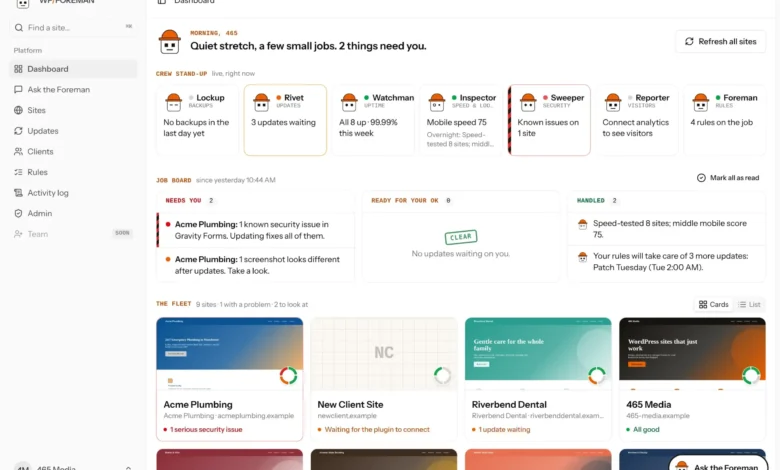
Representing the latest wave of innovation, WP Foreman focuses on the concept of "approve-first" automation. Developed by veteran agency owners, the platform utilizes an AI assistant that functions as a junior developer. Instead of allowing automated scripts to make potentially site-breaking changes, the AI analyzes the requested action—such as updating a plugin suite across 50 sites—and presents the proposed outcome for human approval. This design philosophy addresses the primary fear of agency owners: the "silent break" where an automated update causes a site to crash without immediate notice.
MainWP: The Open-Source Alternative
For agencies that prioritize data ownership and cost control, MainWP remains the definitive choice. Unlike SaaS-based competitors, MainWP is a self-hosted framework. The controller site is a WordPress installation under the agency’s direct control, meaning client data never touches a third-party server. While it requires more initial configuration—as users must integrate their own backup and monitoring solutions—it offers an unlimited growth path without the rising costs associated with per-site pricing models.

ManageWP and WPMU DEV: Established Powerhouses
ManageWP, now under the GoDaddy umbrella, continues to leverage its longevity and massive user base. Its strength lies in its robust free tier, which is ideal for solo freelancers managing smaller portfolios. Conversely, the WPMU DEV Hub serves as an all-encompassing ecosystem. For agencies already utilizing WPMU DEV’s hosting and plugin suites, the Hub is less of a standalone tool and more of a central nervous system for their entire business, integrating billing, site management, and client support into a single interface.
Data-Driven Selection: Cost Comparison for 25 Managed Sites
When evaluating the financial implications of these tools, it is necessary to look past marketing "starting at" prices and consider the cost of a standardized service level—defined here as the inclusion of backups, uptime monitoring, and professional white-label reporting.

| Platform | Monthly Cost (25 Sites) | Notable Exclusions |
|---|---|---|
| WP Foreman | $47.76 | Advanced malware cleanup |
| WP Remote | $49.75 | Advanced staging/testing |
| WP Umbrella | $54.75 | Firewall/Malware scanning |
| ManageWP | $125.00 | Vulnerability protection |
| MainWP Pro | ~$16.58 | Hosting/Storage costs |
Note: Pricing reflects standard 2026 market rates. WPMU DEV is excluded due to its bundle-dependent business model.
The Role of Automation in Agency Sustainability
The integration of AI-driven assistants is arguably the most significant technological leap in the industry since 2023. These tools no longer just alert users to an outdated plugin; they analyze the changelog of that plugin, verify compatibility with the current PHP version of the site, and suggest a rollback if the update fails to pass a simulated load test. This transition from "monitoring" to "active management" is helping small teams perform the work that previously required a full-time system administrator.

Strategic Implications for Agency Owners
The choice of a management tool has moved from a technical preference to a strategic business decision. For agencies, the primary objective is the mitigation of "Client-Detected Downtime." When a client notices a broken contact form or an expired SSL certificate before the agency does, the trust-based relationship is compromised. Consequently, the best tool for an agency is not necessarily the one with the most features, but the one that most effectively reduces the "Mean Time to Detection" (MTTD) for critical errors.
Future Outlook
As we move further into 2026 and beyond, the industry is trending toward deeper interoperability. The emergence of standardized API frameworks, such as the MCP (Model Context Protocol) servers recently adopted by platforms like MainWP, suggests a future where WordPress management tools will communicate seamlessly with broader business intelligence software. This will eventually allow agencies to automatically trigger accounting workflows, client notifications, and support tickets based on the health status of a managed site.

Ultimately, the goal of these platforms remains unchanged: to transform the volatile, high-stakes nature of web maintenance into a reliable, scalable service. Whether an agency chooses the autonomy of MainWP, the predictable pricing of WP Umbrella, or the AI-driven precision of WP Foreman, the underlying necessity remains the same—leveraging technology to ensure that the WordPress ecosystem remains stable, secure, and invisible to the end user. As the market continues to consolidate, the agencies that thrive will be those that successfully leverage these management tools to move away from reactive "firefighting" and toward proactive, automated maintenance cycles.
Related posts: