The modern web development landscape has long championed the philosophy of subtraction. Engineers frequently celebrate the moment fifty lines of JavaScript logic—such as a cumbersome ResizeObserver implementation monitoring DOM elements—can be successfully replaced with a compact, native CSS feature like a container query. On paper, the git diff reveals a sea of red deletions, a slimmer codebase, and a swift approval process before lunch. However, this local simplicity often masks a troubling counter-reality: while a specific component becomes easier to read, the broader application frequently grows exponentially harder to reason about.
Gabriel Shoyombo’s recent exploration into the intersection of modern CSS and existing frontend architectures highlights an industry-wide blind spot. The core dilemma centers on what happens when layout and reactive logic are fragmented across both CSS and JavaScript, leaving developers to debug conditional styles without a clear view of their triggers. While technologies like container queries, native nesting, and the :has() pseudo-class represent monumental leaps forward for browser capabilities, adopting them in mature codebases introduces subtle, systemic friction.
Local Simplicity Versus System Complexity
To understand the friction of modern CSS adoption, industry experts often rely on the metaphor of a shared household. Introducing a new, highly efficient CSS feature is akin to welcoming a quiet, tidy new tenant into a shared apartment. While the tenant themselves causes no direct trouble, they must still share a kitchen with the existing residents—in this case, legacy JavaScript, established layout rules, the CSS Cascade, and the browser’s underlying rendering engine. The overall stability of the household depends less on the virtues of the new arrival and more on how harmoniously they interact with established systems.
This dichotomy has sparked intense debate within the developer community. In April 2026, Igor Roztropiński published a widely discussed essay titled “Modern Frontend Complexity: Essential or Accidental?”, which questioned whether the industry could establish a vastly simpler approach given the rapid evolution of modern browsers. The essay ignited extensive discourse across developer forums like Reddit, drawing sharp divisions.
Critics argued that articles advocating for leaner code often result in applications simply doing less rather than achieving true efficiency. Conversely, proponents maintained that traditional frontend frameworks frequently introduce massive amounts of accidental complexity that native CSS features are uniquely positioned to eliminate.

Industry analysts note that a native feature only reduces true complexity when it cleanly displaces legacy code without disrupting the broader ecosystem. When migrations happen in fragmented phases—such as removing a CSS rule while leaving an orphaned JavaScript event listener intact—applications enter an unpredictable middle ground. Elements begin responding to conflicting rules, resulting in visual bugs that are notoriously difficult to trace.
The Pitfalls of Dual Ownership and Layout Disruption
The first major hazard of modern CSS migrations is dual ownership of component behavior. When developers transition from JavaScript-driven state toggling to native container queries, incomplete deletions often leave both systems partially active. If a JavaScript observer toggles a class based on a 480-pixel threshold while a new container query listens for a 600-pixel threshold, the component can enter unwritten intermediate states. Between those dimensions, a card might render a single-column body alongside an enlarged wide-layout title—a visual defect neither system was explicitly programmed to create.
Beyond state management, modern CSS features frequently trigger unintended layout shifts by altering block formatting contexts. For instance, declaring container-type: inline-size communicates an intent to let child elements query their parent’s width. However, the browser interprets this declaration much more broadly. It applies style and inline-size containment, which halts margin collapsing, alters how floated elements interact with the component, and can cause content-sized elements to completely collapse to zero width if an explicit contextual size is unavailable.
A paragraph with a bottom margin sitting directly above a card will traditionally have its margin collapse through the top of the container, merging with the heading’s top margin. Introducing containment traps that margin inside the element, forcing the margins to stack additively and unexpectedly expanding the container’s height. Similarly, elements designed to sit comfortably beside a floated image can suddenly be shoved outward, drastically altering the page’s structural geometry.
Cascade Conflicts and Performance Implications
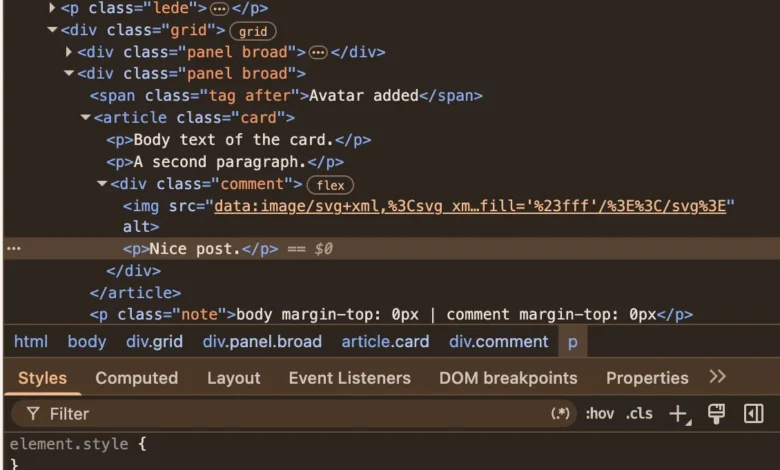
The introduction of powerful selector tools like :has() and native nesting further complicates the CSS Cascade. While these features enable concise stylesheets, they also expand the surface area for unintended specificity clashes. A broad selector intended to strip paragraph margins from a specific card variant can easily bleed into nested sub-components, such as independent user comment blocks, inadvertently wiping out vital spacing across unrelated parts of the application.
Furthermore, native nesting borrows specificity rules from the :is() pseudo-class, meaning a nested selector inherits the highest specificity from its associated selector list. Without careful scoping—such as wrapping target lists in :where() to neutralize specificity weights—developers frequently find themselves trapped in escalating specificity wars.

Performance considerations also challenge the assumption that native CSS is universally faster than JavaScript. While shifting layout computations to the browser engine generally improves performance, complex combinations of structural selectors can create hidden performance bottlenecks.
Benchmark tests examining extensive DOM trees demonstrate that while a single isolated :has() rule introduces negligible overhead, combining multiple broad structural queries can force the browser to restyle thousands of elements simultaneously upon a minor state change. In high-frequency rendering scenarios, these compounded calculations can easily consume multiple animation frames, degrading user experience in ways that standard code reviews fail to catch.
Bridging the Gap Between Greenfield and Migration Realities
The root cause of these systemic issues lies in a fundamental disconnect within technical literature. The vast majority of documentation, tutorials, and architectural guides regarding modern CSS features are written from a greenfield perspective—assuming a clean slate where developers build applications from the ground up. In contrast, the vast majority of enterprise engineering work involves migration: integrating powerful new primitives into legacy codebases laden with historical context and technical debt.
To successfully manage these transitions, engineering teams must shift away from evaluating pull requests purely on the volume of code deleted. Successful migrations require treating CSS features with the same architectural rigor applied to backend services or JavaScript state management.
Industry standards now increasingly recommend exhaustive pre-migration checklists. Before replacing JavaScript logic or adopting structural CSS selectors, teams must verify that all legacy event listeners and classes are completely excised, confirm that parent layout containers are compatible with inline containment, audit the cascade layers to ensure proper rule precedence, and profile the rendering performance of the application under realistic data loads.
Ultimately, modern CSS remains a transformative advancement for web development, offering expressive capabilities that were previously unattainable without heavy dependencies. However, true simplicity is not achieved merely by writing fewer lines of code. It is achieved by ensuring that new stylistic capabilities integrate seamlessly with the existing ecosystem, maintaining predictable behavior across the entire application architecture.