Building a Multi-Modal RAG Pipeline in Python to Unlock Complex Document Intelligence

The rise of Retrieval-Augmented Generation (RAG) has transformed how organizations interact with vast repositories of text-based data. By grounding large language models (LLMs) in verified, proprietary information, developers have successfully mitigated the risks of hallucinations and data staleness. However, standard RAG architectures suffer from a fundamental architectural limitation: they are essentially blind to the non-textual components that often contain the most critical information in modern corporate documents. Financial reports, technical engineering specifications, and legal filings are rarely composed of text alone; they are dense, visual-heavy environments containing complex tables, infographics, architectural diagrams, and handwritten annotations. When traditional text-based chunking algorithms process these documents, they frequently ignore images entirely or reduce table data to unreadable, fragmented character streams. The result is a critical intelligence gap that renders traditional RAG systems ineffective for enterprise-grade document analysis.
The Shift Toward Multi-Modal Intelligence
The development of multi-modal RAG represents a paradigm shift in how AI systems ingest unstructured data. By treating images as first-class citizens alongside text, developers are now able to construct pipelines that maintain the semantic integrity of a document’s visual elements. Recent industry benchmarks suggest that up to 40% of the information value in enterprise PDF reports is contained within visual media, such as charts or diagrams. Traditional systems that strip this information effectively delete a significant portion of the document’s utility before the LLM ever receives the query.
To address this, modern engineering teams are turning to an architecture that combines the unstructured ingestion framework, the LangChain orchestration layer, and the visual reasoning capabilities of models like GPT-4o. This approach does not merely "read" the document; it maps the structural relationships between text and imagery, ensuring that when a user asks a question about a specific performance trend, the system can retrieve both the narrative explanation and the corresponding visualization.
Technical Foundations and Prerequisites
Executing a multi-modal RAG implementation requires a robust development environment. Beyond the standard Python stack, developers must account for the physical processing of PDF documents. The poppler-utils dependency is a vital component of the unstructured library, acting as the engine that renders PDF pages into images for analysis.
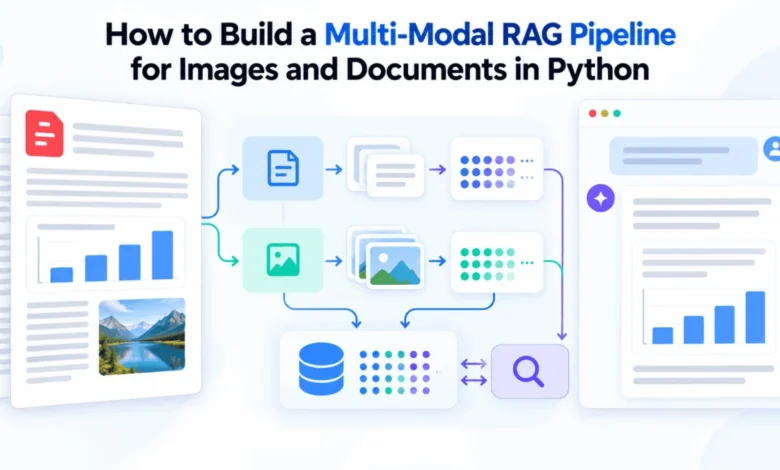
To begin, ensure the following packages are installed: langchain, langchain-openai, unstructured[pdf], chromadb, and pillow. Once the dependencies are configured, the pipeline operates through four distinct, sequential stages: parsing, semantic summarization, multi-vector storage, and multimodal retrieval.
Stage 1: Granular Parsing and Element Separation
The parsing phase is the most critical juncture for ensuring data quality. The partition_pdf() function, provided by the unstructured library, performs an intelligent scan of the document. Unlike basic OCR tools that simply extract text, this function utilizes computer vision to classify content blocks—differentiating between headers, paragraphs, tables, and images.
By setting infer_table_structure=True, the developer instructs the system to maintain the integrity of row-column relationships, which is essential for accurate retrieval. Once the document is parsed, the pipeline must programmatically split the elements. Text elements are preserved for embedding, while images are isolated and written to disk as separate assets. This separation is necessary because, while text can be vectorized directly, images require a secondary "summarization" process to become searchable within a vector database.
Stage 2: Bridging the Visual-Textual Gap
The core challenge in multi-modal retrieval is that vector databases do not natively "see" images. To overcome this, the pipeline creates a synthetic text bridge. Each extracted image is sent to an LLM, such as GPT-4o, with a prompt to generate a detailed, descriptive summary. This summary acts as a high-fidelity proxy for the image.
For example, if an image is a bar chart showing Q3 revenue growth, the model generates a description that includes the chart’s title, axes labels, and the specific data points visualized. This summary is then embedded and stored in the vector database. Consequently, when a user asks, "What was the revenue growth in Q3?", the retrieval system performs a semantic search against the image summaries. If a match is found, the system retrieves the original image file rather than just the summary text. This ensures that the final response provided to the user is grounded in the raw, original visual evidence.
Stage 3: The Multi-Vector Store Architecture
Standard RAG relies on a single vector store to handle all data. Multi-modal RAG, however, necessitates a MultiVectorRetriever architecture. This system manages two distinct stores:
- The Vector Store: This holds the embeddings of both the raw text chunks and the image summaries. It is the "index" the system queries.
- The Document Store: This is an in-memory repository that stores the raw, original content—both the full text paragraphs and the paths to the extracted image files.
These two stores are linked by unique identifiers (UUIDs). When the system identifies a match in the vector store, it uses the associated UUID to pull the original content from the document store. This design is highly efficient for production environments, as it keeps the embedding space clean while maintaining a direct link to the primary data source.
Stage 4: Querying and Synthesis
The final step is the retrieval-and-reasoning loop. When a query is issued, the system performs a similarity search across the combined index of text and image summaries. The top-ranked results are compiled into a multimodal prompt.
If the retrieval includes an image, the pipeline opens the file, encodes it into a base64 format, and transmits it to the LLM alongside the textual context. This allows the model to perform cross-modal synthesis. The model does not just summarize the retrieved text; it visually analyzes the provided image and combines that visual evidence with the text to formulate a comprehensive answer.
Implications and Future Directions
The adoption of multi-modal RAG carries significant implications for data-driven industries. In the financial sector, analysts can now automate the review of thousands of quarterly reports, instantly surfacing discrepancies between reported text and visual charts. In healthcare, this technology enables the analysis of medical reports that combine clinical notes with diagnostic imaging.
However, the transition to this architecture is not without its costs. Every image extracted during the indexing phase triggers an API call for summarization, which can be computationally and financially intensive for large document sets. Engineers must implement filtering logic to discard irrelevant or non-informative imagery—such as logos, icons, or decorative graphics—before they reach the LLM.
Looking forward, the field is moving toward end-to-end vision-language models, such as ColPali. These models aim to bypass the parsing and summarization steps entirely by embedding document pages as images, potentially eliminating the need for complex, multi-stage pipelines. For now, however, the Multi-Vector Retriever approach remains the gold standard for accuracy and reliability, offering a robust, scalable framework that allows organizations to finally extract the full value from their complex, visual-heavy document landscapes. By bridging the gap between text and sight, developers are effectively giving their AI systems the ability to "read" documents with the same depth and nuance as a human professional.