The Paradox of Autonomous Websites: Why Total Automation Fails and How Dynamic Governance Solves Digital Decay

Every digital property experiences its absolute peak on the precise day it officially launches. Code branches merge seamlessly, the deployment pipeline executes without a hitch, and the production environment mirrors the original design specifications down to the final pixel. For a fleeting moment, the digital asset is pristine. Yet, empirical evidence from web management and software engineering indicates that a website will never achieve that level of perfection again. This degradation does not stem from catastrophic software failures, critical security exploits, or sudden hosting outages. Instead, it results from an inexorable mismatch between a static digital artifact and a dynamic operational environment. Market conditions shift, corporate messaging pivots to address new verticals, competitors deploy aggressive redesigns, and the meticulously crafted interface quietly stops reflecting the organization behind it. Twelve months post-launch, a typical enterprise website becomes a digital period piece: fully operational, yet fundamentally obsolete.
For decades, digital teams have treated this steady depreciation as an immutable law of nature—an inescapable operational tax of maintaining an online presence. However, the maturation of artificial intelligence and autonomous agent frameworks has introduced an alternative paradigm. Rather than watching a digital property drift into obsolescence, organizations can theoretically deploy continuous optimization systems. These autonomous architectures operate quietly in the background, updating underlying components, refining layout performance, and adjusting content while human engineers focus on core product development.
Despite the technical feasibility of self-updating web infrastructures, early market reception has revealed a surprising psychological barrier: nearly no stakeholder actually desires a website that mutates entirely on its own. This article explores the evolution of website management, the underlying flaws of total automation, and the emergence of granular, task-specific agent governance models pioneered by platforms like Fimo.
The Illusion of Total Autonomy and the Reality of Digital Decay
When software architects first conceptualize autonomous web systems, the default trajectory points toward total delegation. The rationale appears straightforward: if artificial intelligence models possess the capability to write code, edit copy, optimize assets, and execute deployments, why not grant them unrestricted access to the entire web infrastructure? Let the autonomous agents handle everything from backend routing to frontend copywriting, thereby eliminating human bottlenecks entirely.
However, when software platforms transition this theoretical model from a whiteboard diagram into a commercially viable product, user behavior diverges sharply from expectations. When developers, designers, and marketing executives interact with a fully autonomous website engine for the first time, they exhibit immediate hesitation. This reluctance does not stem from a fundamental distrust of machine learning algorithms or neural network accuracy. Rather, it arises from a more complex organizational reality: corporate websites possess no single, monolithic owner.
Digital properties represent the intersection of multiple departmental domains, each with distinct priorities, key performance indicators, and risk tolerances. A software engineer views a website through the lens of performance metrics, uptime, and accessibility compliance. A brand designer evaluates the same interface through aesthetic cohesion, typographical hierarchy, and emotional resonance. A content strategist prioritizes SEO keyword density, legal disclaimers, and conversion funnel optimization. Because these stakeholders hold divergent interests, the core challenge of autonomous web management is not technological capability. It is the precise establishment of operational boundaries—determining exactly where to draw the line of delegation, and for whom.
Categorizing the Web Maintenance Workflow
To construct a functional autonomous web ecosystem, platform developers must disaggregate the typical website management lifecycle into distinct operational categories. Empirical data gathered from enterprise web management indicates that maintenance tasks generally fall into three distinct tiers: rule-bound chores, untouchable creative judgments, and subjective jurisdictional overlaps.
The first category comprises the vast majority of web maintenance: repetitive, rule-bound, and structurally predictable operations. Maintaining Section 508 and WCAG accessibility compliance as dynamic pages evolve, propagating global design-system updates when a foundational design token changes, identifying broken meta descriptions, compressing unoptimized raster images, and repairing internal links that broke during previous software sprints fall squarely into this domain. Historically, digital agencies and internal engineering teams spent countless billable hours executing these mundane checklists. Nobody enters the software engineering profession out of a passion for locating missing alternative text attributes or validating contrast ratios.
Because these tasks are strictly defined by programmatic rules rather than subjective artistic taste, they represent the ideal workload for autonomous agents. Delegating this eighty percent of web maintenance does not threaten human employment; instead, it relieves knowledge workers of tedious operational overhead. Automated agents can execute these rule-bound checks continuously, ensuring that a digital property remains compliant and optimized without requiring human intervention.
At the opposite end of the spectrum lies the untouchable tier: creative decisions that human stakeholders would refuse to delegate under any circumstances. An autonomous agent can evaluate a newly generated landing page against thousands of programmatic constraints. It can mathematically verify color contrast ratios, confirm proper HTML heading hierarchies, validate design system tokens, and check grammar against a predefined enterprise style guide. However, the machine cannot determine what emotional resonance the page should evoke, nor can it evaluate whether the overarching creative direction aligns with the brand’s long-term vision. That specific brand judgment represents the core value proposition of human designers and strategists. Protecting this small fraction of high-value creative work is essential; attempting to automate it leads directly to sterile, uninspired digital experiences.
The Jurisdictional Dilemma: Subjective Lines of Control
Between purely mechanical chores and untouchable creative judgments lies a vast middle ground where software products cannot establish a universal default. The boundary between human oversight and machine autonomy varies significantly depending on the stakeholder’s role within the organization.
Consider a practical, highly common website modification: shifting the default user interface theme from light mode to dark mode upon visitor arrival. An autonomous optimization agent can execute this structural code change in mere seconds. However, the fundamental debate centers on who holds the authority to authorize the change. For a brand designer responsible for maintaining corporate identity and visual consistency, the default theme is not a trivial settings toggle; it represents a deliberate statement regarding how the organization wishes to present itself to new visitors. Consequently, the designer demands direct veto power over this visual shift. Conversely, for a front-end developer focused on user experience telemetry and battery conservation metrics, a dark-mode default is a rational, data-backed optimization that an automated agent should apply immediately.
This scenario illustrates a profound truth about digital governance: the same task carries vastly different quantities of subjective judgment depending on the observer. For one professional, an action constitutes a strategic design decision requiring deep deliberation; for another, it represents a routine chore. Because organizational roles overlap and conflict, software platforms cannot ship a single, rigid autonomy setting that satisfies every department. Control must be granular, operating on a per-task and per-person basis.
Architectural Evolution: Composing Agents Rather Than Toggling Settings
Recognizing that autonomy boundaries are inherently subjective and role-dependent fundamentally alters how developers must approach software design. A binary global toggle—switching a website between "manual approval" and "full automation"—proves inadequate for complex enterprise environments. Because the threshold of trust depends entirely on the specific function the agent performs, the foundational unit of software control must be the individual agent itself.
This realization shaped the structural architecture of platforms like Fimo, where users do not simply select from a fixed menu of system-wide automation settings. Instead, administrators compose specialized autonomous agents, explicitly defining the operational boundaries and permissions for each digital assistant. Organizations can deploy specialized instances: an accessibility agent granted full autonomy to correct markup errors and maintain WCAG compliance without human sign-off; a translation agent configured to localize regional landing pages subject to periodic review; and a content agent tethered strictly to human approval workflows for any brand-facing announcements.
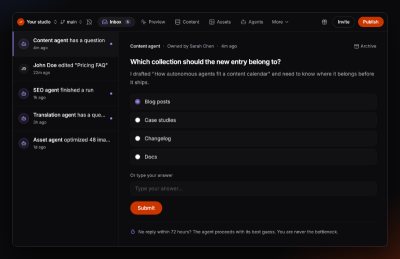
These specialized agents do not operate within static parameters. Utilizing machine learning feedback loops, they learn from executed tasks, historical error logs, and direct human corrections. Consequently, the operational boundary established during initial deployment is not permanent. A task that required mandatory human sign-off last month can transition to automated delegation over time—not because organizational standards slipped, but because the autonomous agent systematically earned institutional trust through verifiable performance.
Practical Implementation: The Progressive Trust Model
Transitioning a digital property toward autonomous optimization does not occur via a reckless, single-click migration on launch day. In practice, enterprise adoption follows a methodical, risk-managed trajectory characterized by progressive trust expansion.
Web teams typically begin by delegating a single, highly constrained class of maintenance tasks—such as image compression or metadata validation—while retaining strict human oversight over all structural code changes. To ensure operational transparency, modern autonomous platforms maintain immutable execution logs, comprehensive audit histories, and side-by-side visual diffs comparing the pre-modification state with the optimized output.
Trust within engineering and design teams does not scale through abstract philosophical acceptance of artificial intelligence. It scales through empirical verification. When an autonomous agent quietly resolves a subtle layout regression that human reviewers overlooked, and the platform provides a transparent, verifiable record of the intervention, subsequent delegations become significantly easier to authorize. Furthermore, automated escalation deadlines prevent human stakeholders from becoming operational bottlenecks. If a designated reviewer fails to evaluate a pending optimization within a specified timeframe, the agent executes the pre-approved protocol, ensuring that the broader digital infrastructure never stagnates due to administrative inertia.
The Ultimate Risk of the Frozen Digital Asset
Discussions surrounding autonomous web infrastructure frequently begin with expressions of anxiety regarding unintended machine modifications. Stakeholders worry that an autonomous agent might alter a critical landing page, modify core brand copy, or introduce an unforeseen layout bug while human teams are offline.
Industry experts argue that this perspective fundamentally misjudges the primary risk facing modern digital properties. The true existential threat to an enterprise website is not an overzealous optimization agent; it is the silent, incremental decay of a frozen digital asset. A static website does not remain secure, accurate, or relevant simply because it remains untouched. It steadily falls behind shifting market dynamics, emerging accessibility standards, and evolving competitive landscapes in a manner so gradual that internal teams rarely notice until the digital property no longer represents the living organization behind it.
The fundamental objective of website autonomy was never to disintermediate human creators from their digital properties. The true purpose of automated web optimization is the systematic elimination of digital decay. By delegating rule-bound maintenance chores to specialized agents, organizations empower human teams to concentrate their finite creative judgment on the small fraction of strategic decisions that genuinely demand human insight—transforming the website from a decaying historical artifact into a continuously evolving digital environment.