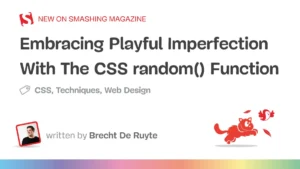
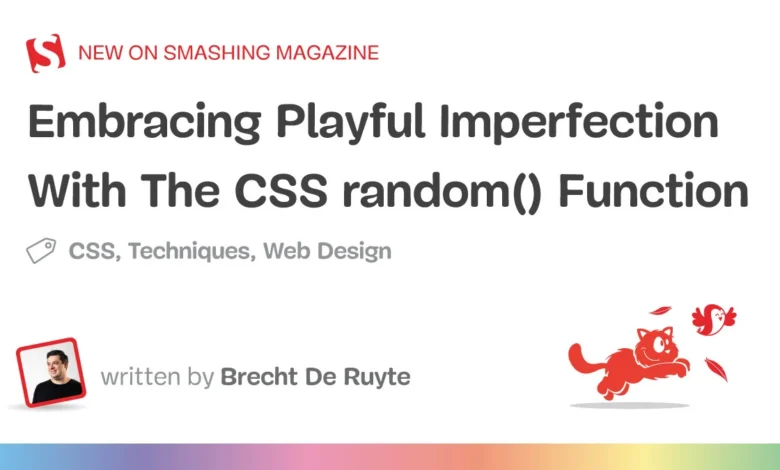
Embracing Playful Imperfection: How the Native CSS random() Function is Redefining Web Aesthetics

Web design has spent the past decade pursuing absolute visual predictability. Driven by the evolution of robust design systems, strict grid frameworks, and tokenized architecture, modern web development has optimized for uniformity. Alignment, consistent spacing scales, and rigid geometry have long been considered the ultimate benchmarks of design engineering maturity. However, a major paradigm shift is underway with the integration of native procedural capabilities directly into stylesheets. The introduction of the CSS random() function—part of the CSS Values and Units Module Level 5 specification—marks a turning point for frontend engineering, officially bridging the gap between rigorous digital systems and organic, human imperfection.
The Technical Evolution of CSS Randomness
Historically, introducing any degree of non-uniformity or stochastic behavior into a web interface required external intervention. Developers relied heavily on JavaScript libraries to calculate and inject inline styles, or depended on complex preprocessor loops—such as those in Sass or Less—to generate hundreds of lines of static, hardcoded variations at build time. While effective, these methods introduced performance overhead, bloated markup sizes, and increased build complexity.
The arrival of the native CSS random() function changes this workflow by shifting pseudo-random computation directly into the browser engine. As browser support matures—having already landed in Safari and rolled out in Chrome version 156, alongside positive signals from Mozilla regarding Firefox implementation—developers gain a lightweight, performant mechanism for dynamic styling.
The standardized syntax follows a structured format: random( <random-key>?, <min>, <max>, <step>? ). Developers can pass comma-separated arguments to dictate numeric boundaries, angles, time durations, or percentages. For instance, applying a minor rotational variance to a UI element can now be written concisely as rotate: random(-3deg, 3deg);, while controlling precise layout intervals is achieved through optional step increments, such as inline-size: random(20px, 80px, 10px);.
Furthermore, the specification addresses the challenge of state synchronization through caching keys. Without optimization, evaluating random() across multiple properties on a single element would yield entirely independent values, distorting elements into unintended rectangular shapes. By introducing element-scoped identifiers—such as random(--square-size element-scoped, 60px, 120px)—developers can ensure that dimensions remain harmonized, preserving structural integrity like a 1:1 aspect ratio while maintaining unique variance across distinct page components.
Chronology and Browser Implementation Timeline
The journey toward native CSS randomness reflects the broader evolution of the CSS specification, which has increasingly adopted functional and programmatic capabilities natively.
- CSS Values and Units Module Level 5 Draft: The CSS Working Group formalized the inclusion of mathematical and pseudo-random generation functions to reduce reliance on scripting environments.
- Safari Adoption: Apple integrated support for the specification, making Safari the first major browser engine to execute native random calculations.
- Chrome Rollout (v156): Google initiated the rollout of the feature in Chrome 156, bringing native stochastic styling to the Chromium ecosystem.
- Ecosystem Outlook: With Mozilla signaling positive intentions for Firefox implementation, cross-browser parity is anticipated to reach maturity, enabling production-ready progressive enhancement via
@supportsquery wrappers.
Balancing Controlled Chaos with Design Systems
The integration of randomness into strict design systems initially sparks skepticism among enterprise teams. In professional software development, visual unpredictability is traditionally categorized as a rendering bug rather than an artistic expression. If a corporate dashboard component shifts randomly upon a page refresh, stakeholder friction is immediate.
However, design engineers exploring the technology emphasize that CSS randomness should not be deployed indiscriminately. Instead, it serves as a tool for "controlled chaos"—introducing micro-variations that mimic analog artifacts without compromising layout reliability. Physical media, such as letterpress prints, analog photography, and hand-tuned typography, inherently possess subtle imperfections that register to the human eye as organic and alive. By applying minute adjustments to typography baseline positioning, image rotations, or box-shadow geometries, digital interfaces can shed the sterile uniformity often associated with automated or unguided layouts.
Industry practitioners have demonstrated practical implementations ranging from organic typography rendering—where individual characters receive slight positional and rotational offsets that snap to geometric alignment upon user interaction—to complex, scroll-driven card decks. By pairing native CSS math functions like sibling-index() with random velocity and jitter calculations, developers can build immersive, dynamic galleries that scale naturally with page navigation without consuming heavy runtime CPU resources.
Accessibility and Implementation Guardrails
While the stylistic possibilities are broad, web standards and accessibility guidelines necessitate strict boundaries for utilizing dynamic randomness.
- Screen Reader Compatibility: Fragmenting typography into individual inline elements (such as
<span>tags per character) to apply random styling transforms the semantic reading order for assistive technologies. Screen readers may interpret words as isolated letters or pause awkwardly between characters. Developers must employ proper mitigation strategies, such as hiding visual character spans viaaria-hidden="true"while supplying the complete, accessible text string througharia-labelattributes on parent wrapper elements. - Motion Sensitivity: Unrestricted procedural animations can trigger vestibular disorders or discomfort for users. Compliance with
prefers-reduced-motionmedia queries is mandatory. Best practices dictate that when reduced motion is detected, rotational offsets, fluid bouncing keyframes, and dynamic drifts must be neutralized to ensure a stable viewing experience. - Unit Consistency: Parser constraints require minimum and maximum bounds within the
random()function to share identical unit types (e.g., mixing rems and pixels directly within a single function call remains invalid unless resolved via nestedcalc()expressions).
Broader Industry Implications and Future Outlook
The deployment of native CSS randomness signifies a maturing web platform capable of handling complex visual choreography independently of JavaScript frameworks. As the specification looks toward future enhancements—such as the proposed random-item() function, which would allow stylesheets to select tokens dynamically from predefined design palettes—the boundaries between static design tokens and dynamic styling continue to blur.
For frontend architects and design system engineers, the challenge moving forward is not technological capability, but governance. Establishing clear guidelines on where organic imperfection adds genuine user value—such as in editorial layouts, creative portfolios, and marketing experiences—while preserving rigorous alignment in data-dense interfaces will define the successful adoption of the tool. Ultimately, the integration of CSS random functions proves that the modern web can maintain its robust, token-driven foundation while inviting a calculated touch of human playfulness back into the digital medium.