Synchronous vs. Asynchronous Agent Execution: Architecture Patterns for Production

The rapid evolution of Large Language Model (LLM) agent frameworks has transformed the landscape of automated software development, moving from simple script-based interactions to complex, autonomous decision-making systems. However, as developers transition these agents from experimental local environments to production-grade distributed systems, they face a critical architectural challenge: the "deployment gap." This gap represents the disconnect between the ease of prototyping an agent in a Jupyter notebook and the rigorous demands of maintaining high-availability, low-latency, and fault-tolerant production environments. At the heart of this challenge lies the fundamental choice between synchronous and asynchronous execution patterns.
The architectural decision to favor one pattern over the other is not merely a matter of developer preference; it is a strategic choice that dictates system scalability, user experience, and resource management. While synchronous patterns offer simplicity, they often falter under the weight of real-world latency, whereas asynchronous patterns provide the resilience required for enterprise-scale AI but introduce significant operational complexity.
The Anatomy of the Deployment Gap
In recent years, the industry has seen an explosion of libraries—such as LangChain, CrewAI, and AutoGen—designed to make agent development accessible. These tools empower developers to create agents capable of iterative planning, tool utilization, and reasoning. However, when these agents are exposed via an API gateway or a web interface, they frequently encounter the limitations of traditional request-response cycles.
Most web infrastructure is built upon the synchronous model, where a client sends a request and expects an immediate response. When an agent is tasked with a multi-step workflow—such as querying a vector database, browsing the web, and synthesizing a comprehensive report—the processing time can easily exceed the standard timeout limits enforced by cloud providers. For instance, AWS API Gateway maintains a default timeout of 29 seconds. If an agent’s chain-of-thought exceeds this window, the connection is dropped, resulting in a failed transaction, wasted computational tokens, and an incomplete user experience. This systemic fragility necessitates a shift toward more sophisticated distributed system patterns.
Synchronous Execution: The Case for Immediate Feedback
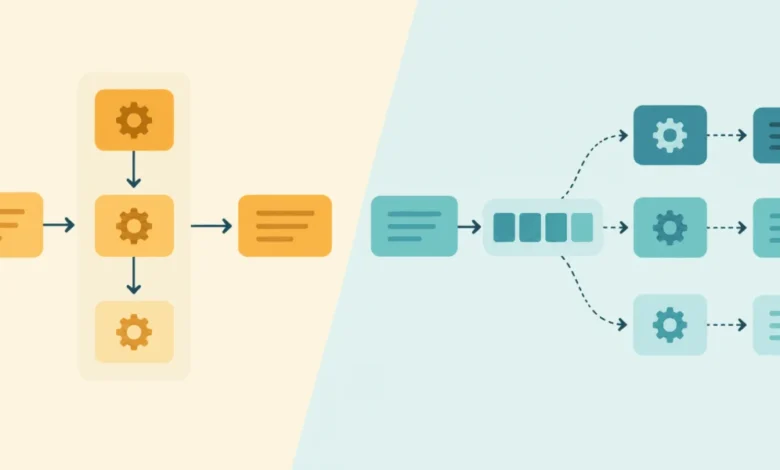
Synchronous agent execution, often characterized by a "wait and see" approach, functions as a direct, blocking operation. In this paradigm, the agent thread remains active and dedicated to the user’s request from the moment the prompt is received until the final output is generated.
This model is most appropriate for low-latency, deterministic tasks where the user requires immediate feedback. Standard Retrieval-Augmented Generation (RAG) pipelines, which prioritize speed and directness, are primary candidates for synchronous architectures. By keeping the execution thread alive, the system minimizes the overhead of managing state transitions between different services.
However, the rigidity of this pattern becomes a liability as agent complexity grows. The primary risk is thread blocking; if a single request occupies a worker thread for an extended period, the capacity to serve other concurrent users diminishes rapidly. In high-traffic scenarios, this leads to the "noisy neighbor" effect, where a few complex agent tasks degrade performance for all users. Developers implementing synchronous agents must balance the simplicity of implementation with the high risk of service timeouts.
Asynchronous Execution: Engineering for Resilience
To address the limitations of synchronous workflows, industry leaders are increasingly adopting asynchronous, event-driven architectures. This "fire and forget" model decouples the client request from the agent execution, effectively insulating the user interface from the underlying latency of complex AI reasoning.
In an asynchronous architecture, the workflow is fundamentally altered:
- Task Submission: The client submits a prompt to an API endpoint.
- Acknowledgment: The system immediately returns a
job_idand a status of "pending," allowing the client to continue other operations without blocking. - Queue Management: The task is pushed into a message broker, such as RabbitMQ, Amazon SQS, or Redis.
- Worker Processing: Independent background worker nodes consume the task from the queue, performing the multi-step reasoning and tool execution.
- State Persistence: Throughout the process, the agent checkpoints its progress to a persistent database (e.g., PostgreSQL or MongoDB), ensuring that if a node fails, the job can be resumed without starting from scratch.
This pattern is essential for sophisticated workflows such as code refactoring, long-form content generation, or multi-agent debating. By offloading these tasks to a pool of workers, the architecture becomes horizontally scalable. If the load increases, an organization can simply spin up additional worker nodes to process the queue, rather than increasing the throughput of the primary API gateway.
Data-Driven Considerations and Trade-offs
The decision to adopt an asynchronous model is not without costs. It necessitates a shift toward more complex infrastructure. A synchronous system can often run on a single container or serverless function. In contrast, an asynchronous system requires:
- Message Brokers: To manage the orchestration of tasks.
- Persistent Storage: To track the state and metadata of thousands of individual jobs.
- Monitoring Tools: To provide visibility into the health of the worker fleet.
According to recent industry benchmarks, transitioning from synchronous to asynchronous processing in agentic workflows can reduce user-facing error rates—specifically those related to 504 Gateway Timeouts—by upwards of 90% for complex tasks. However, it also introduces a "polling" or "webhook" requirement for the client, which adds complexity to the frontend development process. The client must either periodically poll the status of the job_id or implement a callback URL to receive a notification once the task reaches a "completed" state.
Chronology of Architectural Maturity
The progression of AI agent deployment has followed a predictable arc of technical maturity:
- Phase 1 (Prototyping): Local script execution, manual orchestration, no persistence.
- Phase 2 (Synchronous API): Basic HTTP interfaces, standard RAG implementation, immediate response loops.
- Phase 3 (Asynchronous Distribution): Queue-based task processing, persistent state management, multi-worker architectures.
As of late 2026, most enterprise-level agentic applications are firmly in Phase 3. The industry has reached a consensus that for any application where "thinking time" exceeds three to five seconds, the synchronous model is insufficient. The adoption of orchestration frameworks that natively support asynchronous execution—such as Temporal or specialized agent-queue integrations—has become the gold standard for production-ready AI.
Broader Implications for AI Infrastructure
The move toward asynchronous execution is symptomatic of a broader shift in software engineering: the treatment of AI models as distributed system components rather than simple functions. As organizations continue to integrate agents into critical business processes—such as financial auditing, customer support automation, and software maintenance—the reliability of these agents becomes a primary business metric.
The failure of an agent to complete a task in a non-production environment is a minor inconvenience; in a production system, it can lead to data inconsistency, financial loss, or security vulnerabilities. Therefore, the implementation of "Human-In-The-Loop" (HITL) checkpoints within asynchronous workflows has become a critical requirement. By allowing an agent to pause its execution and wait for human validation, developers can create "guardrails" that ensure AI actions remain within defined parameters.
Strategic Recommendations for Deployment
For teams currently evaluating their deployment strategies, the following heuristics are recommended:
- Assess Task Latency: If the agent’s average response time is under two seconds, maintain a synchronous architecture to preserve simplicity. If it exceeds five seconds, begin planning for an asynchronous transition.
- Prioritize State Management: Even in simple agents, implement a database layer to log inputs and outputs. This provides the foundation for auditability and future-proofs the application for eventual asynchronous migration.
- Embrace Event-Driven Patterns: For any agent requiring multiple tool calls or iterative planning, treat the interaction as a series of distinct, recoverable events rather than a single continuous request.
Ultimately, the goal of modern agent architecture is to hide the complexity of AI reasoning from the end-user while maximizing the robustness of the system. By understanding the fundamental differences between synchronous and asynchronous execution, developers can build agents that are not only powerful but also scalable and reliable enough to meet the rigorous demands of the enterprise environment. As the technology continues to mature, the distinction between "AI agent" and "software service" will continue to blur, necessitating a unified approach to distributed system design that prioritizes consistency and availability above all else.