The Evolution of Web Development: Why Autonomous Websites Are Redefining Digital Maintenance


Every modern website achieves its peak aesthetic and functional performance on the exact day it launches. Following the final branch merge, the site goes live precisely as envisioned by its creators, capturing a brief window of perfection. Historically, digital platforms never reclaim this state of pristine alignment.
This decline does not stem from catastrophic technical failures or sudden code corruption. Instead, the gradual erosion occurs because the surrounding market shifts dynamically, enterprise messaging evolves, competitors introduce innovative features, and meticulously engineered interfaces slowly drift out of sync with the organizations they represent. Within twelve months of deployment, a contemporary web property frequently transforms into a digital period piece. While the infrastructure remains functional, the content and design lag behind industry standards.
Software development teams universally recognize this inevitable digital decay, traditionally treating the phenomenon as an immutable law of nature. However, emerging paradigms in artificial intelligence and automation suggest that modern websites can continuously improve post-launch rather than steadily deteriorating. By utilizing autonomous agents that perform background maintenance while human developers focus on higher-level initiatives, the web development sector is reevaluating how digital assets are managed. Pierre Burgy, co-founder of the autonomous website platform Fimo, recently detailed the conceptual challenges and architectural insights discovered while engineering solutions for full website autonomy.
The Illusion of Total Autonomy
The intuitive approach for developers introducing autonomous agents to web infrastructure involves granting end-to-end control. Under this model, artificial intelligence systems would theoretically write, edit, optimize, and publish content independently, liberating human teams from routine oversight. While this scenario represents the logical endpoint of machine learning integration, it immediately confronts a significant psychological and operational barrier: enterprise stakeholders fundamentally resist websites that operate entirely without human supervision.
Building Fimo provided critical empirical insights regarding how organizations interact with automated systems. Developers initially assumed that achieving total autonomy was the primary objective for platform users. Yet, deployment data revealed widespread hesitation among engineering and design teams. This reluctance did not stem from a general distrust of artificial intelligence, but rather from the decentralized ownership structures typical of modern web properties.
Websites do not belong to a single stakeholder. Instead, they represent a collaborative intersection of design, engineering, marketing, and product management. Each department maintains distinct boundaries regarding which tasks can be delegated to automated agents. Consequently, the central engineering challenge evolved from proving technological capability to determining precisely where to establish operational boundaries for different organizational roles.
Categorizing Digital Labor: Chores, Taste, and Context
To resolve the tension between automation and human oversight, workflow analysis reveals that website management divides into three distinct categories: routine maintenance, creative judgment, and context-dependent responsibilities.
The largest category comprises rule-bound, repetitive, and administrative tasks that consume substantial developer hours without requiring creative input. This domain includes maintaining accessibility compliance as page layouts shift, propagating design-system updates across thousands of templates, identifying broken metadata, compressing rushed image uploads, and repairing broken hyperlinks caused by historical URL restructuring. None of these responsibilities leverage human creative talent; rather, they represent necessary maintenance chores. Autonomous agents excel within this category because the parameters are governed by strict operational rules rather than subjective aesthetic taste. Offloading this foundational eighty percent of maintenance work eliminates administrative friction without threatening professional roles.
Conversely, a small but critical category of web development demands absolute human oversight. While automated agents can verify contrast ratios, heading hierarchies, token consistency, and adherence to style guides, they cannot independently determine the emotional resonance or aesthetic quality of a web page. Determining whether a newly deployed interface possesses genuine creative value requires human intuition. Protecting this sphere of work is essential, as the misapplication of automation to creative decisions undermines the core purpose of design and engineering teams.
Between these two extremes lies a vast gray area where operational boundaries vary significantly depending on individual roles within an organization. A single website modification—such as defaulting a visitor’s landing view to dark mode—illustrates this divergence. For a frontend developer focused on efficient codebase optimization, implementing a conditional theme toggle represents a straightforward technical adjustment that can be safely delegated to an autonomous script. However, for a brand designer responsible for maintaining visual identity, the default theme constitutes a fundamental statement regarding how the organization presents itself to the public, requiring deliberate aesthetic authorization. The friction surrounding website automation does not arise from caution versus recklessness, but rather from the reality that the same operational task carries vastly different implications depending on where professional value is concentrated.
Designing Modular Agents for Granular Control
Recognizing that operational boundaries are fundamentally personal led platform architects to abandon monolithic automation settings in favor of modular, customizable agents. Rather than selecting from a binary toggle between complete manual approval and total delegation, teams require granular control over the specific domains assigned to artificial intelligence.
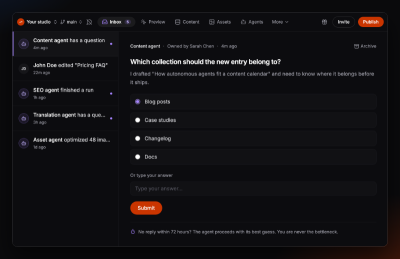
Modern autonomous platforms allow organizations to compose specialized agents from the ground up, tailoring their operational privileges to match internal trust levels. For example, an organization might deploy an accessibility agent with autonomous publishing rights to maintain continuous compliance, while restricting a content generation agent to a strict review-and-approval pipeline for brand-facing copy. Furthermore, these systems are designed to learn continuously from executed tasks and direct human feedback. As artificial intelligence models demonstrate consistent accuracy over time, the operational boundary naturally shifts toward reduced human intervention, reflecting earned institutional trust rather than arbitrary automation settings.
The Macroeconomic Implications of Continuous Optimization
The transition toward autonomous web maintenance carries broad implications for the digital economy. Historically, corporate websites required periodic, capital-intensive redesign projects every three to five years to combat digital decay. These cyclical overhauls frequently strained internal resources and resulted in prolonged periods where web infrastructure remained static while business models evolved.
By shifting toward continuous, agent-driven optimization, enterprises can maintain perpetual alignment between their digital presence and real-time market dynamics. Rather than functioning as static brochures that require manual intervention for every minor update, websites operate as dynamic systems capable of self-correction.
Industry analysts note that this architectural shift alters the fundamental economics of web management. Routine maintenance expenditures decrease significantly, allowing organizations to redirect capital toward strategic product development and innovative user experiences. Furthermore, continuous optimization minimizes security vulnerabilities, search engine optimization degradation, and accessibility regressions that accumulate silently over time.
Conclusion: Reframing the Purpose of Automation
The primary apprehension voiced by enterprise teams regarding autonomous web infrastructure is the fear of uncontrolled alteration. However, industry leaders argue that this perspective ignores the much greater risk posed by static, unchanging web properties. A frozen website does not preserve stability; it merely guarantees gradual obsolescence in a rapidly moving digital marketplace.
The ultimate objective of website autonomy is not to marginalize human creators or remove oversight from digital properties. Instead, the technology is designed to eliminate the relentless accumulation of technical debt and maintenance decay. By delegating rule-based administrative chores to autonomous agents, engineering and design professionals regain the capacity to concentrate their creative judgment on the few initiatives that genuinely require human vision. As artificial intelligence integration matures across the technology sector, the organizations that successfully navigate the boundary between automation and human expertise will redefine the standard for digital resilience.