Tapstitch vs. Printful: A Deep Dive into Print-on-Demand Platforms for Online Sellers

The landscape of e-commerce has been dramatically reshaped by the rise of print-on-demand (POD) services, empowering entrepreneurs to launch branded merchandise without the burden of upfront inventory. Among the leading platforms, Tapstitch and Printful stand out, each offering distinct pathways for sellers to bring their custom products to market. While both facilitate the creation and sale of on-demand goods, their strategic approaches, product offerings, and operational philosophies diverge significantly. This in-depth analysis, based on extensive research and hands-on testing, aims to provide a clear, objective comparison to guide sellers in making an informed decision.
For the vast majority of online sellers seeking a comprehensive and globally accessible POD solution, Printful emerges as the more robust and secure choice. Its extensive catalog, diverse printing capabilities, and expansive fulfillment network cater to a wide spectrum of needs. However, for businesses specifically focused on cultivating a premium streetwear or high-fashion apparel brand, Tapstitch presents a compelling, specialized alternative that warrants serious consideration.
Tapstitch vs. Printful: A Strategic Overview
At its core, the choice between Tapstitch and Printful hinges on the seller’s specific business model and target market. Printful operates as a broad-spectrum POD provider, aiming to be a one-stop shop for diverse product lines, from apparel and home decor to accessories and wall art. This expansive approach is supported by a vast array of printing technologies and an extensive global logistics network, designed to serve a wide range of e-commerce platforms and customer bases.
Tapstitch, conversely, adopts a more focused strategy. Its catalog is deliberately curated to emphasize premium apparel, particularly in the streetwear and fashion segments. The platform prioritizes garment quality, heavyweight fabrics, and oversized cuts, aiming to appeal to brands that seek to position their products as high-end fashion items rather than mass-market merchandise. This specialization allows Tapstitch to offer a depth of quality and aesthetic within its niche that Printful, by necessity of its broader scope, cannot always match.
Pricing Structures: Accessibility and Scalability
When it comes to the financial commitment required to start, both Tapstitch and Printful offer an accessible entry point. Neither platform imposes mandatory monthly subscription fees for basic access, making them attractive options for aspiring entrepreneurs with limited initial capital.
Tapstitch adheres to a straightforward pay-per-order model. Sellers are only charged for the products they sell and ship, eliminating the risk of unsold inventory and recurring platform costs. This simplicity is a significant advantage for new businesses testing the market or operating on a lean budget.
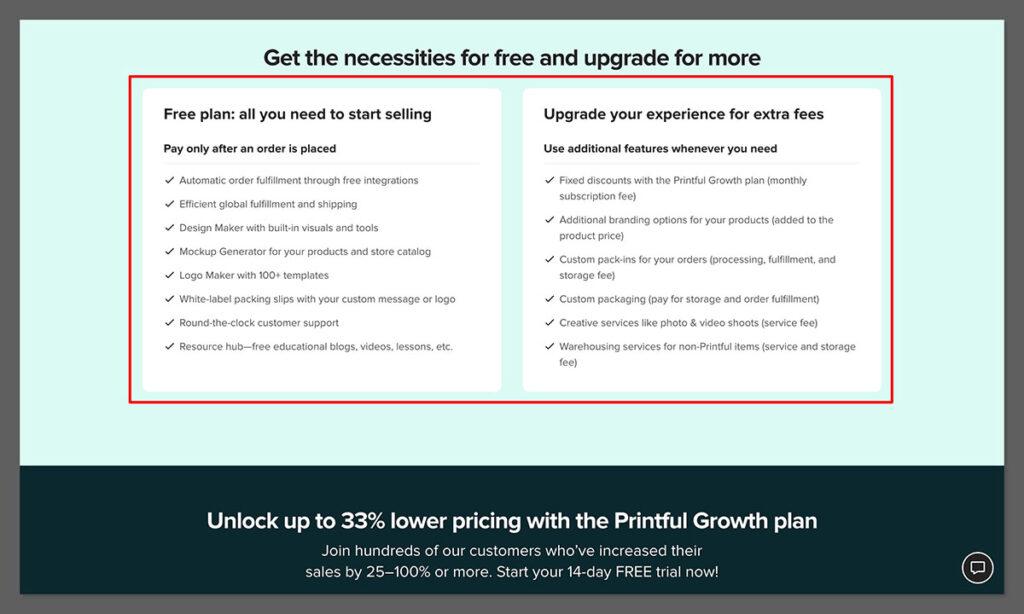
Printful also offers a free-to-start tier, mirroring Tapstitch’s accessibility. However, Printful introduces an optional "Growth" plan, priced at approximately $24.99 per month. This premium tier unlocks significant product discounts, potentially reaching up to 33%, for sellers who achieve a consistent sales volume. This tiered pricing structure highlights Printful’s strategy of rewarding scalability.
In terms of per-unit costs for comparable items, the difference is often negligible at lower volumes. For instance, a standard branded t-shirt with shipping within the United States typically costs around $22.95 through Tapstitch and approximately $21.73 through Printful. While this initial gap is minimal, it can widen considerably when Printful’s Growth plan discounts are factored in for higher order volumes. For small-scale operations or those just beginning their e-commerce journey, the pricing is effectively a tie. However, for businesses anticipating substantial sales, Printful’s paid plan offers a clear financial incentive to optimize costs through increased volume.
Pricing at a Glance:
| Dimension | Tapstitch | Printful |
|---|---|---|
| Base Platform Fee | $0 – Pay per order only | $0 to start; Optional Growth plan ~$24.99/mo |
| Typical Tee + US Shipping | ~$22.95 | ~$21.73 |
| Volume Discounts | None | Up to ~33% off on paid plan |
| Free Trial | Free account, no trial needed | Free account, no trial needed |
Winner: The pricing structure is a tie for low-volume sellers due to the free entry and comparable per-unit costs. Printful gains an advantage for higher-volume sellers through its Growth plan discounts.
Product Range and Print Method Diversity
The most significant divergence between Tapstitch and Printful lies in the breadth and depth of their product catalogs and the printing techniques they employ.
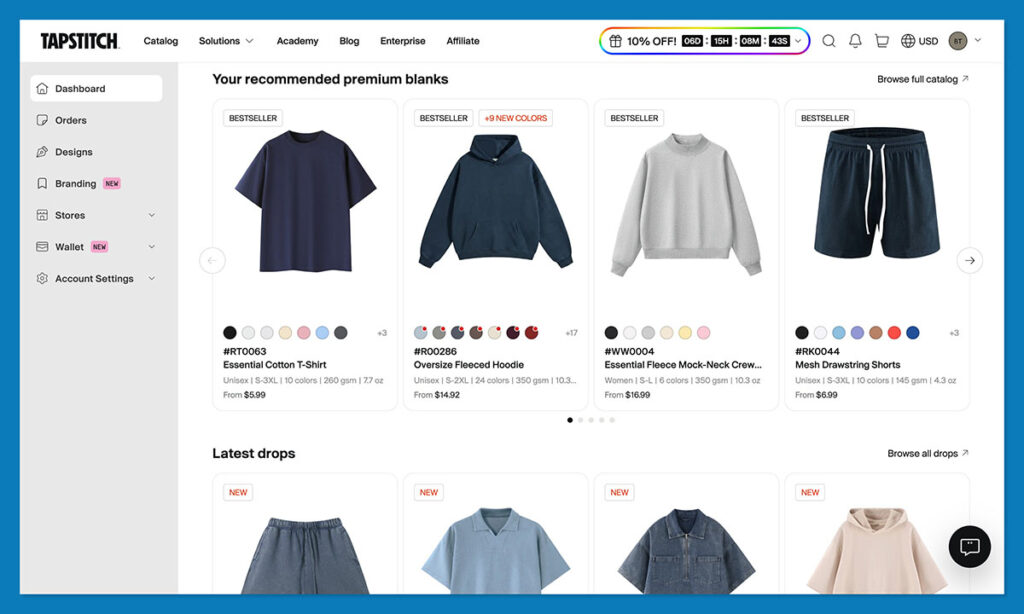
Tapstitch has deliberately cultivated a focused catalog, concentrating almost exclusively on fashion-oriented apparel. With over 400 distinct clothing blanks, the platform emphasizes heavyweight tees, high-GSM hoodies, oversized fits, and styles that align with contemporary streetwear aesthetics. This specialization means that if a seller wishes to offer complementary items like mugs, phone cases, or canvas prints, Tapstitch is not the appropriate provider.
In stark contrast, Printful boasts an expansive catalog exceeding 479 Stock Keeping Units (SKUs) that span a wide array of categories. These include apparel, home decor items, accessories, and wall art. Furthermore, Printful supports a more extensive suite of printing methods, encompassing Direct-to-Garment (DTG), embroidery, all-over sublimation, cut-and-sew, and UV printing. This comprehensive offering makes Printful an ideal choice for sellers aiming to diversify their product lines, test new market segments, or create a fully integrated brand experience under one roof.
However, within its specialized niche, Tapstitch excels in depth. Its apparel selection is meticulously chosen to meet the demands of fashion-conscious consumers, featuring substantial fabric weights and ample print areas, often including large back prints as standard. For brands whose identity is intrinsically tied to high-quality apparel, Tapstitch’s curated catalog serves as a strategic asset rather than a limitation.
Product and Print Method Comparison:
| Dimension | Tapstitch | Printful |
|---|---|---|
| Catalog Breadth | Apparel-only, ~400+ fashion-focused blanks | 479+ SKUs across apparel, home, accessories, wall art |
| Print Methods | DTG, DTF (apparel only) | DTG, embroidery, all-over sublimation, cut & sew, UV |
| Specialty Strengths | Heavyweight tees, 400 GSM hoodies, oversized fits, large print zones | All-over print products, embroidered hats, diverse merch types |
Winner: Printful decisively wins in terms of product range and print method diversity. Its extensive catalog and multiple printing technologies make it the superior choice for sellers looking to offer more than just apparel.
Print Quality and Garment Excellence
The quality of the final product is paramount for any brand, and here, Tapstitch makes a strong case for its premium positioning. The platform operates vertically integrated production facilities, distinguishing it from marketplace models that rely on numerous third-party printers. By controlling its production process, Tapstitch utilizes modern DTG and DTF printing technologies, particularly for dark fabrics.
Independent reviews and product testing suggest that Tapstitch’s garment quality surpasses that of many mass-market POD providers, especially for streetwear applications. Feedback frequently highlights robust white ink coverage, commendable wash performance, and fabric weights that convey a sense of premium quality rather than generic mass production.
Printful, while renowned for its consistency and reliability at scale—a significant achievement given its vast operational footprint—has occasionally faced user community feedback regarding print placement variance. Reports suggest potential deviations of 0.5 to 1 inch, which can be noticeable on larger graphic prints and may lead to off-center designs. For fashion brands where precision in design placement is critical, this is a factor worth careful consideration.
It is important to acknowledge that Tapstitch, being a relatively newer entrant compared to Printful, has a more limited volume of third-party reviews. However, the existing feedback strongly favors Tapstitch for brands prioritizing apparel excellence.
Quality and Fulfillment Details:
| Dimension | Tapstitch | Printful |
|---|---|---|
| Production Model | In-house, vertically integrated facilities | Own and partner facilities across multiple regions |
| Locations | Los Angeles (US) and Guangzhou (China) | 12+ fulfillment centers in North America, EU, and beyond |
| Typical Production Time | ~2–4 business days | ~2–5 business days depending on product and region |
| Quality Notes | Heavy fabrics, strong color output, solid wash performance | Consistent at scale; some reports of print placement variance |
Winner: Tapstitch earns the win for garment quality, particularly for apparel. Its vertically integrated production and focus on premium blanks provide a distinct advantage for fashion-centric sellers where the tactile experience and finish of the product are key selling points.
Global Reach and Fulfillment Efficiency
For businesses with an international customer base, Printful holds a significant structural advantage. The company operates over a dozen fulfillment centers strategically located across North America, Europe, and other global regions. This distributed network enables orders to be produced closer to the end customer, thereby reducing shipping times, lowering costs, and minimizing potential customs delays and complexities.
Tapstitch currently fulfills orders from two primary locations: Los Angeles in the United States and Guangzhou in China. While this setup can be efficient for U.S.-centric brands and international orders routed through its China facility, it offers fewer routing options and less logistical flexibility compared to Printful’s expansive network. For sellers targeting markets within Europe, Printful’s localized production capabilities represent a substantial benefit, offering faster and more predictable delivery timelines.
Winner: Printful leads in global fulfillment. Its network of over 12 facilities provides superior speed, cost-effectiveness, and reach for international shipping compared to Tapstitch’s two-location model.
Integrations, Tools, and Branding Capabilities
The seamless integration of a POD platform with an e-commerce storefront is crucial for operational efficiency. Tapstitch supports integrations with popular platforms such as Shopify, Etsy, and Wix. These three platforms cover the essential needs of many new clothing brands launching their online presence.
However, for sellers aiming for a broader multi-channel strategy, Printful offers a considerably more extensive integration ecosystem. It connects with over 21 e-commerce platforms and marketplaces, including giants like Amazon, eBay, and TikTok Shop. Furthermore, Printful provides an API for developers who wish to create custom integrations, offering unparalleled flexibility.
Beyond direct platform integrations, Printful also offers a more developed suite of supporting tools. These include AI-assisted design features, a sophisticated mockup generator, product templates, bulk ordering capabilities, and "Quick Stores"—a feature designed for sellers to quickly launch a basic storefront.
Tapstitch provides a capable built-in design tool that includes 3D apparel mockups, which is well-suited for building a fashion-focused catalog. Notably, it supports custom neck labels (available at a per-unit fee), a feature that significantly enhances the premium perception of clothing brands by moving away from generic POD branding. However, in terms of sheer platform breadth, automation capabilities, and the overall sophistication of its toolset, Printful maintains a clear lead.
Platform Capabilities Compared:
| Dimension | Tapstitch | Printful |
|---|---|---|
| Integrations | Shopify, Etsy, Wix | 21+ platforms including Amazon, eBay, TikTok Shop, plus API |
| Design Tools | Built-in designer with 3D apparel mockups | Full mockup generator, AI design tools, product templates |
| Branding | Custom neck labels (paid), brand-forward packaging | Inside labels, pack-ins, branded packing slips |
| Scale Tools | Curated catalog focus, fewer automation features | Bulk tools, automation, warehousing, sample discounts |
Winner: Printful wins on integrations and tooling. Its extensive platform connections and more mature design and automation ecosystem position it as the preferred choice for sellers aiming for multi-channel growth and advanced operational capabilities.
Strategic Decision-Making: When to Choose Which Platform
The decision between Tapstitch and Printful is best framed by aligning platform strengths with specific business objectives.
When to Choose Tapstitch Over Printful:
Tapstitch is particularly well-suited for a distinct segment of online sellers. If the primary objective is to build a dedicated clothing brand, rather than a general merchandise store, Tapstitch’s emphasis on premium blanks, fashion-forward cuts, and superior garment quality is difficult to replicate with Printful’s more generalized approach. The heavyweight fabrics, generous print areas, and streetwear-ready aesthetics are specifically engineered for fashion drops and curated apparel lines.
Furthermore, Tapstitch is a strong contender for brands whose primary customer base is located within the United States. Its Los Angeles-based fulfillment can ensure rapid domestic delivery without the logistical complexities inherent in multi-region fulfillment networks. For brands that aspire to present themselves as authentic clothing labels, Tapstitch’s options for custom neck labels and its generally brand-forward presentation contribute significantly to closing the perceived gap between a POD product and a premium fashion item.
However, opting for Tapstitch involves trade-offs. Sellers will find fewer platform integrations, a lack of volume-based discounts, a more limited range of non-apparel products, and a smaller pool of third-party reviews. This means that choosing Tapstitch is, in essence, a strategic bet on a specialized, emerging platform for a specific market niche.
When Printful Still Wins:
Printful remains the superior choice for the majority of sellers across most scenarios. Its extensive product catalog is a significant advantage for those looking to offer a diverse range of items. Whether the aim is to sell embroidered hats, all-over print hoodies, mugs, posters, or phone cases alongside t-shirts, Printful provides a comprehensive solution under a single provider. This eliminates the need to manage multiple POD partners, simplifying operations.
Printful also holds a clear advantage for international sellers. Customers in key markets like Germany, the UK, or Australia will likely experience faster and more cost-effective deliveries when orders are fulfilled from Printful’s local facilities compared to Tapstitch’s U.S. or China hubs. For sellers leveraging marketplaces such as Amazon, TikTok Shop, or eBay, Printful’s extensive integrations are not just beneficial but often essential for seamless operation. Tapstitch currently does not offer direct integrations with these major platforms.
Finally, for businesses experiencing significant growth, Printful’s Growth plan and its tiered discount structure offer a tangible cost advantage that Tapstitch’s flat pricing model cannot match. As order volumes increase, the savings realized through Printful’s discounts can become substantial.
Testing Methodology and Expert Evaluation
The comparative analysis presented here is derived from extensive hands-on testing of both platforms, a thorough review of independent user feedback and community discussions, and an analysis of third-party comparison data. The evaluation prioritized key factors crucial to print-on-demand sellers:
- Product Range and Quality: Assessing the variety of available products and the perceived quality of the blanks and prints.
- Print Methods: Examining the diversity of printing techniques offered and their suitability for different product types.
- Pricing and Value: Evaluating the cost structures, including base fees, per-unit costs, and potential for discounts.
- Integrations and E-commerce Compatibility: Determining the ease of connecting with popular online storefronts and marketplaces.
- Fulfillment and Shipping: Analyzing production times, shipping costs, delivery speeds, and global reach.
- Branding and Customization: Assessing options for private labeling, custom packaging, and overall brand presentation.
- User Experience and Support: Evaluating the intuitiveness of the platform interface and the quality of customer support.
Tapstitch vs. Printful: The Concluding Verdict
For the broad spectrum of online sellers, Printful stands out as the superior platform. Its comprehensive product catalog, diverse printing capabilities, extensive network of over 21 integrations, and robust global fulfillment infrastructure make it the most versatile and scalable choice for the majority of use cases. Whether a seller operates on Shopify, Amazon, or TikTok Shop, or needs to reach customers across Europe, Printful is engineered to meet these demands effectively.
However, Tapstitch earns a clear and strong recommendation for fashion-first clothing brands. If a business’s core identity and strategy revolve around premium t-shirts and hoodies, Tapstitch’s superior garment quality, expansive print areas, and streetwear-optimized blanks offer a distinct advantage that Printful’s more generalized offerings do not quite match. The minimal cost difference at low volumes, coupled with the potential for significant quality enhancement, makes Tapstitch a compelling option for brands where the product itself is the primary differentiator.
Ultimately, the optimal platform choice depends on individual business needs and aspirations. Both Tapstitch and Printful offer free entry points, allowing entrepreneurs to order samples and conduct direct comparisons before making a long-term commitment. This hands-on approach is invaluable for discerning which platform best aligns with a brand’s vision and operational requirements.
Frequently Asked Questions
Is Tapstitch better than Printful for clothing brands?
For premium streetwear and fashion-focused brands, Tapstitch’s heavyweight blanks, large print areas, and apparel-only focus can make it a stronger choice than Printful on garment quality alone. However, Printful’s broader integrations and global fulfillment still make it the safer default for most sellers.
Does Tapstitch integrate with Shopify?
Yes. Tapstitch integrates with Shopify, Etsy, and Wix. For sellers who need connections to additional platforms like WooCommerce, Amazon, or TikTok Shop, Printful offers more extensive options with 21+ supported channels.
Is Printful free to use?
Printful is free to start with no mandatory monthly fee. Its optional Growth plan, priced at around $24.99 per month, unlocks volume discounts of up to 33% on products, which can make it worthwhile for sellers moving consistent order volumes.
How does Tapstitch’s pricing compare to Printful?
Both platforms are close in per-unit cost. A comparable branded tee with US shipping runs around $22.95 on Tapstitch and $21.73 on Printful. The gap widens in Printful’s favor at higher volumes, thanks to its Growth plan discounts, which Tapstitch doesn’t offer.
Does Tapstitch ship internationally?
Tapstitch ships internationally from its US and China facilities, but its fulfillment network is more limited than Printful’s. For sellers with a significant international customer base, Printful’s 12+ global facilities provide faster and more cost-effective delivery across more regions.
Which platform is better for beginners?
Printful is generally the better starting point for beginners, given its broader product catalog, more platform integrations, and larger support community. Tapstitch suits beginners who already know they want to build a focused apparel brand rather than a general merchandise store.