State of Supply Chain Sustainability Report finds corporate commitment at record high, but governance lags behind

When corporate leaders gather in boardrooms to map out their long-term enterprise strategies, the prevailing consensus remains firm: despite fluctuating market conditions, intensifying regulatory shifts, and competing financial priorities, corporate sustainability continues to matter. In fact, it matters more than ever.
According to the newly released 2026 State of Supply Chain Sustainability Report published by the Massachusetts Institute of Technology (MIT) Sustainable Supply Chain Lab, corporate conviction regarding environmental stewardship has reached a historical high point. Based on a comprehensive global survey of 1,810 supply chain professionals operating across 91 countries, an impressive 83 percent of respondents now rate sustainability as either important or very important to the long-term success of their businesses. This figure marks the highest level of perceived importance recorded in the seven-year history of the research initiative, signaling a fundamental cultural shift in how modern enterprises view ecological responsibility.
Yet, a profound paradox sits at the heart of the modern corporate landscape: institutional commitment does not automatically translate into operational capacity. While 59 percent of survey participants report that their internal commitment to sustainability actually intensified following recent U.S. policy shifts that deprioritized environmental protections, these very same organizations are simultaneously being forced to compromise those goals due to unforeseen macroeconomic and geopolitical volatility.
The data illustrates a supply chain sustainability agenda caught precariously between deep conviction and severe operational constraints. Sixty-eight percent of organizations surveyed report that tariff uncertainty has directly compelled them to delay, scale back, or completely abandon vital sustainability strategies. Furthermore, nearly one-third of respondents note that tariff-related disruptions have paradoxically resulted in an increase in their operational emissions, as supply chains are abruptly rerouted through less efficient channels to bypass trade barriers.
"Commitment is strong, measurement is expanding, and AI is accelerating," observes Sreedevi Rajagopalan, director of the MIT Sustainable Supply Chain Lab and lead author of the report. "What comes next is harder: converting commitment into accountability, operational integration into strategic decision-making, and incremental decarbonization into genuine transition."
Chronology and Background of Supply Chain Sustainability
To understand the current friction points documented in the 2026 report, it is necessary to examine the evolution of corporate supply chain management over the past decade. Following the Paris Agreement in 2015 and the subsequent intensification of extreme weather events attributed to global climate change, major multinational corporations began moving away from purely compliance-driven environmental policies. By the late 2010s, sustainability transformed from a public relations initiative into a core metric of risk management.
However, the COVID-19 pandemic exposed the fragility of global trade networks, introducing severe shocks to supply chains worldwide. Between 2020 and 2022, corporate priorities temporarily shifted toward basic operational survival, inventory buffering, and logistics continuity. As pandemic-era restrictions eased, companies attempted to realign their operations with ambitious "Net-Zero" targets, often pledging to eliminate emissions entirely by 2030 or 2050.
Yet, the subsequent years brought a fresh wave of disruptions: escalating trade protectionism, the resurgence of aggressive tariff policies, and major geopolitical conflicts in Eastern Europe and the Middle East. Supply chain networks that were meticulously optimized for low cost, Just-In-Time (JIT) delivery, and stable geopolitical borders suddenly found themselves navigating a fractured global economy. The MIT report captures this exact historical inflection point—a moment where corporate ambition meets the harsh reality of an unstable international order.
Geopolitical Realities and Internal Vulnerabilities
Beyond the immediate friction of trade tariffs, the MIT report underscores the corrosive impact of broader geopolitical instability on corporate climate action. More than eight in ten respondents across North America, Europe, and Asia agree that ongoing geopolitical conflicts are directly reducing the overall effectiveness of their organization’s climate action plans.
Historically, corporate decarbonization roadmaps were constructed on foundational assumptions of stable international trade, predictable regulatory environments, and relative global peace. With none of these assumptions holding true in the current macroeconomic climate, companies are finding that external disruptions quickly expose deep internal vulnerabilities.
A striking example of this internal vulnerability lies within corporate governance structures. Among companies that have established publicly stated sustainability goals, a mere 51 percent have formed a formal cross-functional sustainability team. This specific governance structure is identified by researchers as the single most critical factor associated with successfully embedding sustainability into daily corporate decisions. Furthermore, only 33 percent of surveyed organizations place sustainability oversight at the board level.
This governance deficit reveals that public ambition is vastly outrunning internal accountability infrastructure. The data demonstrates a massive return on governance investment: companies that maintain formal cross-functional teams report that sustainability is "frequently or always" integrated into business decisions 57 percent of the time. Conversely, where responsibility is siloed within a single standalone department, that integration rate plummets to just 13 percent—a staggering 44-point performance gap.
Where Sustainability Takes Root—and Where It Lags
An analysis of operational functions reveals that sustainability is embedding most deeply in areas where companies make immediate, tactical daily choices. Decarbonization efforts are most prevalent in:
- Transportation and logistics: 39 percent
- Procurement: 35 percent
- Warehousing: 34 percent
- Product design: 33 percent
However, these efforts thin out dramatically when organizations shift toward strategic decisions that lock in long-term emissions profiles. Capital investments, long-term network designs, and comprehensive supply chain risk planning frequently lack rigorous environmental oversight. This discrepancy indicates that while modern enterprises are becoming progressively adept at operating more sustainably on a day-to-day basis, they continue to struggle with designing inherently sustainable supply chains for the decades ahead.
The Artificial Intelligence Paradox
Artificial intelligence (AI) has frequently been heralded as the ultimate silver bullet for corporate sustainability, offering advanced capabilities to model emissions, optimize routes, and reduce waste. The MIT report confirms that AI adoption is widespread, particularly in North America, where 78 percent of organizations report using AI in their sustainability initiatives, and 87 percent of those adopters cite a positive overall impact.
Among these organizations, 86 percent have successfully reduced material waste, 81 percent have curtailed energy usage, and 63 percent utilize AI tools to estimate missing or opaque supplier emissions data.
Despite these operational victories, a complex paradox emerges when examining mature, agentic AI users. Among this group, only 53 percent report an actual reduction in total greenhouse gas emissions. Compounding this concern, 29 percent of advanced AI users actually report an increase in total emissions. This finding suggests that maximizing operational efficiency does not automatically translate into lower net environmental impact.
This tension is acutely visible within modern warehousing environments. Among advanced and fully automated warehouses leveraging AI, 78 percent report higher overall energy consumption since implementing the technology, and 76 percent report higher waste generation. Crucially, only 24 percent of these facilities employ AI-driven real-time monitoring to systematically track these environmental consequences. Consequently, many organizations remain entirely unaware that their facility-level energy footprints are climbing until long after the technological implementation is complete.
Freight Transportation and Regional Regulatory Divides
Freight transportation represents another critical battlefield for corporate emissions reduction. Nearly every freight company surveyed is actively working to lower emissions through advanced route optimization, load consolidation, and targeted driver-behavior training programs.
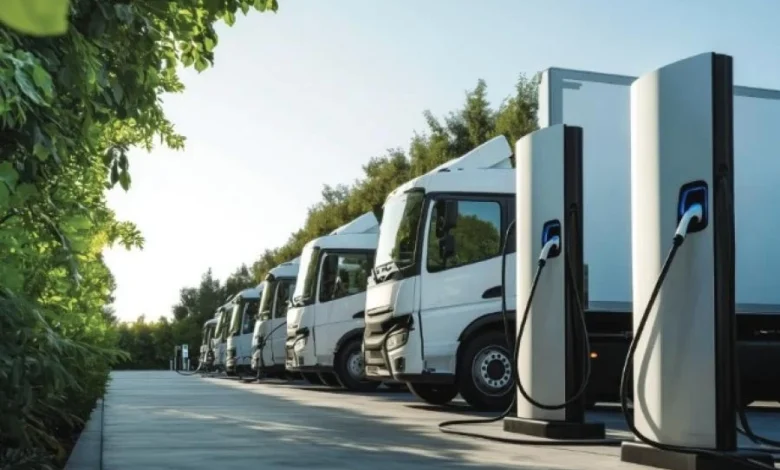
Nevertheless, heavy reliance on legacy fossil fuels remains a massive hurdle. Across the industry, 43 percent of logistics fleets still operate mostly or entirely on conventional diesel fuel, while a mere 8 percent have completed a full transition to low-emission energy sources.
A stark divergence between geographic regions helps explain why this transition is lagging in certain markets. In Europe, 84 percent of freight companies report that recent policy changes have positively influenced and accelerated their decarbonization strategies. In contrast, only 44 percent of North American companies report the same positive policy impact.
When government policy signals are unclear, volatile, or contradictory, capital-intensive technology transitions inevitably stall. This regulatory disparity is clearly reflected in vehicle adoption rates: battery-electric commercial vehicles are operational at scale within 60 percent of European companies, compared to just 36 percent of their North American counterparts.
A Bright Spot in Scope 3 Collaboration
Amidst the myriad challenges detailed in the report, a significant bright spot has emerged regarding Scope 3—or indirect upstream and downstream—emissions. Historically viewed as an intractable accounting nightmare due to the sheer complexity of extended supply chains, collaboration among enterprises has surged dramatically.
Participation in joint supplier engagement and decarbonization programs nearly doubled in a single year, climbing from 31 percent to 58 percent. Furthermore, collaborative partnerships established specifically to manage shared suppliers’ emissions jumped from 23 percent to 55 percent. Most encouragingly, the share of companies attempting to tackle Scope 3 emissions entirely alone collapsed from 18 percent to 6 percent.
This collaborative shift—supported by organizations such as the C.H. Robinson Foundation, Breakthrough, CO2 AI, and Dassault Systèmes—indicates a maturing corporate mindset: companies now widely recognize that Scope 3 emissions cannot be successfully resolved in isolation.
Implications for the Future of Global Enterprise
The 2026 State of Supply Chain Sustainability Report delivers a clear, sobering message to the global business community. The primary barrier to achieving meaningful environmental sustainability is no longer a lack of corporate commitment or ethical desire. Rather, the current obstacles lie firmly within governance frameworks, internal accountability structures, technology infrastructure, and measurement capabilities.
Organizations that successfully close the external gap by building robust resilience against geopolitical and trade disruptions—while simultaneously closing the internal gap by hard-wiring accountability directly into their organizational design—will be the ones whose sustainability commitments ultimately survive. Those that fail to bridge this divide will discover a harsh reality: corporate ambition without structural accountability moves the global needle very little.