The Shift Toward Bespoke Validation
The current state of LLM deployment is characterized by a transition from experimental prototyping to rigorous, production-grade software engineering. In traditional software development, test harnesses—scaffolding that feeds controlled inputs into a system and validates outputs against a predefined baseline—are foundational. For LLMs, this paradigm is now becoming the gold standard for quality assurance. A custom evaluation harness serves as a diagnostic tool that tracks performance metrics such as accuracy, latency, token consumption, and safety compliance over time. By building this system from the ground up, engineers gain granular control over the testing lifecycle, avoiding the "black box" nature of off-the-shelf automated testing suites.
Architectural Foundation and Prerequisites
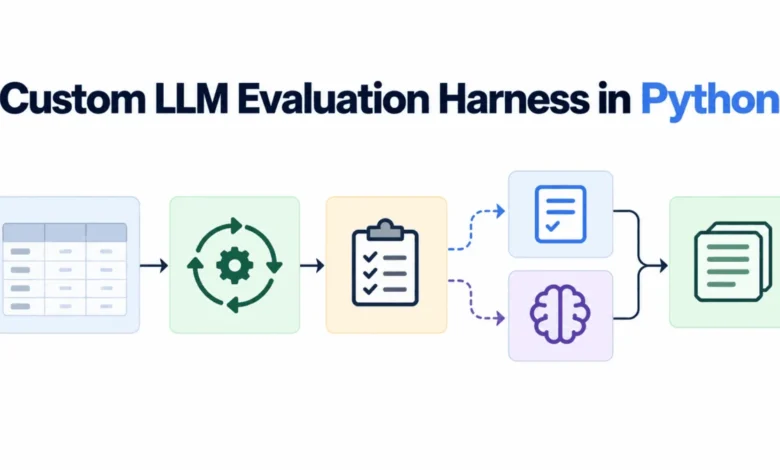
To construct a robust evaluation harness, developers must prioritize modularity. The architecture recommended for this implementation rests on four primary pillars: a curated golden dataset, an asynchronous inference runner, a flexible judge layer, and a structured logging mechanism.
Technologically, the implementation requires Python 3.10 or later. The selection of Python is driven by its native asyncio library, which is critical for scaling evaluation runs. Without concurrency, processing hundreds of test cases sequentially would lead to prohibitively long execution times. For dependencies, the industry has gravitated toward LiteLLM and Pydantic. LiteLLM offers a unified API interface, allowing developers to switch between model providers—such as OpenAI, Anthropic, or local open-weights models like Llama 3—by merely updating a configuration string. Pydantic ensures that the results returned by the judge layer conform to strict, typed schemas, preventing the common failure mode where a model returns unstructured conversational filler instead of a machine-readable score.
Curating the Golden Dataset
The integrity of any evaluation is inherently tied to the quality of the "Golden Dataset." Industry best practices dictate that this collection should consist of 20 to 50 high-fidelity test cases derived from real-world user logs. Synthetic data generation, while convenient, often fails to account for the "long tail" of user behavior—the messy, ambiguous, or edge-case inputs that frequently cause models to hallucinate or violate safety policies.
Each entry in the golden dataset must include a unique identifier for longitudinal tracking, the input prompt, and an expected_concept field that serves as the ground truth. By moving beyond binary "correct/incorrect" labels and utilizing specific concepts, developers can categorize performance metrics by intent—such as identifying whether a model successfully refused a malicious prompt or accurately summarized a technical document.
The Mechanics of the Inference Runner
The inference runner acts as the transport layer of the harness. By utilizing asynchronous programming patterns, the runner can initiate multiple API calls concurrently. In a production setting, settings such as num_retries and timeout are non-negotiable. Research into LLM reliability suggests that network jitter and transient model failures are common; therefore, a robust runner must incorporate exponential backoff and retry logic to ensure that an evaluation run is not invalidated by a momentary connection drop. By isolating the inference step from the scoring step, developers preserve the ability to re-score raw model outputs against new criteria in the future without incurring the redundant costs of re-executing API calls.
Implementing the Judge Layer
The most critical component of the harness is the judge, which evaluates the model’s output. The industry currently balances two primary methodologies: deterministic evaluation and LLM-as-a-judge.
Deterministic judges are the preferred method for high-speed, low-cost verification. This approach relies on string matching, regex patterns, or structural validation to determine if a response contains required elements. For example, if a model is expected to provide a JSON output, a deterministic judge can instantly verify the format.
Conversely, the LLM-as-a-judge paradigm is employed for semantic evaluation. In this setup, a more powerful model (often GPT-4 or a similarly capable model) acts as an evaluator for a target model. The judge is provided with the original input, the target response, and a clear rubric. By utilizing Pydantic to enforce a schema on the judge’s response, the system ensures that the evaluation is delivered as a JSON object containing a boolean "passed" status and a qualitative "reason" string. This layer allows for the assessment of nuance—such as tone, empathy, or reasoning depth—that simple string matching cannot capture.
Logging and Data Persistence
Data persistence is the final, essential step in the workflow. Using a line-delimited JSON (.jsonl) format is standard practice, as it provides a crash-safe way to accumulate results. Because each line is a standalone JSON object, the system can write results to disk incrementally. If a long-running evaluation is interrupted, the progress up to that point remains preserved.
Furthermore, this data serves as the foundation for post-hoc analysis. By aggregating these logs, engineering teams can calculate pass rates, analyze drift in model performance across versions, and visualize the impact of prompt engineering changes. The separation of the "raw output" from the "score" in these logs is a key design choice that enables iterative development; as grading rubrics evolve to become more precise, developers can re-process historical logs without repeating the inference phase, significantly reducing operational expenditure.
Implications for Production AI
The transition toward custom evaluation harnesses reflects the broader maturation of the artificial intelligence sector. As organizations move beyond proof-of-concept deployments, the requirement for verifiable, repeatable, and scalable quality assurance has become a strategic priority.
The implications of failing to implement such systems are significant. Without a dedicated harness, regressions in model performance—often introduced by minor prompt adjustments or underlying model updates—can go undetected until they impact end-users. Conversely, by adopting a modular, code-first approach to evaluation, teams can integrate these tests into their Continuous Integration/Continuous Deployment (CI/CD) pipelines. This ensures that every deployment is measured against the golden dataset, maintaining a consistent performance baseline.
Furthermore, the data generated by these harnesses provides the necessary evidence for compliance and governance. In regulated industries such as finance and healthcare, the ability to demonstrate exactly how a model was tested, what criteria it was held to, and how it performed over time is vital for meeting transparency standards.
Conclusion and Future Trajectory
The architecture outlined—comprising a golden dataset, an asynchronous runner, a dual-method judge layer, and JSONL logging—provides a scalable foundation for LLM quality assurance. This framework is designed to evolve; as requirements grow, teams can easily extend the system by adding latency monitoring, cost-tracking fields, or more sophisticated evaluation metrics such as RAG-specific retrieval accuracy. By treating LLM evaluation as a first-class engineering problem rather than an afterthought, developers can build systems that are not only performant but also resilient to the inherent unpredictability of generative AI. The shift from "testing by observation" to "testing by design" is arguably the most important trend in the current AI landscape, separating transient experiments from reliable, long-term enterprise applications.