PressMeGPT Revolutionizes WordPress Development by Bridging the Gap Between AI-Generated Frontends and Production-Ready Themes

In an era defined by rapid digital transformation and the burgeoning influence of artificial intelligence, a significant challenge has emerged within web development: the efficient transition of visually appealing, often AI-generated or no-code designs, into robust, manageable, and scalable content management systems. Historically, the journey from an aesthetically pleasing frontend built on platforms like Lovable, Bolt.new, or Base44, or even a client-provided self-made site, to a fully functional WordPress installation capable of publishing blog posts, installing plugins, and managing extensive content, has been fraught with manual effort. This often necessitated a complete, time-consuming rebuild of the site within the WordPress ecosystem, a process devoid of a clean, automated pipeline from an AI-generated design to a native WordPress theme.
The Evolving Landscape of Web Design and the WordPress Imperative
The digital landscape has undergone a profound evolution over the past decade. Early web development relied heavily on manual coding, demanding specialized skills in HTML, CSS, and JavaScript. This was gradually streamlined by the advent of visual page builders like Elementor, Beaver Builder, and the native WordPress Block Editor (Gutenberg), which democratized website creation, allowing individuals and small businesses to craft professional-looking sites with reduced reliance on deep coding knowledge. This trend further accelerated with the rise of no-code and low-code platforms, promising even faster deployment of web presences.
The latest frontier is AI-driven web design, where platforms leverage artificial intelligence to generate layouts, content, and even full website structures based on simple prompts or existing assets. These tools excel at speed and initial visual appeal, offering an incredibly fast path from concept to a presentable online presence. However, this rapid prototyping often comes with a critical caveat: platform lock-in. Many AI-generated sites reside on proprietary platforms, limiting user control over hosting, data, and the ability to integrate advanced functionalities crucial for long-term growth. Furthermore, while visually stunning, these initial designs frequently lack the robust content management capabilities, SEO-friendliness, and extensibility offered by a mature CMS.
This is where WordPress, the undisputed leader in content management systems, enters the equation. Powering over 43% of all websites on the internet, WordPress offers unparalleled flexibility, a vast ecosystem of plugins (over 60,000 available), themes, and a global community. Its open-source nature ensures true ownership and control, making it the preferred destination for any serious website aiming for scalability, comprehensive SEO, and advanced functionalities like e-commerce, membership sites, or complex blogging. The disconnect, however, has been the laborious, manual process of migrating an existing design – especially one generated by AI – into a native WordPress theme or an Elementor template. This gap often resulted in agencies, freelancers, and businesses spending countless hours on reconstruction rather than refinement.

PressMeGPT: Bridging the Conversion Chasm
Addressing this critical industry gap, PressMeGPT emerges as a pivotal innovation. This platform is specifically engineered to automate the conversion of existing websites, AI-generated projects, or even plain text prompts into production-ready WordPress themes or Elementor templates. The core proposition is groundbreaking: it offers a clean, automated path where none previously existed, empowering users with full ownership of the generated output, which can be hosted on any platform of their choosing.
PressMeGPT claims to complete this complex conversion process in mere minutes, delivering approximately 80% of a finished design. This efficiency allows developers, agencies, and individual creators to redirect their valuable time from the tedious task of reconstruction to the more impactful work of refinement, customization, and strategic content integration. The platform’s ability to interpret diverse inputs positions it as a versatile tool for a broad spectrum of web development scenarios.
Versatile Inputs for Comprehensive Conversion
The strength of PressMeGPT lies in its expansive range of accepted inputs, making it adaptable to various starting points in the design process. Users can initiate a conversion from:
- Existing Website URLs: By simply providing the URL of an existing website, PressMeGPT can analyze its structure and design elements to generate a WordPress theme. This is invaluable for migrations from proprietary builders or static sites.
- Plain Text Prompts: Leveraging the power of AI, users can describe their desired website layout, style, and content structure in natural language, and PressMeGPT will interpret these prompts to generate a visual design.
- HTML/CSS Code: For developers or designers who have raw code snippets or entire HTML/CSS templates, the platform can ingest this code and translate it into a WordPress-compatible format.
- Screenshots or Image Files: The ability to convert visual representations of a website into functional code is a testament to the AI’s sophistication, offering a pathway for designs that may not exist in a live format.
Furthermore, PressMeGPT has ambitious plans for future integrations, with Canva and Figma support "coming soon" across all its plans. This roadmap promises to extend its utility to an even wider audience of designers and content creators, allowing them to convert their design mockups directly into functional WordPress assets, further streamlining the workflow from design conception to deployment.

Regardless of the input method, each generation process yields three distinct design variations. This provides users with options and a foundation to choose from, which can then be refined using their preferred builder, whether it’s the native WordPress Block Editor or Elementor. This crucial feature differentiates PressMeGPT from many prompt-only AI website builders that focus solely on generating new designs from scratch, positioning it as a powerful tool for existing site migrations and accelerating the development lifecycle.
The Technical Advantage: Native WordPress Themes and Elementor Integration
PressMeGPT’s output is not merely a static page or a proprietary format; it’s a genuine WordPress theme or Elementor template. This commitment to native output is a significant differentiator. For WordPress themes, PressMeGPT generates proper block themes, which are fully compatible with the native Full Site Editor (FSE). This means users gain access to editable header and footer template parts directly within WordPress, offering granular control over the site’s structure without needing to delve into complex code. Many other AI tools often produce only individual blocks or sections, leaving users to manually assemble the fundamental site structure.
The platform’s FAQ explicitly states that generated themes adhere to modern block theme standards and are designed to function optimally without requiring additional plugins or subscriptions for their core functionality. This approach has profound implications for site performance, security, and long-term maintainability. By minimizing reliance on third-party plugins, PressMeGPT themes are inherently less prone to conflicts, typically load faster, and present a smaller attack surface for potential security vulnerabilities – a critical consideration given that plugins are frequently the source of security issues in WordPress.
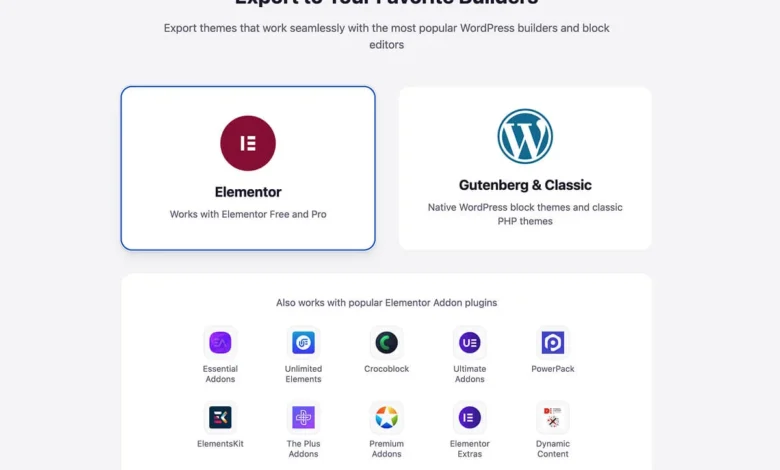
For teams and freelancers already entrenched in the Elementor ecosystem, PressMeGPT offers a seamless integration path. The platform can export designs as Elementor templates, which can be directly imported into a familiar Elementor workflow. Crucially, these templates are compatible with Elementor’s free version, eliminating the need for a Pro license to utilize the output. This accessibility ensures that even smaller teams or individual freelancers can leverage PressMeGPT without incurring additional builder costs. The only distinction is that Elementor export functionality is available starting from the Freelance plan, while the entry-level Creator plan focuses on Gutenberg and classic theme exports. PressMeGPT also supports popular Elementor add-ons such as Essential Addons, Unlimited Elements, and Kadence Blocks, ensuring broad compatibility within the Elementor community.
Workflow in Practice: A Streamlined Path from Concept to Customization

The practical workflow with PressMeGPT is designed for efficiency, typically unfolding in three main steps:
- Input: The user provides their chosen input, whether it’s a website URL, a text prompt, HTML/CSS code, or an image. This initiates the AI analysis and generation process.
- Generate: PressMeGPT’s AI engine processes the input, creating three distinct design variations. These variations serve as starting points, allowing the user to select the most suitable foundation for their project.
- Export and Refine: Once a design variation is chosen, it can be exported as a native WordPress block theme or an Elementor template. From this point, the user takes over, utilizing the Full Site Editor, Elementor, or the Block Editor to apply branding, add specific content, and fine-tune the remaining 20% of the design.
This structured approach significantly accelerates the initial setup phase, allowing developers and designers to focus their expertise on the nuanced aspects of a project rather than repetitive foundational work.
Target Audiences: Agencies, Freelancers, and Content Creators
PressMeGPT’s value proposition resonates strongly across several key demographics within the web development and content creation spheres:
- Agencies: For web development agencies managing multiple client projects, the ability to generate 80% of a site’s design in minutes offers monumental time savings. These saved hours compound rapidly across a client list, drastically improving project turnaround times and profitability. Furthermore, the Elementor export feature allows agencies to delegate the refinement phase to junior team members who are proficient in Elementor but may not have deep coding knowledge, optimizing team resources. This also positions agencies to take on more migration projects that were previously too labor-intensive.
- Freelancers: Independent web developers and designers face constant pressure to deliver high-quality work efficiently. PressMeGPT enables freelancers to quickly prototype and build out initial site structures, freeing them to concentrate on the custom functionalities, complex integrations, and bespoke solutions that truly differentiate their services and command higher fees. It complements other AI tools for WordPress development that are already enhancing freelancer workflows, offering a competitive edge in a crowded market.
- Bloggers and Content Creators: For individuals and small businesses looking to establish or upgrade their online presence, PressMeGPT democratizes the process of website creation. Instead of learning complex theme development, hiring expensive custom developers, or wrestling with generic off-the-shelf themes, content creators can simply describe their vision, receive a functional theme, and then customize it to their exact specifications. This lowers the barrier to entry for professional website ownership, empowering more individuals to build and manage their digital platforms effectively.
The "80% Problem": Acknowledging Limitations and Future Outlook
While PressMeGPT offers substantial benefits, it’s crucial to approach its claims with a realistic understanding of its current capabilities. The platform’s assertion of delivering "around 80% of a finished design" in minutes is a significant time-saver, but it inherently means the remaining 20% is left to human intervention. This final 20% typically encompasses the critical elements of branding, unique visual identity, specific content integration, accessibility considerations, and the subtle polish that distinguishes a generic template from a truly bespoke and engaging user experience. Users must set this expectation from the outset, understanding that PressMeGPT provides an excellent draft, not a fully autonomous, finished product.

Currently, PressMeGPT does not include built-in features for reviewing generated themes against accessibility guidelines or Core Web Vitals, which are crucial for SEO and user experience. However, a "Theme Checker" feature is planned for higher-tier plans, indicating a future commitment to addressing these aspects. Until then, users are advised to manually check the initial themes for compliance before deploying them on live sites.
A practical detail from the knowledge base worth noting is how media is handled. By default, exported themes reference images and videos via their remote paths from the original source. Localizing this media into the WordPress media library is a separate step that consumes credits and is not included in the free plan. This is a manageable task but requires awareness to avoid unexpected complications during the initial project setup.
Pricing, Credits, and Unconditional Ownership
PressMeGPT operates on a credit-based system, common among AI-powered tools. Generating a theme costs 3 credits and produces three design variations. Each AI modification typically costs at least 1 credit, and converting an existing website ranges from 2 to 3 credits. PressMeGPT estimates that a fully customized theme might utilize between 7 and 10 credits in total.
To allow users to evaluate the platform, a free plan offers 5 credits per month, sufficient for testing a single theme. However, themes generated on the free plan are public, media migration is excluded, and exports are limited to classic themes, without the advanced Elementor or Block Editor compatibility of paid plans.
Paid plans, billed annually, start at $69 per year for the Creator plan, which includes 120 credits (roughly equivalent to one completed site per month). The Freelance plan (starting from $199/year) offers more credits and unlocks Elementor exports. The Agency plan, at $399 per year, provides 1,800 credits (approximately 15 sites per month), catering to high-volume users. Monthly and one-time billing options are also available, backed by a 30-day money-back guarantee across all paid tiers.

A cornerstone of PressMeGPT’s offering is the concept of true ownership. Once a theme is exported, it belongs entirely to the user. There are no recurring per-site fees, no mandatory subscriptions, and no required plugins to keep the theme functional. This ensures that the generated themes are future-proof, allowing users complete freedom to install them on an unlimited number of sites, switch hosting providers at will, and maintain full control over their digital assets, whether for personal projects or client work. This stands in stark contrast to many proprietary builders that tie users to their ecosystem or impose ongoing licensing fees.
Conclusion: A Pragmatic Solution for Modern Web Challenges
PressMeGPT enters the market at a critical juncture, providing a much-needed bridge between the rapid design capabilities of AI and no-code platforms and the robust, scalable infrastructure of WordPress. By automating the conversion process, it effectively addresses a long-standing pain point for web developers, agencies, and content creators alike.
For those grappling with the challenge of migrating sites from AI builders or locked platforms to WordPress, PressMeGPT offers a compelling and efficient solution that warrants serious consideration and practical testing. Similarly, agencies and freelancers fielding frequent requests for website migrations or seeking to optimize their development workflows will find its time-saving capabilities invaluable. Even individual bloggers and content creators can leverage its power to generate a professional online presence without the traditional barriers of cost and technical expertise.
The availability of a free plan, offering 5 monthly credits for a test theme, provides an accessible entry point for prospective users to evaluate PressMeGPT’s output on a real project. As the web continues its rapid evolution, tools like PressMeGPT are poised to redefine development paradigms, making high-quality, manageable web presences more accessible and efficient to create than ever before.