Meta Unveils New AI-Driven Ad Ranking Enhancements That Deliver Massive Growth in Clicks, Conversions, and Creator Partnerships

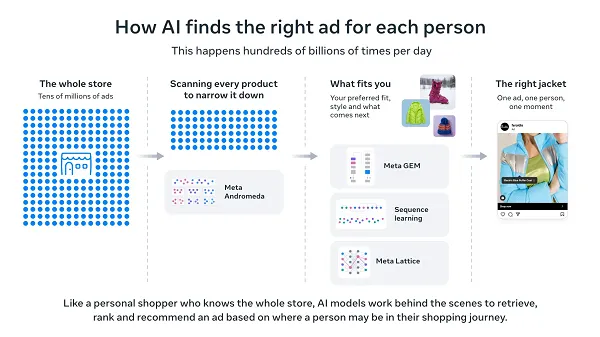
The digital advertising landscape is undergoing a profound structural transformation, driven primarily by the rapid integration of advanced artificial intelligence and machine learning architectures. Meta, the parent company of social media giants Facebook, Instagram, and WhatsApp, has released a comprehensive set of performance data illustrating how its evolving AI-powered ad delivery systems are transforming digital marketing. According to the company’s latest disclosures, these sophisticated machine learning enhancements are yielding significant improvements in audience targeting, click-through rates, and overall advertising conversions, signaling a major leap forward in automated ad optimization.
The announcement comes at a time when global enterprises and small-to-medium-sized businesses alike are demanding higher accountability and clearer return on investment from their digital marketing budgets. By refining how its algorithms evaluate user behavior, predict intent, and serve content, Meta is attempting to solidify its position as an indispensable engine for commerce. The data released by the tech conglomerate paints a picture of a digital ecosystem where predictive AI is no longer just an experimental feature, but the foundational bedrock of ad delivery.
Main Facts and Performance Metrics
The core of Meta’s recent announcement centers on the measurable business impact of its upgraded ad ranking and delivery systems. In a corporate update issued on October 28, the company detailed how algorithmic adjustments deployed throughout the year have directly translated into enhanced engagement metrics for brands operating on its platforms. Specifically, Meta revealed that improvements to its ad ranking system during the second quarter of 2026 drove an 8.3 percent increase in ad clicks and a remarkable 15.7 percent uplift in conversions on Facebook alone.
These gains are not isolated to a single surface or ad format. Meta’s expanding data analysis capacity has fundamentally accelerated its ability to assess a broader range of user actions, signals, and product catalogs simultaneously. By analyzing vast streams of audience response data at unprecedented speeds, the platform’s underlying algorithms can identify subtle behavioral trends that correlate with high-probability ad engagement. Consequently, advertisers are experiencing more precise audience matching, reducing wasted ad spend and maximizing campaign efficiency.
Complementing these algorithmic upgrades, Meta’s newly deployed AI business assistant—which is currently being rolled out globally to an expanding cohort of advertisers—has already begun demonstrating tangible economic benefits. Early implementation data indicates that the conversational business assistant is driving a 5 percent increase in conversions while maintaining the exact same cost structure for the advertiser. This efficiency boost highlights the growing value of generative and assistive AI tools in helping commercial entities streamline their customer acquisition funnels without increasing their financial outlay.
Chronology of Meta’s AI Infrastructure Push
To understand the scale and velocity of Meta’s current advertising performance gains, it is necessary to examine the multi-year trajectory of the company’s infrastructure investments. The journey toward fully AI-driven ad ranking did not happen overnight; it represents the culmination of a massive capital expenditure cycle and a strategic corporate pivot.
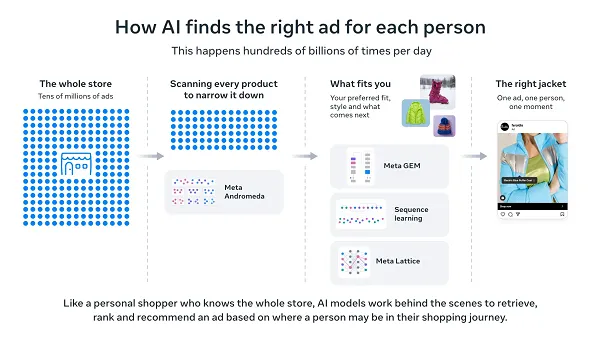
The foundation for these advancements was laid years prior, as Meta restructured its engineering priorities to prioritize deep learning frameworks over traditional heuristic-based ad delivery models. Throughout 2023 and 2024, the company gradually integrated large language models and advanced recommendation systems into its core advertising infrastructure. This transition allowed the platform to move beyond simple demographic targeting toward a more fluid, intent-based matching process.
By 2025, Meta had accelerated its infrastructure buildout, committing unprecedented financial resources to secure the necessary hardware, specialized data centers, and high-performance computing clusters required to train next-generation models. Notably, industry reports highlighted Meta’s multi-billion-dollar commitments toward domestic U.S. AI infrastructure spending, including expansive data center projects designed specifically to handle real-time inference workloads at a global scale.
Entering 2026, these capital investments began paying measurable dividends. The optimization of Meta’s ads ranking system in the second quarter marked a turning point, where the sheer processing power of the company’s new data centers allowed for more complex multi-task learning models. These models can evaluate millions of data points per second, matching commercial intent with relevant ad inventory with astonishing precision. The ongoing rollout of the AI business assistant and the development of in-stream commerce agents in late 2026 represent the latest chapters in this continuous evolution.
Explosive Growth in Partnership Ads and Creator Economies
While algorithmic refinements within core Facebook and Instagram feeds form a crucial pillar of Meta’s strategy, the company is simultaneously capitalizing on the booming creator economy through partnership ads. These collaborative advertising formats, which enable brands to run campaigns alongside verified creators, influencers, and publishing partners, have emerged as one of the fastest-growing segments of Meta’s digital portfolio.
According to data released by the company, partnership ads experienced a staggering year-over-year growth rate exceeding 97 percent during the third quarter. More impressively, this explosive expansion has propelled the product category past a monumental milestone: a $15 billion annual revenue run-rate.
This surge underscores a fundamental shift in consumer psychology. Modern audiences, particularly younger demographics, frequently place higher levels of trust in individual creators and independent voices than in traditional corporate brand messaging. By fusing the authentic reach of creators with the sophisticated targeting capabilities of Meta’s AI ad engine, brands are able to bypass ad fatigue and achieve significantly higher conversion rates. Meta’s systems seamlessly optimize these partnership ads, ensuring that creator-led content is delivered precisely to users whose behavioral profiles suggest a high affinity for the promoted products.
The Future of In-Stream Commerce and AI Agents
Looking ahead, Meta is preparing to bridge the gap between discovery and transaction by embedding direct checkout options within its suite of artificial intelligence agents. Among the most anticipated developments is the integration of commercial capabilities into AI interfaces like Muse.

Traditionally, social media advertising has functioned primarily as a top-of-funnel discovery mechanism, requiring users to click through an external link, navigate a mobile web browser, and complete a checkout process on a separate e-commerce site—a friction-heavy journey that often results in cart abandonment. Meta’s initiative to develop native checkout options within its conversational AI agents aims to eliminate this friction entirely. By allowing users to discover products, converse with intelligent assistants, and finalize purchases entirely within the Meta ecosystem, the company is positioning itself as a comprehensive commerce hub.
This friction-free shopping experience relies heavily on the same underlying data processing capacity that powers Meta’s ad ranking systems. As AI agents become more adept at understanding natural language queries and user preferences, they can curate personalized product recommendations and facilitate instantaneous transactions, transforming passive social media browsing into an active, streamlined shopping destination.
Broader Impact and Industry Implications
The implications of Meta’s latest performance disclosures extend far beyond the company’s quarterly financial reports, signaling a broader paradigm shift across the entire digital advertising and technology sectors. As privacy regulations tighten and traditional third-party tracking mechanisms continue to deprecate, platforms with robust, first-party data ecosystems and advanced machine learning capabilities hold a distinct competitive advantage.
By demonstrating that AI-driven enhancements can yield double-digit improvements in conversions and clicks without relying on external tracking identifiers, Meta is offering a viable blueprint for the post-cookie advertising era. The success of these systems suggests that raw computational power, combined with sophisticated multi-task learning algorithms, can successfully compensate for the loss of granular user-level tracking by predicting intent with extraordinary accuracy.
However, this growing reliance on automated AI systems also presents new challenges and considerations for marketers. As ad placement, budgeting, and creative optimization become increasingly automated, the role of the traditional media buyer is evolving. Advertisers must shift their focus from manual keyword targeting and bid adjustments to providing high-quality creative assets, rich product catalogs, and clear strategic guardrails for the AI to execute upon.
Furthermore, the integration of commerce directly into AI chat interfaces raises important questions about user data governance, transparency, and platform monopolization. As Meta deepens its control over every stage of the consumer journey—from initial algorithmic discovery and creator endorsement to conversational AI assistance and final in-stream checkout—regulatory scrutiny is likely to remain high. Competitors across both social media and traditional e-commerce sectors will undoubtedly feel pressure to accelerate their own AI infrastructure investments to keep pace with Meta’s integrated commerce flywheel.
Ultimately, Meta’s strategic convergence of advanced data centers, real-time AI ranking algorithms, creator partnerships, and conversational commerce agents represents a definitive evolution in digital marketing. As these technologies mature throughout the latter half of the decade, the boundary between social media engagement and digital retail will continue to blur, establishing a new standard for how brands connect with consumers in an increasingly automated world.
Related posts: