Lego Expands Smart Play Ecosystem with Interactive Pokémon Sets Featuring Advanced Smart Brick Technology

The global toy market witnessed a significant evolution in interactive play this August with the official release of the Lego Pokémon Smart Play sets. This new product line, which launched on August 1 following an extensive teaser campaign and a high-profile debut at CES 2026, represents a sophisticated fusion of traditional plastic brick construction and advanced sensor-based technology. By integrating the proprietary "Smart Brick" hardware into the Pokémon franchise, Lego has introduced a "Fluid Play" experience that allows physical models to respond to movement, proximity, and tactile interaction through light, sound, and a dedicated digital "Battle Mode."

The Engineering of the Smart Brick
At the core of this new product line is the Lego Smart Brick, a hardware-dense 2×4 element designed to fit seamlessly into standard Lego builds. While appearing similar to a traditional brick, the component houses a suite of sensors and processors, including a three-axis accelerometer, a gyroscope, a color sensor, and magnetic field sensors. The hardware is further augmented by internal microphones and high-fidelity speakers, allowing the Pokémon figures to "vocalize" and respond to their environment.

The Smart Brick functions as a central processing unit for the play set. When embedded within a figure—such as the Charizard or Pikachu models—it utilizes its color sensor to identify "Smart Tags" embedded in the environment or other figures. This allows for localized interactions; for instance, when a Squirtle figure is placed near a Charmander figure, the internal logic of the Smart Bricks triggers a specific dialogue or sound effect sequence, simulating a social interaction between the characters.

Power management for the system is handled via an included wireless charging pad, a departure from the disposable battery systems found in previous electronic Lego iterations. This move toward rechargeable internal batteries reflects a broader industry trend toward sustainability and long-term playability in high-tech toys.

Product Lineup and Market Positioning
Lego has structured the Pokémon Smart Play launch with a tiered pricing strategy designed to encourage ecosystem growth. The collection is divided into "All-in-One" starter kits and "Smart Play Compatible" expansion sets.

The flagship "All-in-One" kits include:

- Training House with Pikachu: A comprehensive set featuring the iconic electric-type Pokémon, a modular training facility, and a Smart Brick with a charger.
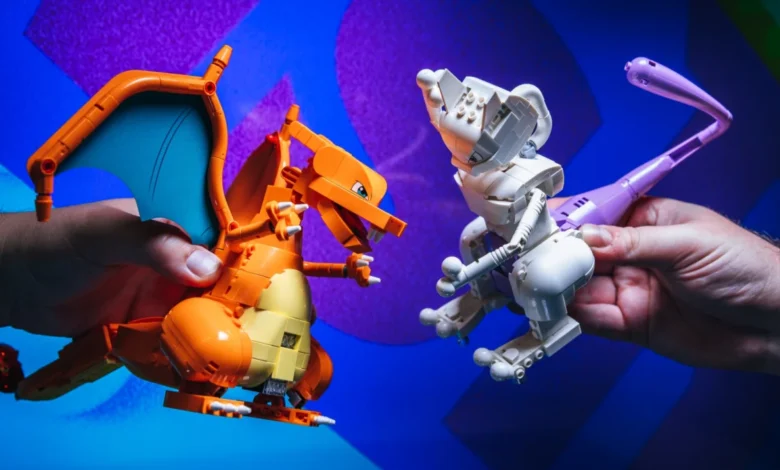
- Charizard vs. Jolteon Ultimate Battle: A dual-figure set designed specifically to showcase the "Battle Mode" mechanics, providing two Smart Bricks to facilitate immediate competitive play.
Complementing these are several expansion sets, priced more affordably to allow collectors to expand their roster without needing to purchase a new Smart Brick for every figure. These include:

- Mewtwo’s Lab Break: Focusing on high-stakes narrative play and legendary Pokémon lore.
- Trainer’s Buggy Adventure with Squirtle: An entry-level interactive set featuring vehicle-based sound effects.
- Charmander and Geodude’s Cavern Clash: A terrain-focused set that utilizes magnetic sensors to trigger environmental sounds.
- Eevee and Lapras’s Treasure Hunt: A water-themed set emphasizing exploration and discovery mechanics.
- Berry Bash with Bulbasaur and Bidoof: A "lifestyle" set focusing on the non-combat, nurturing aspects of the Pokémon franchise.
- Cubone and Gengar’s Spooky Showdown: A set exploring atmospheric lighting and sound effects through the Gengar figure.
By pricing add-on sets as low as $19.99 and starter kits at approximately $69.99, Lego is positioning the line to compete directly with both traditional action figures and digital-to-physical hybrids like Nintendo’s Amiibo.

Mechanics of Interactive Play and Battle Mode
The defining feature of the Pokémon Smart Play series is the "Battle Mode," a gameplay layer that elevates the sets beyond static display pieces. When two Pokémon equipped with Smart Bricks are brought into proximity, they can enter a competitive state. The internal accelerometers track physical movement, allowing users to "charge" special attacks by moving the figures in specific patterns.

The system includes a risk-reward mechanic: if a user shakes the figure too aggressively to charge an attack, the "move" may fail, indicated by a specific sound effect and LED flash. Conversely, successful timing allows for "leveling up" the Pokémon, which increases the frequency and intensity of their responses.

Outside of combat, the sets emphasize "cute" or "life-like" interactions. The Pikachu Training House, for example, features a "Murphy Bed" element. When a Pokémon is placed on this bed, the Smart Brick’s orientation sensors detect the horizontal position and trigger a snoring sound effect, accompanied by a rhythmic "breathing" light pulse from the internal LEDs. Similarly, the Squirtle Buggy set uses the gyroscope to detect rolling motion, generating engine noises that sync with the speed of the wheels.

Chronology of the Smart Play Rollout
The development and release of the Pokémon Smart Play sets followed a multi-year roadmap aimed at refining Lego’s electronic integration.

- January 2026 (CES Debut): Lego officially unveiled the Smart Brick prototype at the Consumer Electronics Show. The demonstration focused on the brick’s ability to identify individual Minifigures and respond to gravitational changes, though no specific IP was attached at the time.
- Early 2026 (Star Wars Launch): The technology was first brought to market through a Star Wars-themed line. While technically proficient, consumer feedback suggested a desire for more character-driven vocalizations and interactive gameplay, which informed the development of the Pokémon line.
- Summer 2026 (London Launch Event): A dedicated launch event in London provided the first hands-on opportunities for the press. This event highlighted the "Battle Mode" and the social interactions between different Pokémon species.
- August 1, 2026 (Global Retail Release): The sets became available worldwide through Lego’s online portal, Amazon, and physical retail locations.
Industry Analysis and Broader Implications
The release of the Pokémon Smart Play sets is a strategic move for Lego as it navigates a toy industry increasingly dominated by digital entertainment. By embedding the "smarts" directly into the brick rather than relying on a secondary smartphone app—a method used in previous lines like Lego Hidden Side—Lego is attempting to keep the user’s focus on the physical toy.

Industry analysts suggest that the Pokémon IP is uniquely suited for this technology. The franchise’s core themes of collecting, training, and battling provide a natural framework for the Smart Brick’s capabilities. Furthermore, the "Smart Tag" system allows for a high degree of modularity; users can move a Smart Brick from a Charizard to a Gengar, effectively "transferring" the intelligence between models, which encourages creative rebuilding—a core tenet of the Lego brand.

The inclusion of multiple sensors also hints at future expansion possibilities. The magnetic field sensors and color sensors could theoretically be programmed to interact with a wide variety of future sets, suggesting that the Smart Brick is intended to be a long-term platform rather than a one-off novelty.

Consumer and Critical Reception
Initial reception from industry experts and early adopters has been largely positive, particularly regarding the tactile feedback and the charm of the sound design. The "social" aspect of the toys—where figures react to one another—has been cited as a significant step forward in making physical toys feel "alive" without the need for an expensive robotic chassis.

However, some critiques have been leveled at the ecosystem’s requirement for the Smart Brick. Because not every set includes the hardware, consumers must be diligent in ensuring they have at least one "All-in-One" kit to enable the interactive features of the smaller expansion sets. Despite this, the lower price point of the expansion sets has been praised for making the technology more accessible than the previous Star Wars Smart Play iterations.

As Lego continues to monitor the performance of this line, it is expected that the Smart Play ecosystem will expand to include other high-profile intellectual properties. For now, the Pokémon Smart Play sets stand as a benchmark for how traditional toy manufacturers can successfully integrate modern technology to enhance, rather than replace, the classic building experience. The combination of nostalgic IP, sophisticated hardware, and a clear gameplay loop positions Lego to maintain its leadership in the "Smart Toy" sector for the foreseeable future.