How Modern Web Standards and the Baseline Initiative Are Revolutionizing Frontend Development by Shrinking JavaScript Bundles

The continuous evolution of modern web browsers has fundamentally transformed the parameters of frontend engineering, steadily narrowing the historic divide between third-party library dependencies and native browser functionality. For years, developers routinely integrated a wide array of specialized external packages into their projects to handle common development tasks, ranging from complex date and time computations to internationalization, user interface primitives, and utility functions. Over time, however, these packages frequently became permanent fixtures within application codebases, overlooked during routine maintenance cycles. Today, contemporary web browsers natively incorporate capabilities that once required dedicated external libraries, offering an unprecedented opportunity for developers to audit their codebases, significantly reduce JavaScript payload sizes, and optimize overall web application performance.
This shift toward native browser implementation is closely tied to the maturing ecosystem of modern web standards and community governance. Industry stakeholders, including major browser vendors collaborating through initiatives like the WebDX Community Group, have systematically prioritized interoperability and predictable feature rollouts. The introduction of the Baseline framework has established a clear, empirical metric for determining when a web platform feature is safe to deploy across all major rendering engines. By categorizing features into distinct availability stages—ranging from newly introduced capabilities to those widely supported across Chrome, Edge, Firefox, and Safari—developers now possess a reliable roadmap for deprecating redundant dependencies without compromising user experience or cross-browser compatibility.

An examination of typical mid-sized JavaScript applications reveals that between 60KB and 90KB of minified and gzipped dependencies can frequently be replaced by native platform APIs. Historically, development teams relied on specialized libraries out of necessity. Tasks such as formatting relative timestamps, localizing currency and numbers, executing asynchronous HTTP requests, managing modal dialog interactions, anchoring tooltips, and performing deep object cloning represented genuine functional gaps in early web specifications. As browser vendors accelerated their release cycles, these gaps closed rapidly. Despite these advancements, many organizations fail to periodically re-evaluate their dependency trees, maintaining legacy packages primarily due to institutional inertia rather than technical necessity. While security vulnerabilities are routinely identified via package management audits, the fundamental question of whether an external library duplicates native browser capabilities is seldom addressed.
To navigate this architectural transition systematically, industry experts advocate for a structured, cluster-based evaluation framework before undertaking code removal. This methodical approach requires development teams to assess candidate replacements through three primary lenses: verification of Baseline safety against specific user demographics, measurement of the true performance cost of any necessary polyfills, and confirmation that native features adequately cover edge cases previously managed by specialized libraries. By evaluating dependencies in functional clusters—such as internationalization, network requests, user interface components, and data manipulation utilities—engineering organizations can capture substantial performance gains while minimizing regression risks.
The internationalization cluster exemplifies the immediate benefits of adopting native platform features. The browser’s native Intl namespace now encompasses comprehensive formatting tools that obviate the need for multiple lightweight packages. For instance, Intl.RelativeTimeFormat provides localized relative time strings such as "yesterday" or "in three hours," matching the functionality of legacy packages like timeago.js. Similarly, Intl.NumberFormat and Intl.ListFormat handle complex currency rendering, compact numerical notation, and grammatically correct list joining, including Oxford comma rules, natively. While certain advanced formatting tools, such as Intl.DurationFormat, remain in transitional availability phases, the broader internationalization toolset offers an immediate reduction of approximately 14KB of gzipped code for applications that previously relied on dedicated formatting libraries.

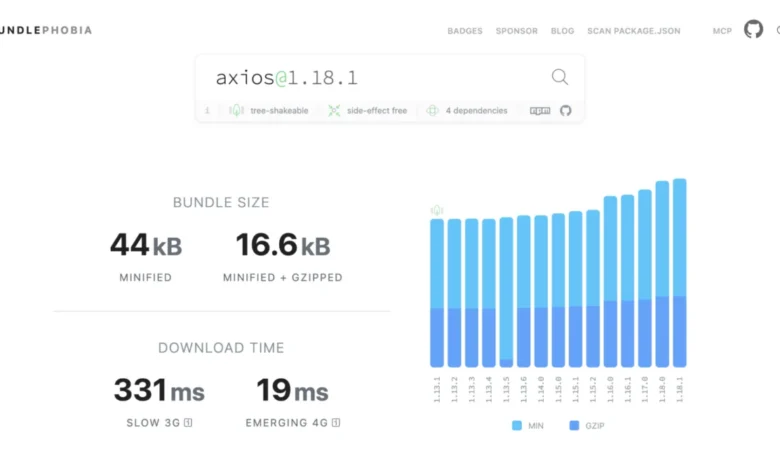
In the domain of network communication, the transition from third-party HTTP clients like Axios or Superagent to the native fetch API requires careful consideration. While fetch, when paired with AbortController and AbortSignal.timeout(), efficiently manages standard GET and POST requests, specialized libraries often provide advanced features such as request and response interceptors, automated retries, and global configuration defaults. Developers must audit their actual utilization patterns to determine whether adopting native primitives necessitates writing custom wrapper classes. For applications executing straightforward data fetching operations, replacing external HTTP clients can eliminate roughly 17KB of gzipped dependencies from the final production bundle.
User interface primitives represent another area where native browser capabilities surpass traditional third-party solutions in both performance and accessibility compliance. The implementation of the HTML <dialog> element, the Popover API, and CSS anchor positioning allows development teams to eliminate multiple specialized packages dedicated to modal dialogs, focus trapping, body scroll locking, and tooltip positioning. The <dialog> element natively manages focus containment, background inertness, escape-key dismissal, and top-layer rendering, effectively replacing legacy libraries like a11y-dialog and focus-trap. Combined with the Popover API for light-dismiss floating panels and CSS anchor positioning for dynamic element placement, these native features collectively save approximately 24KB of gzipped assets while delivering superior accessibility defaults compared to custom JavaScript implementations.
Utility libraries, particularly subset functions drawn from Lodash, likewise offer significant opportunities for bundle reduction. Native JavaScript features such as Object.groupBy, Map.groupBy, and the structuredClone method provide performant, native alternatives to functions like lodash.groupby and lodash.clonedeep. Furthermore, modern enhancements to native Set objects now support native mathematical operations including unions, intersections, and differences without requiring external algorithmic helpers. Removing redundant utility functions typically yields an immediate savings of 8KB to 25KB of gzipped code, depending on whether applications previously imported individual modular packages or the entire monolithic library.

Conversely, empirical analysis demonstrates that premature adoption of emerging standards can negatively impact application performance if browser support remains incomplete. The Temporal API, designed to replace legacy JavaScript Date objects with a robust, immutable time-handling system, illustrates this principle. Although Temporal has advanced significantly within the TC39 standardization process and achieved support across multiple modern browsers, it has not yet attained universal Baseline status due to pending stable releases in Safari. Consequently, deploying Temporal today requires substantial polyfills that can inflate bundle sizes significantly more than lightweight legacy date libraries such as Day.js. Industry frameworks appropriately advise maintaining existing date libraries until universal native support is achieved, highlighting the importance of balancing architectural modernization with practical payload constraints.
Executing a successful dependency audit requires a disciplined, repeatable operational workflow. Engineering teams typically begin by generating a comprehensive inventory of production dependencies utilizing package manager inspection commands, followed by bundle analysis via visualization tools to determine the exact byte-weight of individual packages within production builds. Each candidate library is subsequently cross-referenced against platform availability databases, evaluated through the established decision framework, and phased out using progressive enhancement strategies where necessary. By implementing conditional feature detection for newly available APIs, organizations can deliver optimized, lightweight code paths to modern browsers while maintaining reliable fallbacks for legacy environments.
Ultimately, the ongoing convergence between native browser functionality and third-party library ecosystems represents a fundamental maturation of frontend engineering practices. As web platform standards continue to advance, the regular auditing of application dependencies transitions from an optional optimization task to an essential component of sustainable software maintenance. By systematically reclaiming platform-supported features, development organizations can consistently minimize application payload sizes, improve load performance across diverse device profiles, and maintain leaner, more maintainable codebases over the long term.