The Evolution of WordPress Site Management: Navigating the Landscape of Multi-Site Administration in 2026

The transition from managing a single WordPress website to overseeing a portfolio of dozens represents a significant inflection point in a developer’s professional lifecycle. What begins as a creative or business-oriented endeavor quickly shifts into a complex logistics operation, characterized by the repetitive nature of plugin updates, security hardening, performance monitoring, and the persistent, low-level anxiety that a critical failure may occur on a client site without notice. As of late 2026, the industry has seen a decisive maturation in how these administrative burdens are mitigated, with a clear trend emerging toward centralized, automated, and AI-integrated management dashboards.

The core problem for agencies and freelancers is one of scale. Managing 30 distinct WordPress installations manually is an unsustainable model that invites human error. Consequently, the site management category has undergone a rapid evolution. Pricing models have shifted from the traditional "free dashboard, pay-per-add-on" structure toward flat, per-site billing architectures that prioritize cost predictability. Simultaneously, the integration of generative AI assistants has transformed these tools from passive monitoring consoles into active operational partners capable of queuing and executing complex maintenance workflows across massive, disparate networks of sites.
A Chronology of Site Management Transformation
The history of WordPress management tools is a reflection of the platform’s own growth. In the early 2010s, the market was dominated by manual intervention and basic uptime monitors. By 2016, tools like ManageWP had set the standard by offering a modular, add-on-based approach that allowed users to toggle features like backups or security scanning as needed. This model provided flexibility but often resulted in unpredictable monthly invoices for growing agencies.

Entering 2020, the focus shifted toward security and consolidation. The rise of sophisticated cyber threats targeting WordPress led to the integration of more robust security features, such as virtual patching and firewall management, directly into the management consoles. By 2024 and 2025, the industry reached a new milestone: the "all-in-one" mandate. Developers began demanding consolidated pricing and simplified workflows. As of the fourth quarter of 2026, we are witnessing the "AI-agent" era, where tools like WP Foreman are leveraging LLM-based logic to interpret natural language commands and execute multi-site operations with a "human-in-the-loop" approval process, effectively reducing the administrative overhead of standard maintenance by an estimated 40 to 60 percent.
Comparative Analysis of Leading Management Platforms
The modern landscape is bifurcated between proprietary, SaaS-based management services and self-hosted, open-source frameworks. The choice between these two categories defines not only the cost structure but the level of agency ownership over data and infrastructure.

1. WP Umbrella: The Predictable Scaling Solution
WP Umbrella has established itself as a leader in the mid-market agency space. By offering a flat, per-site monthly fee that includes core functionality—updates, backups, and monitoring—it provides a level of financial clarity that allows agencies to bake maintenance costs directly into their client retainers. Operating from servers based in France, the platform is particularly attractive to European agencies grappling with strict GDPR compliance requirements, as it maintains data sovereignty within the EU.
2. WP Remote: The Security-First Architecture
For agencies managing high-risk environments, such as WooCommerce storefronts or membership portals, WP Remote remains a top-tier choice. Backed by the technical expertise of the teams behind BlogVault and MalCare, it excels in deep security integration. Unlike competitors that treat security as an optional bolt-on, WP Remote embeds firewalls, malware remediation, and sandboxed update testing into its advanced tiers. This is critical for preventing "white screen" incidents during plugin updates, as the system can simulate updates in a safe, automated environment before they are deployed to production.

3. WP Foreman: The AI-Centric Disruptor
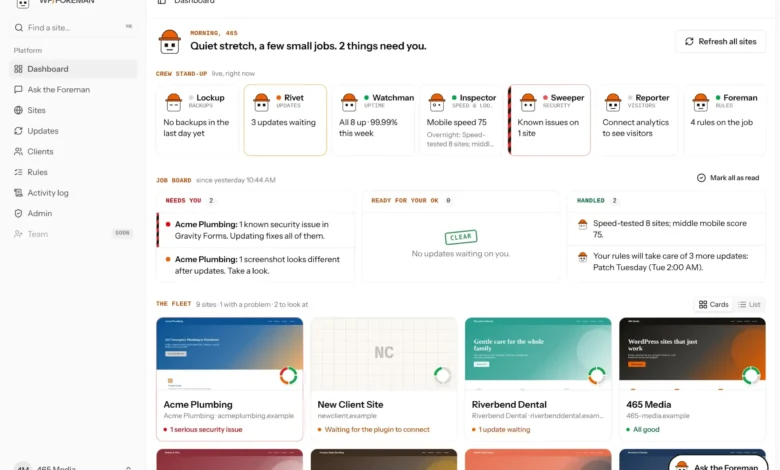
The arrival of WP Foreman in the market marks a significant departure from legacy models. Designed by long-term agency operators, the platform directly addresses the "add-on fatigue" associated with older services. Its standout feature, "Ask the Foreman," represents the cutting edge of AI-assisted administration. By allowing users to issue commands such as "update plugins on all client staging sites," the tool acts as a junior developer. The crucial innovation here is the "approve-first" design, ensuring that no automated script executes a breaking change without explicit human authorization.
4. MainWP: The Open-Source Standard
MainWP remains the preferred choice for privacy-conscious developers who refuse to outsource their client data to a third-party server. Because MainWP is a plugin installed on a private, self-hosted "dashboard site," it keeps all administrative logs and client credentials within the user’s own environment. While it lacks the "turnkey" convenience of SaaS competitors—requiring the user to assemble their own stack of backup and security plugins—it offers an unparalleled degree of control and scalability, with no per-site fees.

5. ManageWP: The Legacy Reliability
Despite the emergence of newer competitors, ManageWP continues to hold a significant market share due to its longevity and reliability. Owned by GoDaddy, it offers a level of institutional stability that appeals to risk-averse businesses. Its free tier is perhaps the most robust in the industry, providing a gateway for small freelancers to manage their first few sites without any initial capital outlay. However, as portfolios grow, the cost of the granular, per-add-on pricing model can quickly exceed that of competitors offering flat-rate pricing.
6. WPMU DEV Hub: The Integrated Ecosystem
WPMU DEV occupies a unique position. It is not merely a management dashboard but a comprehensive ecosystem that includes hosting, plugin suites, and white-label billing tools. This platform is ideal for agencies that want to consolidate their entire tech stack under a single vendor. While it is the most expensive entry point for those only seeking a dashboard, the total cost of ownership often drops when factoring in the elimination of separate subscriptions for hosting, security plugins, and billing software.

The Financial Implications of Maintenance
For an agency managing 25 websites, the cost discrepancy between these platforms is substantial. A rigorous cost analysis of these services—including backups, uptime monitoring, and white-label reporting—reveals a significant range in monthly operational expenses.
- WP Foreman: Approximately $47.76/month.
- WP Remote (Essential): Approximately $49.75/month.
- WP Umbrella: Approximately $54.75/month.
- ManageWP: Approximately $125.00/month (depending on selected add-ons).
- MainWP: Nominal (hosting costs only), though this ignores the value of the user’s time required to configure and maintain the dashboard infrastructure.
These figures illustrate that while "free" tiers exist, the real cost of site management lies in the "middle tier" features—the security and backup services that clients expect as standard.

Strategic Considerations for Agencies
Choosing a management tool is no longer a technical decision; it is a strategic business decision. Agencies must weigh the following factors:
- Data Sovereignty: Does the client require data to be stored on specific servers or within specific jurisdictions? If so, self-hosted solutions like MainWP or EU-based services like WP Umbrella may be non-negotiable.
- Workflow Automation: Can the team benefit from AI-assisted workflows? If the current bottleneck is the time spent reading changelogs or manually testing updates, AI-integrated platforms like WP Foreman offer a clear path to increasing profitability.
- Revenue Model: Is the agency billing for maintenance as a separate line item? If the goal is to provide a "premium" care plan, platforms with advanced white-label reporting features are essential for demonstrating value to the end client.
- Integration Requirements: Does the agency rely on specific security or backup vendors? Some management tools act as "wrappers" for third-party services, while others provide proprietary, integrated solutions.
Conclusion and Future Outlook
The industry trend in 2026 suggests that the commoditization of basic site maintenance is nearly complete. The competitive advantage for agencies in the coming years will not come from the ability to update plugins, but from the ability to provide high-level, proactive security and site performance management at scale.

As these tools become more intelligent, the role of the site manager is shifting from "technician" to "orchestrator." The most successful agencies will be those that leverage AI-driven, high-trust platforms to reduce operational drag, thereby freeing up time to focus on high-value development and strategic consulting. The tools highlighted in this report represent the current vanguard of this shift, each offering a distinct philosophy on how to best secure and maintain the backbone of the modern web. Whether through the self-hosted autonomy of MainWP or the AI-forward efficiency of WP Foreman, the objective remains the same: ensuring that the underlying infrastructure remains invisible to the client, providing stability and security as a silent, reliable service.