For merchants operating e-commerce storefronts within the European Union, Value Added Tax (VAT) is far from a static percentage. It is a dynamic, geography-dependent obligation that shifts based on the customer’s residence, the legal status of the buyer, and the total volume of cross-border sales. While WooCommerce provides a foundational framework for tax calculation, it lacks the sophisticated, real-time decision-making capabilities required to maintain full compliance with evolving EU regulations. This gap often forces store owners to choose between expensive third-party SaaS subscriptions, complex manual spreadsheets, or the risk of significant tax liability.
The introduction of the VAT Right plugin, an open-source solution for the WordPress ecosystem, offers a new avenue for merchants to automate these requirements. By integrating directly with the European Commission’s VIES (VAT Information Exchange System) and HMRC’s API, the tool aims to bridge the gap between simple tax tables and the rigorous demands of cross-border tax law.
The Evolution of EU VAT Regulations
The complexity of the current landscape stems from the European Union’s efforts to modernize cross-border e-commerce. Historically, tax compliance was hindered by a fragmented system where businesses had to register for VAT in every single country where they made sales. This created an immense administrative burden for small and medium-sized enterprises (SMEs).

To alleviate this, the EU implemented the One Stop Shop (OSS) framework. The OSS allows businesses to register for VAT electronically in one member state for all intra-EU distance sales of goods and services. However, the transition to this system introduced new thresholds. Merchants must track their sales against a €10,000 pan-EU threshold. Once this threshold is crossed, the merchant is required to charge VAT at the destination country’s rate rather than their own. Managing this transition manually is error-prone, as it requires constant monitoring of sales data and instant updates to checkout logic.
Technical Limitations in Standard E-commerce Platforms
WooCommerce, while the most popular e-commerce platform globally, is designed as a modular system. By default, its tax settings are static; they allow store owners to input rates manually, but the software does not inherently possess the intelligence to verify the legitimacy of a VAT number or detect when a business has surpassed the €10,000 threshold.
This limitation is not merely a matter of convenience; it is a significant liability. If a store owner fails to verify a VAT number, they may inadvertently offer a tax exemption to a non-eligible entity. Conversely, failing to adjust to destination-based VAT after crossing the threshold can lead to audits, fines, and the requirement to retroactively pay the difference to various tax authorities. Furthermore, tax inspectors require a clear audit trail—documented proof of why a specific tax rate was applied or why a VAT exemption was granted—which standard WooCommerce settings do not generate.
Functionality and Compliance Automation
The VAT Right plugin addresses these issues by acting as a middleware between the checkout process and the European Union’s tax databases. The plugin’s core functions include:

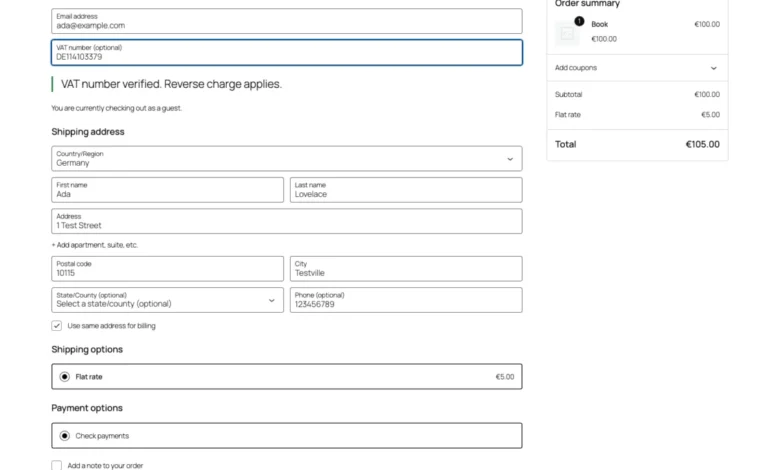
- Real-time VIES Validation: During the checkout process, the plugin queries the VIES database to verify the authenticity of the buyer’s VAT ID.
- Reverse Charge Mechanism: If a business customer provides a valid VAT ID, the plugin automatically triggers the reverse charge mechanism, shifting the VAT accounting responsibility to the buyer and exempting the sale from the merchant’s tax total.
- Threshold Monitoring: The plugin tracks cross-border sales volume and automatically switches from domestic VAT to destination VAT once the €10,000 threshold is reached.
- Automated Reporting: The plugin compiles data for the quarterly OSS return and the EC Sales List, significantly reducing the labor hours required for tax preparation.
Implementation and Regulatory Integration
For store owners, the integration process is designed to be streamlined. Upon installation, the plugin conducts a diagnostic check to identify missing configuration steps. A critical component for UK-based businesses is the integration with the HMRC Developer Hub. Because the United Kingdom is no longer part of the EU VAT regime, transactions between the UK and the EU are treated as international trade. By registering an application on the HMRC Developer Hub and subscribing to the VAT Registered Companies API, merchants can ensure that their system remains compliant with UK-specific requirements.
The setup also requires careful attention to product classification. EU VAT rates vary not only by country but also by the nature of the product (e.g., standard rates for physical goods versus reduced rates for books or food). By utilizing the plugin’s tax class mapping, merchants can align their existing product categories with the specific VAT requirements of each EU member state.
Comparative Analysis of Compliance Tools
When evaluating options for VAT management, store owners typically face four categories of solutions: manual spreadsheets, dedicated SaaS tax platforms, specialized paid extensions, and open-source plugins.
Manual management is widely considered unsustainable for any business processing more than a handful of orders per week. SaaS platforms, while robust, often come with high monthly recurring costs that can eat into the margins of small businesses. Paid extensions offer varying levels of support but often suffer from "feature creep" or inconsistent updates.

The advantage of a specialized, open-source approach like VAT Right lies in its transparency and lack of hidden branding. Unlike proprietary solutions that may insert "Powered by" links into the customer experience, or premium models that gate essential features behind paywalls, the plugin provides core compliance functionality as a free utility. However, users should note that the plugin does not provide legal or tax advice. As with any financial software, the responsibility for regulatory adherence remains with the merchant.
Broader Implications for E-commerce
The shift toward automated tax compliance is reflective of a wider trend in the digital economy: the "digitization of the state." As tax authorities across the globe move toward real-time reporting—often referred to as "Making Tax Digital"—the role of software in financial compliance is becoming non-negotiable.
For the WooCommerce ecosystem, tools that handle the heavy lifting of compliance are essential for the platform’s long-term viability in the European market. Without such tools, merchants are often forced to migrate to more expensive, restrictive platforms that bundle tax compliance into their pricing. By keeping these tools accessible and open-source, the WordPress community ensures that small businesses remain competitive against larger, enterprise-level retailers that have the budget to afford dedicated tax departments.
Limitations and Risk Mitigation
Despite the automation provided by such plugins, there are inherent limitations that merchants must acknowledge. For instance, the plugin’s reliance on the VIES API means that if the European Commission’s servers are down, the validation service may be temporarily unavailable. To mitigate this, the plugin is designed to "fail-safe"—usually by defaulting to charging standard VAT and flagging the order for manual review. This ensures that the merchant never inadvertently commits a tax under-collection error, which is the most penalized outcome during an audit.

Furthermore, the complexity of VAT in specific jurisdictions—such as the rules governing digital products versus physical goods—requires that the store owner maintains a baseline understanding of their own tax liabilities. The plugin provides the mechanism for calculation, but the merchant remains the taxpayer of record.
Final Considerations for Store Owners
The transition to destination-based VAT is a milestone in the maturity of an online store. For those scaling their operations into the EU, the implementation of a robust, automated system is no longer optional. Whether a business opts for a high-end SaaS solution or a specialized plugin, the objective remains the same: accuracy, auditability, and efficiency.
As regulations continue to evolve, the ability to rapidly update tax logic without disrupting the checkout experience will define which stores thrive in the cross-border market. Merchants are advised to test any tax-related software on a staging environment before deployment to ensure that the logic aligns with their specific tax registration and product catalog. By taking a proactive approach to compliance, store owners can focus on growth rather than the administrative burdens of international tax law.