The rapid expansion of the digital infrastructure required to support artificial intelligence and cloud computing has placed data centers at the forefront of the American political landscape. As energy demand skyrockets, local communities and state governments are increasingly clashing over the placement, environmental impact, and economic utility of these massive server farms. New York State has emerged as a primary battleground, serving as a bellwether for how state legislatures and executive branches intend to navigate the competing interests of technological growth and resident quality-of-life concerns.
A Chronology of Conflict and Policy
The tension surrounding data center development in New York reached a legislative peak in early 2026. For years, residents in regions like Genesee County had been organizing against large-scale developments, citing concerns over proximity to protected lands, including federal wildlife refuges and indigenous territories.
In the spring of 2026, the New York State Legislature passed an omnibus bill designed to impose a one-year moratorium on new data center development. The legislation was notably aggressive, proposing strict limits on the physical footprint of facilities and, crucially, mandating that the Department of Environmental Conservation (DEC) conduct exhaustive environmental impact assessments before any new construction could be authorized.
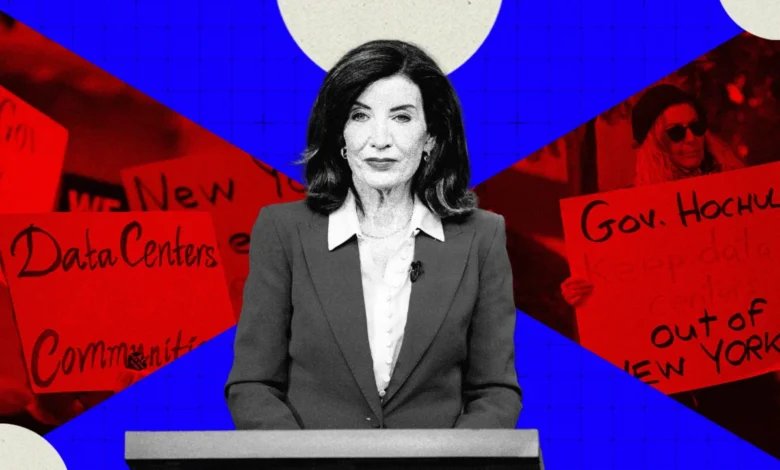
Governor Kathy Hochul’s response was a calculated maneuver that sought to balance industrial development with public outcry. In July 2026, after previously dismissing the necessity of a total halt, the governor signed an executive order establishing a state-wide moratorium. However, the order served as a compromise; it was more limited in scope than the omnibus bill passed by the legislature. While the bill remains under consideration for her signature—with a deadline set for the end of the calendar year—the executive order effectively granted the state breathing room to study the long-term grid and environmental implications of the industry.
The Economic and Environmental Trade-offs
At the heart of the debate is the sheer energy appetite of modern data centers. These facilities often require hundreds of megawatts of power, frequently necessitating direct access to high-voltage transmission lines and, in many cases, natural gas infrastructure.
The financial risks associated with this demand are beginning to manifest in corporate disclosures. For instance, recent IPO filings from major AI firms, including Anthropic, have highlighted the volatility of the natural gas market as a potential threat to business continuity. The competition for energy resources is not limited to the tech sector; it pits data center operators against residential consumers, who are increasingly sensitive to fluctuating utility rates. In communities across New York, residents have reported concerns regarding both noise pollution from cooling systems and the potential for rising water and energy bills as infrastructure is diverted to support these facilities.
Political Alignments and Public Sentiment
The political fallout of the data center debate has been significant. In the lead-up to the 2026 midterm elections, the issue became a litmus test for candidates. Governor Hochul, while advocating for a measured approach, has sought to position herself as a leader who prioritizes community sovereignty. During a recent roundtable in the Hudson Valley, she emphasized that the goal of the current pause is to allow local communities to have a definitive voice in the development process. "This is democracy in action," Hochul stated, noting that infrastructure projects should only proceed with clear local support and robust regulatory guardrails.
Data suggests, however, that the public is not merely looking for "guardrails," but is instead leaning toward outright rejection of new projects. A September 2026 poll conducted by the Siena College Research Institute found that 63 percent of likely voters in New York oppose the construction of data centers in their immediate area, even after the current moratorium expires. Among self-identified Democrats, that opposition rises to 75 percent.
The Republican opposition, led by figures like challenger Bruce Blakeman, has taken a different tack. Blakeman has characterized the moratorium as an economic impediment, arguing that data centers are essential to the future of the state’s digital economy. Despite this, the political leverage of the moratorium has been clear; voters have expressed significantly higher trust in the incumbent administration’s handling of AI infrastructure compared to their opponents, with Quinnipiac polling showing a 22-point lead in voter trust for Hochul on this specific issue.
Broader National Implications
New York is not an outlier in this political trend. According to data compiled by MultiState, a government relations firm, at least 20 gubernatorial candidates across the United States have campaigned on platforms promising either a moratorium or strict new regulations for data centers. In states like Texas and Pennsylvania, incumbent leaders who were previously viewed as staunchly pro-development have begun to pivot, signaling a recognition that the "not in my backyard" (NIMBY) sentiment regarding industrial-scale tech infrastructure is becoming a potent electoral force.
The transition from protest to policy is perhaps most evident in the evolution of grassroots organizing. Residents who once focused exclusively on blocking individual sites are now engaging in broader discussions about land-use planning and alternative economic development. For many, the fight against data centers has served as an entry point into local civic participation. This new generation of activists is increasingly demanding that state governments move beyond temporary pauses to enact permanent, site-specific zoning laws that empower local municipalities.
Challenges for the Future
As the January deadline for the New York omnibus bill approaches, the pressure on the Governor’s office is mounting. The state must reconcile its desire to attract tech investment—often viewed as a way to bolster local tax bases and job creation—with the reality of a constituency that is increasingly wary of the environmental and utility costs.
One significant hurdle is the role of the Department of Environmental Conservation. Critics argue that without the DEC’s formal involvement in the vetting process, current moratoriums are merely a "wait and see" strategy that fails to address the underlying regulatory gaps. If the state opts to sign the more stringent legislation currently sitting on the Governor’s desk, it would set a national precedent, effectively shifting the burden of proof onto data center developers to demonstrate that their projects will not degrade local air quality or exhaust local energy reserves.
The situation in western Genesee County serves as a microcosm of this tension. Organizers there are no longer just fighting a 600-megawatt proposal; they are actively soliciting community input on alternative uses for land that could foster sustainable economic growth without the heavy resource footprint of a server farm.
Conclusion
The "Power Play" currently unfolding in New York and across the country suggests that the era of unfettered, rapid data center deployment is coming to a close. As the technology sector continues to expand, the demand for physical space and electricity will continue to crash into the rising tide of local environmentalism. For the newly elected and reelected officials taking office in 2027, the challenge will be to craft a regulatory framework that is transparent, scientifically rigorous, and, above all, responsive to the public’s changing expectations for how their communities should participate in the digital age. The upcoming months will determine whether the current wave of moratoriums will prove to be a lasting shift in policy or merely a temporary reprieve in a much longer struggle for control over local resources.