B2BKing Integrates Model Context Protocol to Enable AI-Driven WooCommerce Management


The integration of artificial intelligence into the WordPress ecosystem has reached a significant inflection point with the deployment of the Model Context Protocol (MCP) by B2BKing. While many recent AI-centric plugins have focused on superficial features such as content generation or simple chatbot interfaces, B2BKing has moved toward functional automation. By leveraging the WordPress Abilities API and the official MCP Adapter, the plugin now allows AI assistants—including Claude, Cursor, and VS Code—to directly modify store configurations, manage wholesale pricing, and organize customer tiers through natural language commands.
The Evolution of AI in WordPress Administration
For much of the past two years, the implementation of AI in WordPress has been primarily limited to front-end tasks. Content generation, image optimization, and rudimentary customer service bots dominated the market. However, the introduction of the WordPress Abilities API in version 6.9, released in late 2025, provided a standardized framework for developers to expose plugin functionality to external agents.
B2BKing, which currently serves over 15,000 WooCommerce stores, represents one of the first major enterprise-grade plugins to adopt this standard. By utilizing MCP, the plugin bypasses the need for proprietary connectors, instead creating a bridge between LLM-based assistants and the core settings of a WooCommerce wholesale store. This shift marks a transition from "AI-assisted writing" to "AI-assisted operations," where the agent acts as an administrator rather than just a content creator.

Technical Foundation: The Role of the Abilities API and MCP
The technical efficacy of this integration relies on three pillars: the WordPress Abilities API, the Model Context Protocol, and the WordPress MCP Adapter. The Abilities API functions as a standardized "instruction manual" for plugins. It describes to an AI agent exactly what a plugin is capable of doing, the required data schema, and the necessary permission levels.
When a store administrator connects an AI assistant to their site, the assistant parses these abilities. Because the system is built on the open-source Model Context Protocol—a standard promoted by Anthropic and other industry leaders to allow LLMs to interact with local development environments and databases—the setup is agnostic to the specific AI model being used.
Data security is managed through standard WordPress Application Passwords. This ensures that the AI assistant operates within the existing authentication framework, respecting user roles and capabilities. The plugin’s architecture includes internal safeguards; for example, the system validates inputs to prevent logical errors, such as setting a discount exceeding 100% or attempting to reference non-existent customer categories.
Streamlining Complex Wholesale Workflows
Operating a B2B store on WooCommerce historically requires a high volume of manual configuration. Unlike standard retail stores, B2B environments necessitate the management of hybrid B2B/B2C logic, tiered pricing structures, minimum order quantities (MOQs), and complex approval workflows for new trade accounts.
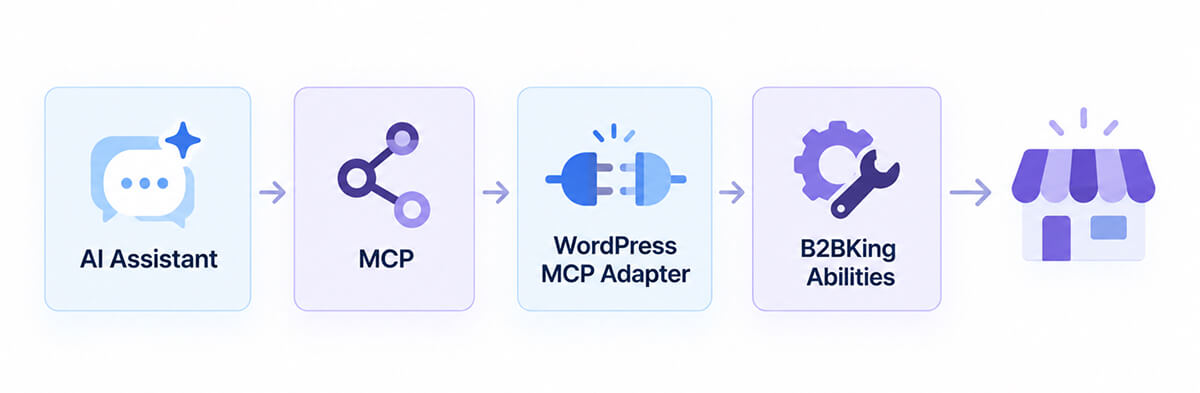
In a traditional manual setup, an agency or store owner might spend several hours navigating multiple settings pages to define customer groups and pricing rules. With the B2BKing MCP integration, this process is condensed into a single prompt. An administrator can instruct an agent to: "Transition the store to a hybrid model, implement a 15% discount for the ‘Distributor’ group, and enforce a $500 minimum order requirement."
The AI agent retrieves the current site state, calculates the necessary changes to the database, and executes the updates. Because the data produced by the AI is native to B2BKing, the store owner retains full visibility and the ability to manually override or audit any changes via the standard WordPress dashboard.
Implications for Agencies and Developers
The ability to offload routine configuration to an AI agent has profound implications for digital agencies that manage high volumes of client sites. In the past, scaling B2B store deployments required significant man-hours for repetitive setup tasks. By utilizing AI-driven configuration, agencies can maintain consistency across multiple sites while drastically reducing the time-to-launch for new features.
Furthermore, this approach mitigates the risks associated with "vibe-coding"—a term used to describe the practice of generating custom code snippets with AI that may not account for the complexities of a live e-commerce environment. By allowing the AI to interface with a proven, battle-tested plugin like B2BKing, the user benefits from the plugin’s existing handling of edge cases, such as tax calculations, inventory syncing, and REST API integration, which a custom-generated script might overlook.

Safety Protocols and Future Outlook
To address concerns regarding autonomy, the development team has implemented specific safety filters. Developers can utilize b2bking_mcp_enabled and b2bking_mcp_write_enabled filters to restrict the AI to read-only mode or disable the integration entirely. This granular control ensures that the AI serves as a tool for the administrator rather than an autonomous actor with unrestricted access.
As the WordPress AI ecosystem continues to mature, the precedent set by this integration is expected to influence how other enterprise-grade plugins approach automation. The industry is currently moving away from the "AI-powered label" phenomenon—where existing features are rebranded as AI-driven—and toward actual utility-based integration.
For store owners, the transition represents a shift in operational strategy. Instead of acting as "data entry" specialists, site managers are evolving into "AI architects" who provide the high-level intent, while the underlying software ensures the technical execution remains stable and secure. The success of this model will likely determine the pace at which other major WooCommerce extensions adopt the Model Context Protocol over the coming fiscal year.
Current indicators suggest that as long as these integrations prioritize security and standard compliance, the reliance on AI for administrative configuration will become a standard requirement for competitive e-commerce management. For the present, the B2BKing implementation offers a functional roadmap for developers looking to bridge the gap between generative AI and the complex, data-heavy requirements of B2B e-commerce.