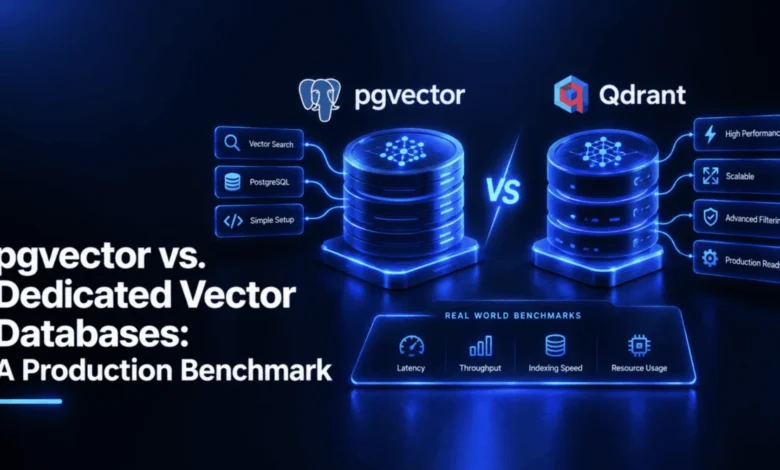
The rapid evolution of generative artificial intelligence has fundamentally altered the landscape of data infrastructure. As organizations rush to integrate Large Language Models (LLMs) and retrieval-augmented generation (RAG) into their production stacks, a quiet but intense architectural debate has emerged: should developers rely on the familiarity of relational databases equipped with vector extensions, or should they invest in specialized, purpose-built vector databases? This decision is rarely about simple convenience; it represents a significant choice regarding scalability, operational complexity, and performance predictability.
For many engineering teams, the integration of vector search begins on a Tuesday afternoon. A developer installs pgvector into an existing PostgreSQL instance, merging high-dimensional embeddings with traditional relational metadata. This approach allows for unified queries—performing a semantic search while simultaneously filtering by relational attributes like date, category, or user ID. For months, this configuration functions seamlessly. However, as the dataset grows and query traffic increases, the team eventually encounters unsolicited advice from vendors: they are told they must migrate to a dedicated vector database to avoid a performance "wall." Often, these warnings are delivered with high confidence but minimal data. This article aims to replace those anecdotal assertions with empirical evidence, dissecting the performance characteristics of pgvector against dedicated solutions like Qdrant, Pinecone, and Milvus.
Understanding the Architectural Divide
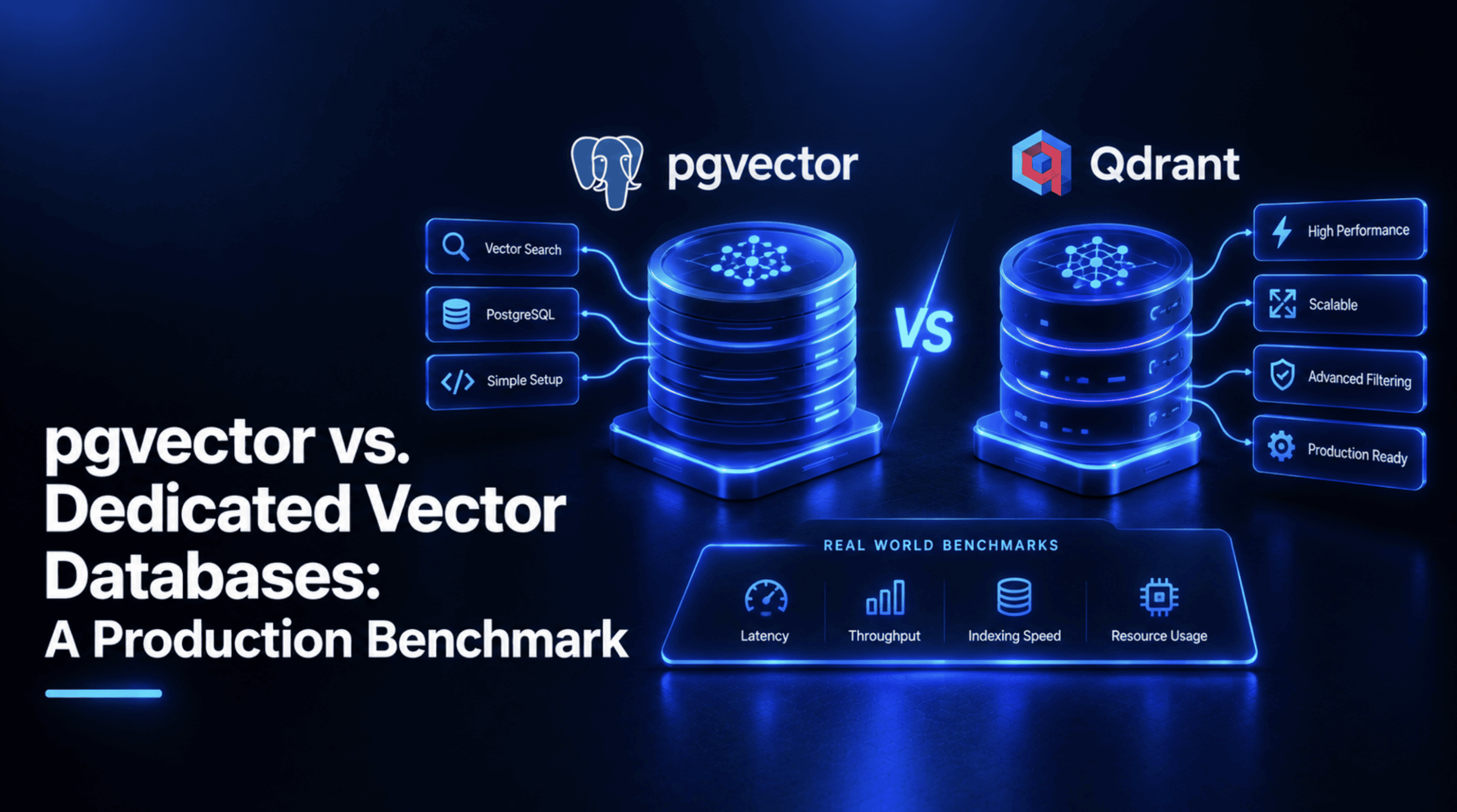
The distinction between pgvector and a dedicated vector database is rooted in fundamental design philosophies. pgvector is an open-source extension that enables PostgreSQL to treat vector embeddings as native data types. By utilizing the existing relational engine, pgvector allows embeddings to reside in the same row as the source data, enabling ACID-compliant transactions. This ensures that when a record is updated or deleted, its associated embedding is updated or removed simultaneously, preventing the data drift that can plague distributed systems.
Conversely, dedicated vector databases are purpose-built from the ground up. These systems, including Qdrant, Weaviate, and Milvus, utilize custom storage engines and indexing algorithms—such as HNSW (Hierarchical Navigable Small World) or IVF (Inverted File Index)—optimized specifically for high-speed similarity search. They often provide features like built-in vectorization, hybrid search capabilities (combining keyword and vector search), and distributed architecture that separates compute from storage. The trade-off is clear: by introducing a dedicated database, an organization adds a new system to its infrastructure that requires independent deployment, monitoring, backup, and, crucially, synchronization with the primary source of truth.
The Methodology of Measurement
To determine which approach is superior, one must move beyond marketing claims and look at controlled benchmarks. A fair comparison requires standardized variables: identical vector dimensions (e.g., 1536 dimensions, the standard for OpenAI’s text-embedding-3-small), consistent distance metrics (Cosine vs. Euclidean), and identical HNSW index parameters.
In a controlled local environment using Docker, both pgvector and Qdrant can be configured to manage a test set of 100,000 synthetic vectors. While this scale is sufficient for prototyping, it rarely reveals the performance bottlenecks of a production environment. For true insight, engineers must look to large-scale benchmarks, such as those published by Tiger Data, which tested 50 million Cohere embeddings on AWS r6id.4xlarge instances.
When comparing these two architectures, the performance metrics often reveal a nuanced reality. In tests using pgvector combined with the pgvectorscale extension, which introduces optimized index types like StreamingDiskANN, results show that Postgres is not merely a "simple" alternative. At 99% recall, this configuration can achieve significantly higher throughput than many dedicated databases. However, dedicated systems like Qdrant often exhibit superior consistency in tail latency. For businesses where a 70ms p99 response time is acceptable but throughput must be high, pgvector is formidable. For applications where a strict 30ms p99 latency SLA is non-negotiable regardless of concurrent load, the predictability of a dedicated vector database becomes a primary value proposition.
Chronology of the Vector Search Explosion
The rise of this architectural debate is tied to the release of the Transformer architecture and the subsequent popularity of RAG.
- 2017–2019: The academic foundation is laid by research papers on HNSW and the initial development of early vector engines.
- 2021: pgvector is introduced as an open-source extension, bringing vector search to the most popular relational database in the world.
- 2022–2023: As ChatGPT triggers a gold rush for AI applications, specialized vector databases like Pinecone and Milvus see a massive influx of venture capital and enterprise adoption, marketing themselves as essential for "production-grade" AI.
- 2024–2025: A "re-normalization" phase occurs. As costs and operational overhead mount, many organizations begin to question whether they truly need a dedicated vector database for their specific scale, leading to a resurgence in interest for pgvector and its newer performance-enhancing modules.
Fact-Based Analysis of Implications
The choice between these two paths involves three primary pillars: operational burden, consistency, and scale.
1. Operational Burden: Utilizing pgvector allows teams to leverage their existing expertise in SQL and PostgreSQL administration. There is no new database to learn, no new vendor contract to sign, and no complex integration between systems. For a startup or a small team, this is often the most efficient path to market.
2. Data Consistency: In a dedicated database, keeping the vector index in sync with the relational database often requires a two-phase commit or an event-driven architecture, which introduces complexity and the risk of eventual consistency issues. pgvector’s ability to maintain transactional integrity between metadata and vectors is a significant technical advantage for applications where data accuracy is paramount.
3. The Scale Threshold: The "wall" that vendors often warn about is real, but it is typically further away than many assume. For workloads under 5 to 10 million vectors, pgvector on well-tuned hardware is rarely the bottleneck. It is only when reaching hundreds of millions or billions of vectors that the distributed, shard-aware nature of systems like Milvus or Qdrant becomes essential.
Industry Perspectives
Industry analysts suggest that the "vector database" category may eventually consolidate. Just as "full-text search" transitioned from a separate, specialized field into a feature provided by most major databases (such as Elasticsearch integration or Postgres’s own GIN indexes), vector search is trending toward becoming a native capability of general-purpose data stores.
"The best infrastructure choice is the one that minimizes the number of moving parts while still meeting your performance SLAs," says one lead infrastructure engineer at a major fintech firm. "If I can get the performance I need by adding an extension to a database I already trust, I am not going to introduce a secondary, distributed system unless the business requirements strictly demand it."
Conclusion: Matching Architecture to Workload
The data suggests that the narrative of "one-size-fits-all" is inaccurate. If an organization is building a massive, global-scale recommendation engine with billions of data points and a requirement for sub-30ms tail latencies, a purpose-built vector database is likely the correct investment. The architectural maturity of these platforms—offering GPU acceleration and complex, tiered storage—is designed specifically for such high-pressure environments.
However, for the vast majority of enterprise applications, the "simple" route is often the most effective. pgvector provides a robust, highly performant, and transactionally consistent solution that avoids the "operational tax" of maintaining a separate stack. By focusing on the actual, measured performance of their own workloads rather than the marketing claims of external vendors, engineering teams can make decisions that optimize for both technical efficiency and long-term maintainability. The ultimate goal is not to choose the "trendiest" technology, but the one that ensures the product remains performant, scalable, and—above all—reliable.