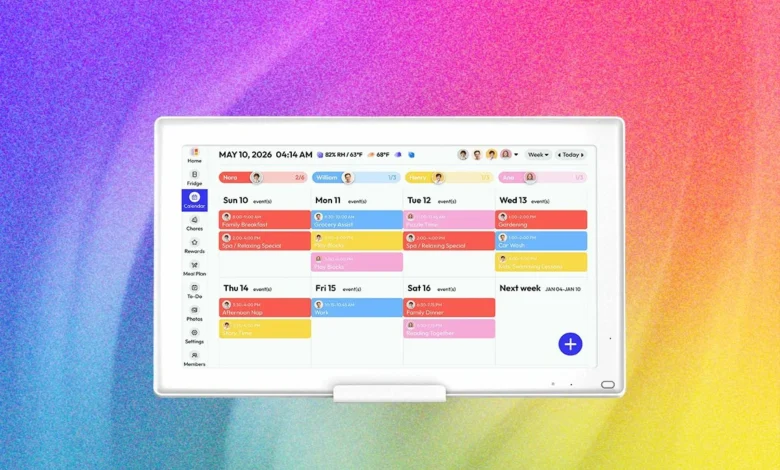
The modern household has become an increasingly complex ecosystem of digital logistics. As families balance multiple Google Calendars, iCloud schedules, Outlook work commitments, and various shared school or extracurricular trackers, the traditional paper wall calendar has largely been rendered obsolete. In its place, a new category of consumer electronics has emerged: the dedicated digital wall calendar. These devices serve as centralized hubs, aggregating disparate data streams into a single, permanent visual display that removes the need to constantly refresh mobile applications or rely on fragmented notifications.
While early iterations of this technology were often niche, expensive, or technically cumbersome, the market has matured significantly over the past 24 months. Industry analysts note that the shift toward these "always-on" smart displays represents a broader trend in home automation, where consumers are seeking to reduce "screen fatigue" by offloading information from personal smartphones onto dedicated hardware.
The Evolution of the Digital Calendar Market
The concept of the digital calendar gained significant traction around 2020 and 2021 as remote work and distance learning blurred the lines between professional and domestic life. Early adopters gravitated toward products like the Skylight Calendar, which prioritized user experience and cross-platform synchronization. These devices typically function by syncing with existing digital accounts—such as Google Calendar, iCal, and Outlook—and presenting them on an oversized, high-resolution touchscreen.
However, as the market reached a saturation point, many manufacturers transitioned to a "hardware-as-a-service" business model. To sustain the costs of cloud infrastructure, software updates, and proprietary app development, companies began gating premium features behind monthly or annual subscription paywalls. For many users, this created a friction point: the hardware was purchased at a premium, yet features like photo-frame slideshows, advanced meal planning, and chore-tracking rewards remained inaccessible without recurring payments.
The Emergence of Subscription-Free Alternatives
The recent introduction of devices such as the Everblog HomeCal 21.5-inch calendar marks a potential shift in the competitive landscape. By offering a subscription-free model, the device challenges the industry-standard reliance on recurring revenue. This model appeals to consumers who are increasingly wary of "subscription fatigue," where even simple household appliances require ongoing financial commitments to remain fully functional.
Technically, the HomeCal mirrors the core capabilities of its subscription-based rivals. It integrates with major calendar providers, manages family member profiles, and facilitates shared to-do lists. The device also incorporates gamification elements, allowing parents to track chore completion and manage allowance distributions, a feature set that has become highly requested in the family-tech sector.
Market Dynamics and Pricing Analysis
The current retail environment for digital calendars is highly sensitive to seasonal demand, particularly leading into the holiday season. The Everblog HomeCal, which lists at a premium price point, is currently experiencing a significant price reduction. At the time of this report, the unit is available for $300 at major online retailers—a $100 reduction from its standard retail price—and $349 directly from the manufacturer.
This pricing strategy serves a dual purpose: it lowers the barrier to entry for prospective customers during the high-traffic Q4 shopping season and positions the device as a high-value alternative to competitors who require long-term financial commitments. Analysts suggest that for a household, the "total cost of ownership" over a three-year period is significantly lower for the HomeCal than for a subscription-based competitor, even if the initial hardware price remains comparable.
Technical Specifications and User Integration
The HomeCal features a 21.5-inch display, a size selected to provide high legibility from across a room while remaining compact enough for standard interior mounting. The device utilizes a proprietary app for initial configuration and synchronization. While the current iteration of the software has been noted for having a slightly more manual process for media uploads—specifically regarding the single-image upload constraint—the trade-off is the absence of a monthly billing cycle.
From an installation perspective, the device is designed for flexibility. It includes integrated wall-mounting hardware for a flush finish, and the base is engineered to allow for tabletop placement. However, given the center of gravity on a 21.5-inch screen, independent accessory manufacturers have begun producing specialized stands and wooden frames to enhance stability and aesthetic integration with home decor. These accessories, while optional and priced separately, demonstrate the growing secondary market for digital display customization.
Comparative Feature Analysis
| Feature | Subscription-Based Models | Subscription-Free Models (e.g., HomeCal) |
|---|---|---|
| Calendar Sync | Included | Included |
| Meal Planning | Often Paywalled | Included |
| Photo Screensaver | Often Paywalled | Included |
| Chore Tracking | Included | Included |
| Monthly Fee | Required for full access | None |
The lack of an integrated voice assistant remains a notable gap across the entire category. While consumers often expect voice control in smart home devices, manufacturers have largely avoided this integration in dedicated calendars, citing privacy concerns and the technical difficulty of maintaining high-quality speech recognition in busy, high-traffic home environments. The few products that have attempted to integrate voice features typically come with higher hardware costs or additional service fees, further segmenting the market.
Broader Implications for Home Automation
The proliferation of these devices indicates a broader change in how households manage information density. Unlike a smart display (such as the Amazon Echo Show or Google Nest Hub), which is designed for multi-purpose tasks like streaming video, making calls, or controlling lighting, the digital calendar is a "unidirectional" device. It is designed to be looked at, rather than interacted with constantly.
This specialization is a key factor in its growing popularity. By reducing the number of notifications that ping a phone, a digital calendar acts as a "source of truth" for the household. It creates a focal point that keeps family members aligned without the distraction of social media, emails, or unrelated app notifications.
Furthermore, the rise of these devices highlights the ongoing tension between "smart" features and "analog" simplicity. Consumers are increasingly favoring technology that feels like a permanent fixture of the home—much like a traditional clock or a framed print—rather than a device that requires frequent software updates and troubleshooting.
Future Outlook
As the market continues to evolve, we can expect to see more differentiation between "hub-style" devices and "display-style" devices. The success of the current generation of subscription-free calendars suggests that there is a significant segment of the population that prioritizes ownership over ongoing software services.
Future iterations of these products will likely focus on improving the companion mobile applications, as the software interface is currently the primary differentiator between brands. Improving the ease of photo synchronization, increasing the speed of calendar updates, and expanding compatibility with niche third-party apps will be the next frontier for manufacturers.
For the holiday season, households considering the transition from paper to digital should weigh their need for specific features against the long-term cost of a subscription model. While the initial investment in a high-end digital calendar is substantial, the utility of a consolidated family management system is increasingly viewed as a standard, rather than a luxury, in the modern, connected home. Whether opting for a subscription-based model with a refined user experience or a one-time-cost model like the Everblog HomeCal, the shift toward a centralized digital calendar is clearly gaining momentum as a permanent fixture in the modern smart home.