The Ultimate Guide to Naming UI Components, Design Tokens, and Digital Products: Best Practices and Industry Frameworks

In the intricate landscape of digital product development, few challenges are as universally persistent or deceptively complex as nomenclature. Whether establishing a foundation for enterprise-level design systems, structuring cascading style sheets, or introducing innovative features to a global user base, the words selected by engineering, design, and product teams fundamentally dictate how concepts are understood and discussed. Language shapes thought, and misaligned vocabulary frequently leads to operational friction, semantic confusion, and fractured user experiences.

Industry studies consistently highlight that cross-functional teams lose hundreds of hours annually debating terminology, often speaking in distinct internal dialects—designers favoring visual metaphors, developers leaning toward structural or computational logic, and product managers prioritizing business value. When these vocabularies fail to intersect with the everyday language of the end user, product adoption stalls. To address this perennial industry hurdle, a robust ecosystem of practical guides, open-source directories, and systematic frameworks has emerged to help digital creators bring clarity and consistency to their naming conventions.
The Psychological and Semantic Roots of Naming Friction
The root of nomenclature challenges in software architecture generally stems from two extremes: choices that are overly generic, rendering components ambiguous and prone to misinterpretation, versus choices that are overly specific, stifling flexibility and rendering components impossible to reuse across disparate contexts.

Historically, software engineering addressed this through rigid conventions like BEM (Block, Element, Modifier), yet modern multi-brand design systems operating across web, iOS, and Android environments require far more sophisticated taxonomies. According to recent workflow analyses from enterprise design operations, standardized naming frameworks directly correlate with reduced technical debt and faster onboarding times for incoming engineers and designers. When every stakeholder across an organization references UI elements, color variables, and layout groups by a unified, predictable identifier, the velocity of code deployment and design handoffs accelerates significantly.
Resource Architectures for Code, Classes, and Functions
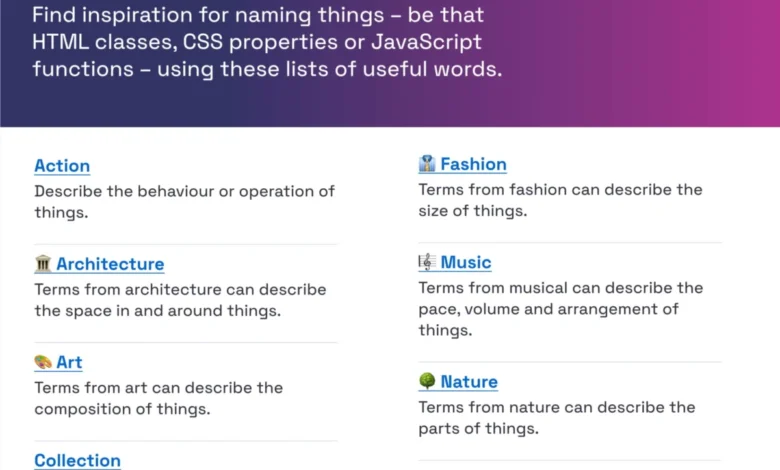
For practitioners seeking inspiration outside standard internal terminology, specialized repositories have been established to expand creative problem-solving. Among the most prominent is Classnames, curated by Paul Robert Lloyd, which functions as an expansive, thematically organized lexicon tailored for developers naming HTML classes, CSS properties, and JavaScript functions.

Rather than relying on repetitive, utilitarian naming patterns, Classnames encourages structural thinking by providing categorized lists of descriptive terms. These encompass behavioral traits, relational markers, order, grouping, and thematic vocabularies drawn from architecture, publishing, fashion, music, and the natural sciences. By stepping outside traditional programming vernacular, teams can craft concise yet expressive identifiers that remain legible without sacrificing semantic accuracy.
Standardizing Color Taxonomies and Design Tokens
Color naming remains one of the most contentious areas in front-end development and design systems. Translating subjective visual perceptions into standardized code identifiers often results in arbitrary naming conventions such as "blue-light-v2" or hex-code variables that lack human readability.

To combat this, David Aerne maintains an extensive open-source color naming repository comprising over 30,000 unique color entries compiled from user contributions and historical design references. Integrated with utility tools like Color Parrot, this repository allows developers and designers to assign evocative, standardized names to exact color values. This standardization ensures that design tokens remain consistent when synchronized between design tools like Figma and production codebases.
Similarly, scaling design tokens across multi-product enterprises requires deliberate structural planning. A notable benchmark in this domain was established by the design systems team at Intuit, parent company to platforms like Mailchimp, QuickBooks, and TurboTax. Nate Baldwin documented Intuit’s transition to a flexible token taxonomy capable of transcending individual brand themes. By establishing a clear hierarchy that separates primitive values from semantic roles and component-specific applications, Intuit created a resilient system where the name of a variable immediately communicates its contextual purpose and hierarchical origin within the codebase.

This approach aligns closely with foundational frameworks established by industry experts such as Nathan Curtis, whose multi-tiered token naming architectures have served as the blueprint for enterprise design systems worldwide. More recent iterations, such as the Vodafone UK Design System’s Variables Taxonomy Map, further refine this methodology by demonstrating how complex, multi-brand organizations can map relationships from brand primitives down to page-level semantics without losing traceability. Complementary tools, such as Romina Kavcic’s Design Token Naming Guide and accompanying token inventories, provide interactive frameworks that allow teams to configure custom taxonomies incorporating components, categories, states, and roles.
Categorizing UI Components and Interface Patterns
When establishing a new component library, reinventing established UI nomenclature introduces unnecessary friction for users accustomed to standard interaction patterns. To streamline this process, Iain Bean compiled the Component Gallery, an exhaustive reference catalog archiving over 50 interface components drawn from real-world design systems.
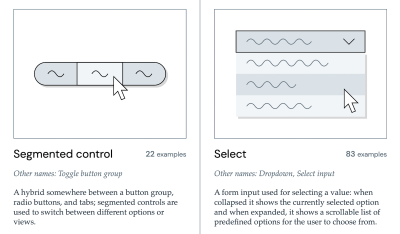
The gallery documents not only standard UI elements—ranging from basic accordions to visually hidden utility classes—but also catalogues the various alternative names these components hold across different organizational design systems. This cross-referencing capability enables design system architects to select universally recognized terms, minimizing user cognitive load and ensuring alignment with established accessibility guidelines. This is further reinforced by visual dictionaries such as Name That UI, which offer rapid visual identification for common interface patterns.
Strategic Nomenclature for New Product Features
While internal code and design tokens require systemic predictability, customer-facing feature naming demands a distinct psychological approach. Low feature adoption rates are frequently attributed not to poor utility, but to weak discoverability stemming from obtuse or internal-facing nomenclature.

UX strategist Erin Gannon highlighted in her comprehensive research on feature discoverability that successful feature names must be anchored firmly in user needs rather than internal corporate terminology. Gannon’s framework dictates that optimal feature names should communicate a clear value proposition or outcome—reflecting the user’s "job-to-be-done"—while directly adopting the vocabulary used by customers during user research sessions. By asking users to articulate their workflows and pain points in their own words, product teams can bridge the gap between technical implementation and intuitive user discovery.
Enterprise Product and Service Naming Methodologies
Beyond interface elements and tokens, naming entire digital products, services, or sub-brands represents a critical juncture for organizational growth. Open-source repositories such as Onym consolidate methodologies, brainstorming frameworks, vetting procedures, and linguistic resources specifically designed for product nomenclature. These resources guide teams through the complexities of linguistic analysis, trademark screening, and cultural vetting, mitigating the risk of costly rebranding campaigns resulting from ambiguous or culturally insensitive naming choices.

Broader Implications and Strategic Recommendations
The cumulative impact of standardized nomenclature extends far beyond aesthetic neatness; it represents a core pillar of operational efficiency and software maintainability. Industry analysts note that organizations investing in robust documentation, clear design token taxonomies, and cross-functional naming conventions experience significantly fewer regressions during major design system updates and platform migrations.
To successfully implement these practices within active engineering and design workflows, industry leaders recommend establishing cross-functional nomenclature committees, maintaining centralized design token inventories, and conducting regular audits of feature names against user testing data. By treating naming as a first-class engineering and design discipline rather than an afterthought, organizations can eliminate costly semantic misunderstandings, accelerate development cycles, and deliver more cohesive, intuitive digital experiences to their users.