Choosing a Chunking Strategy for Your LLM Apps: A Decision-Tree Approach

The Foundational Challenge of Document Partitioning
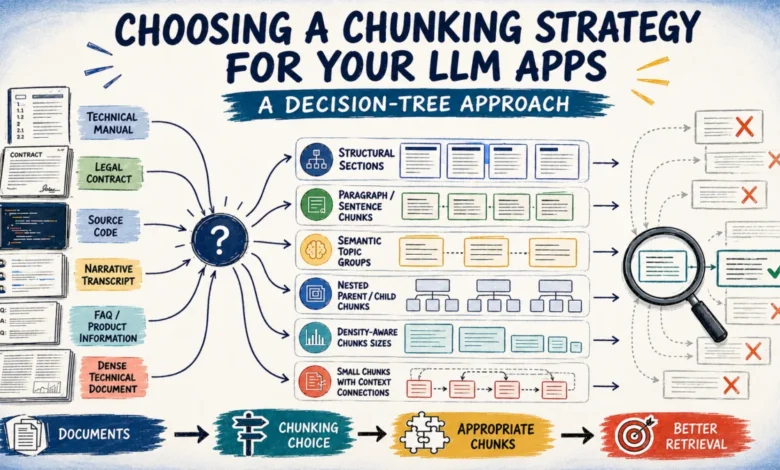
Retrieval-augmented generation (RAG) functions by grounding large language models in external, domain-specific data. However, modern embedding models and LLMs operate within constrained context windows. When a document is significantly larger than these limits, it must be subdivided. While this process seems straightforward, industry data indicates that improper chunking strategies are responsible for a significant percentage of retrieval failures.
When a chunking algorithm slices a document in a way that disrupts semantic cohesion—such as cutting a sentence in half or separating a header from its corresponding data—the embedding representation loses its descriptive power. This leads to a degradation in vector search performance, where relevant information is either ignored or incorrectly ranked, ultimately forcing the downstream LLM to generate responses based on fragmented or contextually bankrupt data.
Chronology of RAG Development and the Rise of Chunking
The evolution of chunking techniques has tracked the broader development of the RAG architecture. In the early stages of the generative AI boom (roughly 2022–2023), "fixed-size" or "token-based" chunking was the industry standard. This method, which arbitrarily cuts text after a specific number of tokens, was favored for its computational simplicity and speed.
However, as developers encountered the limitations of this "blind" approach, the field transitioned toward more sophisticated methodologies. By late 2023, the focus shifted to "document-based" or "structural" chunking, which leveraged existing metadata like HTML tags, markdown headers, and indentation patterns. In 2024 and 2025, the industry saw the rise of semantic and agentic chunking, where the AI itself evaluates the content to determine where a logical thought ends and a new one begins. This progression highlights a clear industry trend: moving away from rigid, rule-based systems toward dynamic, context-aware processing.
The Decision-Tree Framework
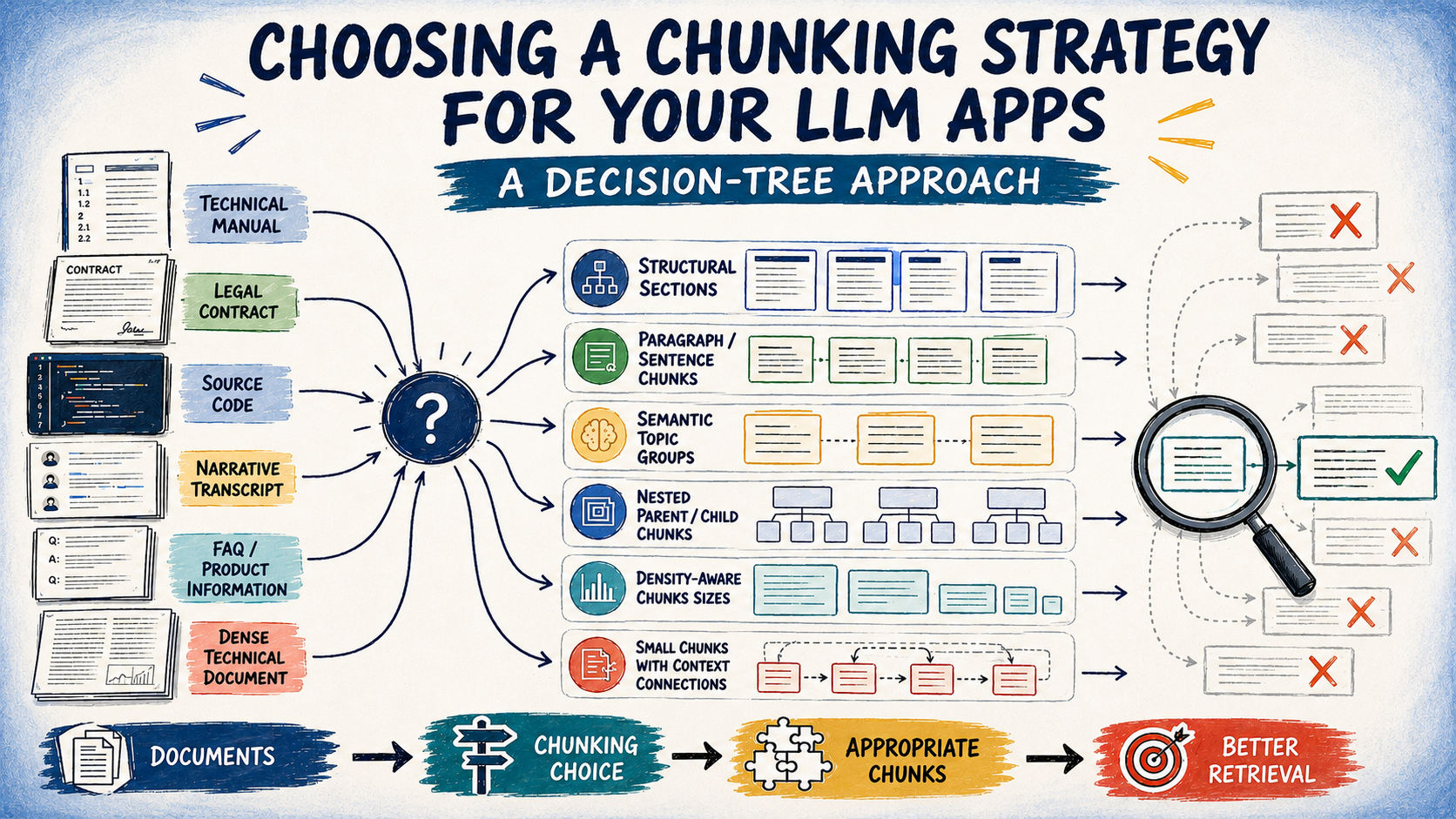
To streamline the selection process, developers can utilize a six-step decision-tree model that evaluates both the nature of the source documents and the specific requirements of the retrieval task.
1. Evaluation of Document Utility
The first question is whether the document actually requires chunking. For concise assets such as FAQ entries or individual configuration files, the overhead of segmenting data is often unnecessary. Research suggests that if a document can fit entirely within the embedding model’s context window, maintaining its integrity as a single unit preserves the highest level of semantic nuance.
2. Identifying Structural Markers
If the document exceeds the context window, the next step is to evaluate its internal structure. Documents with robust, machine-readable formats—such as structured PDFs, Markdown, or code files—are ideal candidates for document-based chunking. By utilizing parsers that recognize headers, function definitions, or bullet points, the system ensures that chunks represent complete logical units.
3. Managing Cross-Reference Dependencies
A frequent failure point in RAG systems is the loss of "global context." For legal documents or complex technical specifications, the meaning of a paragraph in the final section often depends on a definition provided in the preamble. For such cases, "late chunking" has emerged as a superior methodology. By embedding the entire document using a long-context model before partitioning it, the system ensures that every chunk retains a mathematical representation of the entire document’s context.
4. Balancing Density and Granularity
In instances where a document contains varying levels of information density—such as a manual that alternates between high-level summaries and granular technical details—adaptive or hierarchical chunking becomes necessary. Hierarchical chunking, in particular, allows a system to retrieve a high-level summary chunk for broad queries and a detailed sub-chunk for specific, technical questions, effectively optimizing the retrieval process for multiple query types.
5. The Cost-Quality Tradeoff
For high-stakes applications like medical or financial diagnostics, the accuracy of retrieval is paramount, often justifying the use of LLM-based chunking. In this model, an LLM acts as an editor, identifying atomic propositions within the text. While this approach is computationally expensive and introduces higher latency, it minimizes the risk of semantic drift. Conversely, for cost-sensitive applications, semantic chunking—which uses vector distance to detect topic shifts—offers a middle ground between performance and affordability.
6. Handling Heterogeneous Collections
When dealing with large, diverse datasets, "agentic chunking" represents the cutting edge of current best practices. By employing an AI agent to inspect each document individually and select the most appropriate strategy (e.g., using structural chunking for a report but recursive chunking for a transcript), developers can achieve high performance across varied data environments.
Analysis of Common Pitfalls
Industry reports indicate that when systems underperform, the issue is rarely the quality of the LLM itself, but rather the quality of the "retrieval signal." A common symptom of poor chunking is the "mid-sentence cut," which occurs when developers apply structure-blind methods to highly structured data. The corrective measure is almost always to shift toward recursive or structure-aware chunking.
Another observed pitfall is "budget bloat" associated with agentic or LLM-based chunking. To mitigate this, enterprise developers are advised to cache the strategy decisions made at the collection level rather than re-evaluating every document during every ingestion cycle. This simple architectural change can reduce infrastructure costs by orders of magnitude without sacrificing the benefits of the agentic approach.
Broader Implications and Future Directions
The shift toward more intelligent, context-aware chunking signifies a broader move toward "data-centric AI." As the capabilities of LLMs continue to expand, the bottleneck for high-quality generation is increasingly becoming the way data is prepared and surfaced.
The integration of these strategies into automated data pipelines is expected to become the industry standard for enterprise search and RAG systems. By moving beyond "one-size-fits-all" partitioning, organizations can significantly improve the accuracy of their AI applications, leading to more reliable, hallucination-resistant outputs. As the field matures, the focus will likely shift further toward automated, real-time optimization, where the system itself tunes its chunking strategy based on the performance of its own retrieval metrics, effectively closing the loop on the RAG lifecycle.
Conclusion
Selecting the appropriate chunking strategy is not merely a technical configuration; it is a fundamental design decision that dictates the efficacy of the entire RAG pipeline. By mapping document properties to the appropriate strategy—whether it be the simplicity of recursive methods or the precision of LLM-based parsing—organizations can build systems that are both robust and highly accurate. The goal for developers remains clear: minimize the loss of information during the preprocessing phase so that the model can perform with the highest possible degree of contextual awareness.