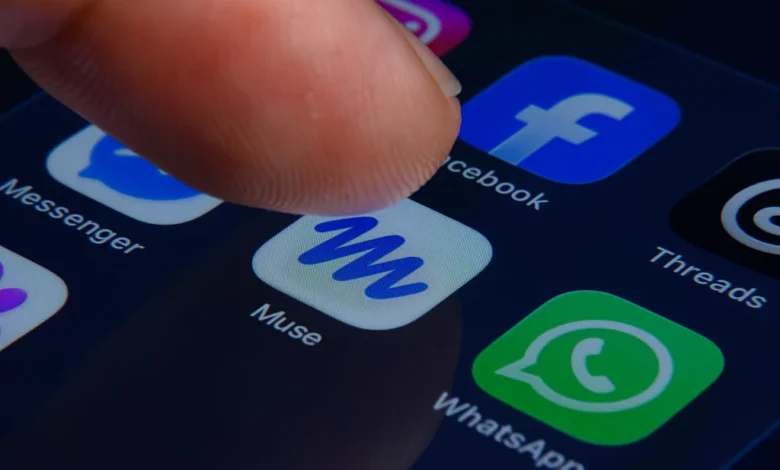
Meta’s newly introduced artificial intelligence application, Muse, has achieved a remarkable start in the consumer technology market, outperforming the early mobile rollout benchmarks set by OpenAI’s ChatGPT in key regions. According to fresh estimates published by market intelligence firm Apptopia, the personal AI agent recorded higher download volumes and daily active user counts during its initial 12 days on the market than ChatGPT managed during the exact same corresponding timeframe following its historical debut.
The early trajectory of Muse underscores a broader corporate strategy by Meta to aggressively cement its foothold in the consumer artificial intelligence sector. By leveraging its vast ecosystem of established social platforms, the tech giant is positioning its new application to capture mainstream attention rapidly, signaling a potential shift in the competitive landscape of generative AI and personal assistant technologies.
A Methodological Breakdown of Early Adoption Metrics
Comparing the early performance of two major consumer applications requires navigating disparate rollout strategies. When OpenAI originally introduced ChatGPT to mobile devices, the release was deployed on a global scale but restricted exclusively to Apple’s iOS platform. Conversely, Meta engineered Muse to be accessible across both major mobile operating systems—Apple’s App Store and Google Play—yet initially constrained its geographical availability strictly to the United States and Canada.
To establish an equitable evaluation, Apptopia analysts isolated the dataset to examine exclusively iOS downloads within the U.S. and Canada for both applications during their respective 12-day launch windows. Within this filtered parameter, Muse accumulated approximately 1.8 million downloads, surpassing ChatGPT’s early baseline of 1.3 million installations over the same duration.
When expanding the scope to encompass total global availability across both supported platforms and regions, Muse crossed a total of 2.8 million installs during its first 12 days on the market. Furthermore, market tracking indicates that consumer interest has accelerated rather than plateaued. Muse steadily climbed the rankings on the U.S. Apple App Store, moving from an initial position of No. 2 overall at launch to claim the No. 1 spot shortly thereafter, briefly outpacing the historical trajectory of competing AI tools.
Engagement and Daily Active User Comparisons
Download volume provides only a preliminary view of consumer adoption; active user engagement offers a clearer picture of an application’s long-term viability. Apptopia’s metrics reveal that Muse has also captured superior daily active user (DAU) numbers compared to ChatGPT at the identical juncture in its market lifecycle.
In a direct comparison of U.S. mobile app daily active users, Muse registered roughly 642,000 daily active users, contrasted with 231,000 for ChatGPT at the same post-launch milestone. Even when neutralizing the operating system variable by restricting the comparison purely to U.S. and Canadian iOS users, Muse maintained the advantage, securing 359,000 daily active users compared to ChatGPT’s historical figures for that platform subset.

Industry analysts emphasize that while these findings are derived from third-party estimation models rather than direct corporate disclosures from Meta, they provide a reliable directional gauge. Even viewed as approximations, the figures confirm that Muse has successfully transitioned from a heavily anticipated software release into a high-engagement consumer utility.
The Power of Cross-Platform Integration and Ecosystem Leverage
A primary driver behind the rapid ascension of Muse is Meta’s well-documented proficiency in cross-promotion and ecosystem integration. The company previously validated this playbook with the launch of Threads, its microblogging platform designed to compete with X (formerly Twitter). Bolstered by deep integrations within Facebook and Instagram—Meta’s flagship properties boasting billions of monthly users—Threads scaled rapidly to secure over 500 million monthly active users.
Muse appears positioned to benefit from a similar architectural advantage. The personal AI agent is designed to interface directly with Instagram and Facebook, while also offering functionality within messaging applications like WhatsApp. Third-party data analytics highlight the immediate impact of this interconnected architecture: over 95% of active Muse users are simultaneously registered users of Facebook, and approximately 63% maintain active profiles on Instagram.
This tightly wound digital funnel drastically reduces customer acquisition costs for Meta. Rather than relying entirely on external search engine optimization or costly digital ad campaigns, the company can direct billions of existing social media users straight to the application store listings through native notifications, feed placements, and profile cross-links.
Chronology of the Muse Rollout
The rapid deployment and subsequent market reception of Muse unfolded across a concentrated timeline of strategic announcements and analytical milestones:
- Early September: Meta initiates the regional rollout of Muse, making the personal AI application available on both the Apple App Store and Google Play, restricted to users in the United States and Canada.
- Launch Day: The application immediately captures consumer attention, securing the No. 2 overall ranking on the U.S. App Store.
- Day 5 to 7: Analytics firms, including Appfigures, report that the application has crossed the 1-million-download threshold globally, reflecting strong initial word-of-mouth momentum.
- Day 10: Muse climbs past competing tools to secure the No. 1 overall spot on the U.S. App Store charts.
- Day 12: Apptopia releases comprehensive comparative estimates showing that Muse has outpaced ChatGPT’s early mobile download and daily active user benchmarks in the North American market.
Broader Industry Implications and Corporate Response
As of publication, representatives for Meta have not publicly released official adoption figures or commented directly on the third-party market estimates compiled by Apptopia. The silence from corporate headquarters is consistent with Meta’s historical approach to early-stage product deployments, preferring to let platform performance and analytical consensus drive the narrative.
The strong early performance of Muse highlights an evolving shift in the generative artificial intelligence sector. While standalone applications like ChatGPT pioneered the direct-to-consumer conversational AI market, technology conglomerates with massive pre-existing distribution networks are proving uniquely capable of driving rapid adoption at scale. By embedding intelligence capabilities directly into everyday social routines and messaging workflows, Meta is attempting to normalize personal AI usage for a broader demographic that may not actively seek out standalone productivity tools.
Whether Muse can sustain this explosive growth over the long term will depend heavily on user retention, feature expansion, and the ongoing utility of its personal agent capabilities. However, the initial data establishes that Meta’s serious entry into the consumer AI application space has successfully captured the immediate attention of the North American market, setting the stage for a prolonged battle for digital assistant supremacy.