Building Tactile UX: Honoring Intentional Design with Lottie, DOM Events, and Distance-Based Math

The modern web is increasingly driven by interactive, gamified experiences that demand physical intuition from users. When front-end developers and user experience (UX) engineers are tasked with building a web interface that feels tactile, bouncy, or responsive to destruction, the standard industry instinct is almost invariably to reach for a dedicated physics engine. Frameworks such as Matter.js, Cannon.js, or custom WebGL solutions have long served as the gold standard for creating immersive, gamified websites that mimic the laws of the physical world. However, these tools are not always the optimal choice when precision and art direction take precedence over algorithmic chaos.
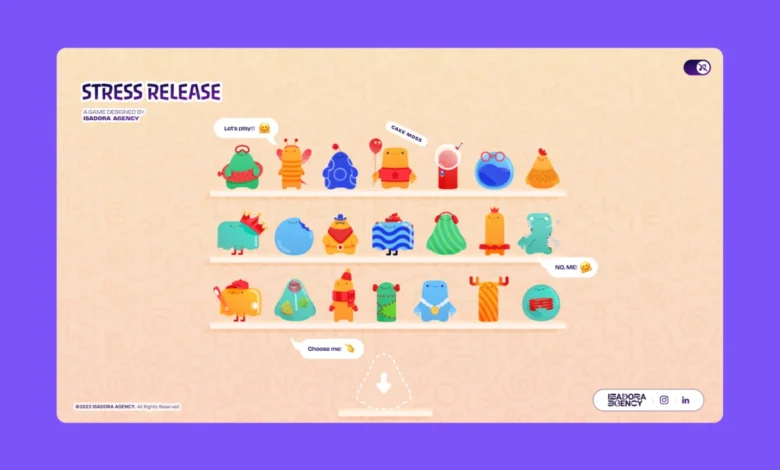
When the engineering and design team at Isadora Agency set out to build Stress Release—a digital stress-relief squeeze toy application designed to let burnt-out creatives smash, stretch, and distort animated UI characters—they initially explored the physics engine route. The overarching goal was to construct a highly tactile environment where every click yielded a satisfying, squishy reaction reminiscent of a physical stress ball. Yet, as the team progressed into the prototyping phase, a fundamental architectural conflict emerged: physics engines produce plausible, emergent motion, whereas the project’s animators had produced meticulously crafted, intentional motion.
Rather than relying on real-time gravity, friction, and elastic collisions that could cause animated characters to bounce unpredictably across a canvas, the developers needed exact, frame-by-frame predictability. This realization led to a decision to scrap the physics engine entirely in favor of a stack built on programmatic Lottie state controls, standard Document Object Model (DOM) manipulation, and distance-based mathematics. The resulting project proved that highly responsive, tactile digital environments could be engineered without a single line of WebGL or Matter.js, paving the way for a new approach to interactive web design.
The Design Requirements: Prioritizing Deterministic Control Over Emergent Simulation
The core technical requirement for Stress Release was absolute deterministic control. The project’s motion designers had crafted bespoke JavaScript Object Notation (JSON) Lottie files that required exact, frame-by-frame sequencing to achieve their intended comedic and visual impact. For example, a signature "mega squeeze" reaction required a precise 181-frame build-up followed by a specific, timed release sequence.
Allowing a physics engine to dictate how a character deformed would have overwritten the animators’ carefully timed keyframes with algorithmic approximations. In interactive design, the tighter the feedback loop between user input and visual output—such as click, squish, and score—the greater the need for deterministic frame control. By utilizing programmatic state management through Lottie’s native application programming interface (API), the development team ensured that the interaction layer acted as a flawless, immediate trigger for the animation layer rather than a simulation environment.
Mapping DOM Elements to Lottie States Through Mathematical Precision

Because the architecture relied on Lottie and the standard DOM, rendering was handled directly by the Lottie runtime, which interprets vector animations as Scalable Vector Graphics (SVGs) internally. Developers selected interface elements directly by their identification tags and CSS classes, driving their behavior using a combination of Lottie animation segments, Cascading Style Sheets (CSS) transforms, and click-event coordinate math.
To achieve a convincing tactile sensation when a user interacted with a character, the team implemented radial input mapping. The primary technical hurdle involved converting raw click coordinates from global page space into the character’s local coordinate space. Every user click was measured relative to the character’s absolute center point and subsequently translated into a point score, feedback intensity rating, and precise explosion particle placement.
By utilizing standard geometric principles, specifically the Pythagorean theorem, the application calculated the straight-line distance from the center of the click to the character’s core. This single numerical value served as the driver for multiple application logic branches, including point rewards, visual feedback intensity, and the coordinates for overlay effects. Concentric distance zones mapped directly to point rewards, functioning identically to a traditional dartboard. Consequently, the visual complexity of the Lottie SVG became irrelevant to hit detection, as the interactive hitbox remained a clean, predictable circle.
Furthermore, auxiliary Lottie animations, such as impact explosions, were dynamically repositioned to match the exact vector coordinates of the user’s click. This spatial synchronization fostered an immediate psychological connection for the user, reinforcing the sensation of physical impact entirely through basic mathematics and DOM positioning.

Managing Interactive Narratives and Responsive Design Benefits
Handling user interactions efficiently required a streamlined approach to event listening. Because the experience utilized DOM-managed SVG elements, desktop mouse clicks and mobile touchscreen taps were managed natively via standard event listeners. This design choice circumvented the need for complex raycasting or coordinate remapping layers, keeping the interaction model closely aligned with how the vector graphics were rendered on the screen.
Each character within the application featured a predefined set of animation sections, categorized into idle loops, progressive reaction frames, and terminal end states stored as discrete frame ranges. When a user input was registered, the application immediately halted any ongoing animation, disabled looping to ensure the sequence played out correctly, and jumped directly to the animation segment corresponding to the current game state. Once the specific reaction sequence concluded, an event callback returned the character smoothly to its default idle loop.
Opting for a DOM-based architecture yielded significant advantages in responsive design. Crafting Stress Release within the standard web document structure allowed the team to bypass the notorious complexities of scaling bounding boxes and collision vectors across disparate mobile and desktop viewports. Responsive scaling was handled entirely through CSS custom properties, commonly known as CSS variables. By dynamically recalculating these properties upon window resize events, the user interface adapted fluidly, permitting the Lottie SVGs to scale naturally inside their respective containers without suffering state corruption or rendering degradation.

Addressing Mobile Performance Optimization and Asset Weight
While the chosen architecture granted the development team total control over the artistic direction and visual pacing, it introduced a notable technical challenge: asset file size. Lottie JSON files can quickly become bloated, particularly when containing complex vector paths. The Stress Release application incorporated 21 distinct character animations alongside multiple explosion variants, all of which needed to be loaded efficiently.
To ensure that frame rates remained fluid, especially on resource-constrained mobile devices, the development team implemented aggressive optimization strategies. For the character selection shelf—where 21 separate vector animations played simultaneously in a grid—the global Lottie quality was deliberately throttled. By reducing interpolation calculations and lowering the playback speed on background elements, the application successfully mitigated central processing unit (CPU) bottlenecks. Conversely, the primary interactive play screen utilized full-quality rendering, as only a single character animation was active at any given moment.
Broader Implications for Web Architecture and Creative Engineering

The development of Stress Release underscores a vital lesson in modern web development: technology stacks should always be dictated by specific design requirements rather than prevailing industry trends. While physics engines remain indispensable for games requiring emergent behavior, gravity simulations, or multi-object collisions, they can hinder projects that prioritize artistic intentionality and strict narrative control.
By strategically mapping Lottie’s native timeline capabilities directly to the DOM, developers can deliver exceptionally rich, tactile user experiences while retaining absolute dominion over art direction. This methodology bridges the traditional gap between creative vision and technical execution, proving that sophisticated interactivity can be achieved through clever programmatic state control and mathematical precision rather than heavy simulation libraries.