Tapstitch vs. Printful: A Comprehensive Comparison for Print-on-Demand Sellers

In the burgeoning landscape of e-commerce, print-on-demand (POD) platforms have emerged as crucial tools for entrepreneurs and established brands alike seeking to offer custom merchandise without the burden of upfront inventory. Among the prominent players, Tapstitch and Printful represent distinct philosophies in this dynamic market. While both platforms facilitate the creation and sale of custom-designed products, they cater to different niches and offer varying levels of functionality. This in-depth analysis, drawing from extensive research and hands-on testing, aims to provide a clear, objective recommendation for sellers navigating this choice. For those prioritizing a broad product catalog and extensive global reach, Printful stands out as the more robust and adaptable option. Conversely, Tapstitch presents a compelling case for businesses focused on cultivating a premium streetwear or fashion-forward brand identity.
The core divergence between Tapstitch and Printful lies in their strategic focus. Printful, a seasoned veteran in the POD space, has cultivated an expansive ecosystem designed to serve a wide array of sellers, from individual creators to large enterprises. Its strength lies in its sheer breadth of product offerings, integration capabilities, and global fulfillment network. This comprehensive approach makes it a versatile choice for those looking to diversify their product lines or tap into international markets with relative ease.
Tapstitch, on the other hand, has carved out a more specialized niche. Its deliberate focus on high-quality apparel, particularly within the streetwear and fashion segments, allows it to offer a curated selection of premium blanks. This specialization is geared towards brands that prioritize the tactile feel, cut, and overall aesthetic of their garments, aiming to position themselves as authentic fashion labels rather than general merchandise providers.
Tapstitch vs. Printful: A Quick Verdict
For the majority of print-on-demand sellers, Printful emerges as the safer and more versatile bet. Its extensive product catalog, encompassing a wide range of apparel, home decor, accessories, and wall art, coupled with its advanced print methods and expansive global fulfillment network, provides unparalleled flexibility. Printful’s robust integration capabilities with over 21 e-commerce platforms and marketplaces, including major players like Amazon, TikTok Shop, and eBay, further solidify its position as the go-to solution for sellers aiming for broad market penetration and multi-channel sales strategies.
However, Tapstitch deserves serious consideration for brands specifically targeting the premium streetwear and fashion market. Its commitment to high-quality, heavyweight apparel blanks, coupled with a focus on large print areas and precise garment construction, offers a distinct advantage for those aiming to cultivate an authentic fashion identity. The platform’s vertically integrated production facilities and emphasis on garment feel and finish can provide a superior product for discerning customers in this niche.
Quick Comparison: Tapstitch vs. Printful
To provide a clear overview, a comparative analysis of key features is essential:
| Category | Tapstitch | Printful | Winner |
|---|---|---|---|
| Product Range | 400+ apparel-only blanks | 479+ SKUs across apparel, home, accessories, wall art | Printful |
| Print Methods | DTG, DTF | DTG, embroidery, sublimation, cut & sew, UV | Printful |
| Garment Quality | Heavyweight, premium streetwear cuts | Consistent, good across large catalog | Tapstitch |
| Integrations | Shopify, Etsy, Wix | 21+ platforms including Amazon, TikTok Shop, API | Printful |
| Pricing | Free, pay-per-order | Free to start; Growth plan ~$24.99/mo | Tie |
| Global Fulfillment | US & CN facilities only | 12+ global fulfillment centers | Printful |
| Branding Options | Custom neck labels, brand-forward packaging | Inside labels, pack-ins, packing slips | Tie |
Best for Pricing: It’s a Tie (with a caveat)
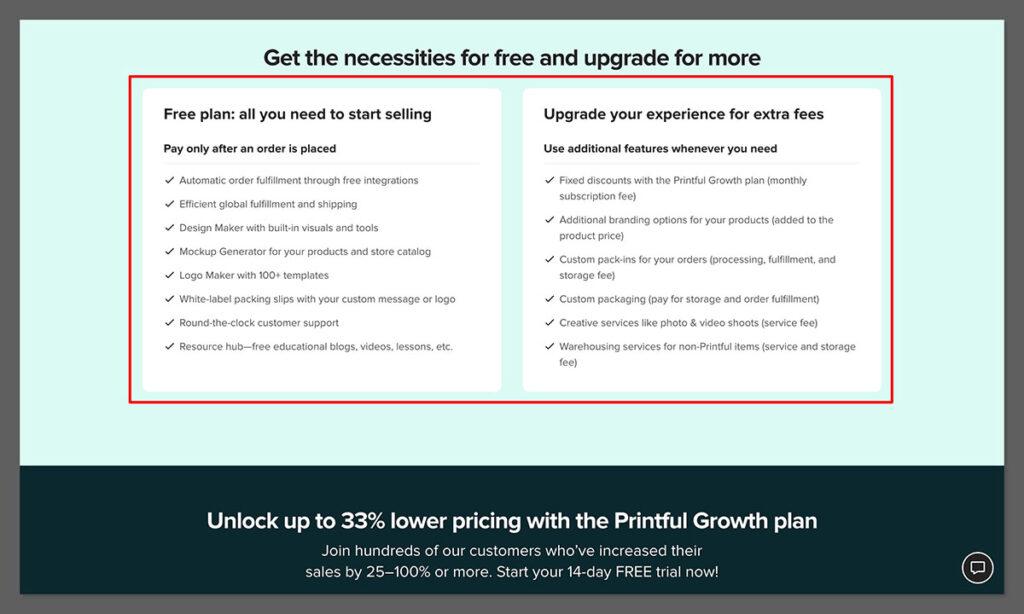
Both Tapstitch and Printful offer an accessible entry point for new sellers by not imposing mandatory monthly fees. Tapstitch operates on a straightforward pay-per-order model, ensuring that costs are directly tied to sales. Printful adopts a similar free-to-start approach but also offers an optional "Growth" plan, priced at approximately $24.99 per month. This premium tier unlocks product discounts of up to 33%, which can become a significant cost-saving advantage for sellers experiencing higher order volumes.
At the unit level, the pricing difference is often minimal. A comparable branded t-shirt with U.S. shipping typically falls around $22.95 on Tapstitch and approximately $21.73 through Printful. This slight disparity becomes more pronounced when factoring in Printful’s Growth plan discounts at scale. For smaller operations or those just beginning their e-commerce journey, both platforms present a cost-neutral starting point. However, for businesses anticipating substantial sales volume, Printful’s Growth plan can offer substantial savings, effectively paying for itself through reduced per-unit costs.
Pricing at a Glance
| Dimension | Tapstitch | Printful |
|---|---|---|
| Base platform fee | $0 – Pay per order only | $0 to start; Optional Growth plan ~$24.99/mo |
| Typical tee + US shipping | ~$22.95 | ~$21.73 |
| Volume discounts | None | Up to ~33% off on paid plan |
| Free trial | Free account, no trial needed | Free account, no trial needed |
The Winner for Pricing: At low volumes, pricing is a tie, with both platforms offering free access and comparable per-unit costs. Printful gains an edge for higher-volume sellers through its Growth plan discounts.
Best for Product Range: Printful
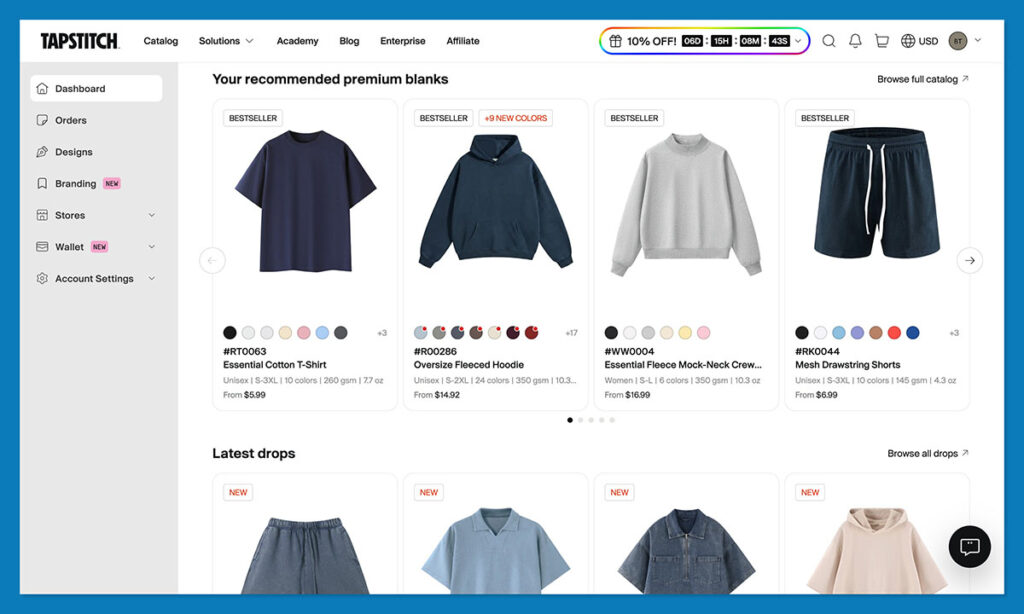
The most significant differentiator between Tapstitch and Printful lies in their product catalog breadth. Tapstitch has intentionally adopted a focused approach, concentrating almost exclusively on fashion apparel. Its catalog boasts over 400 clothing blanks, meticulously curated to cater to the streetwear and fashion-forward aesthetic, featuring heavyweight tees, high-GSM hoodies, oversized cuts, and styles that align with contemporary trends. If a seller’s vision extends beyond apparel to include items like mugs, phone cases, or canvas prints, Tapstitch is not the appropriate platform.
In stark contrast, Printful offers an expansive and diverse product range, exceeding 479 Stock Keeping Units (SKUs). This comprehensive catalog spans apparel, home decor, accessories, and wall art, providing sellers with the flexibility to create a multifaceted product line. Furthermore, Printful supports a wider array of printing techniques, including Direct-to-Garment (DTG), embroidery, all-over sublimation, cut-and-sew, and UV printing. This versatility is a considerable advantage for sellers looking to diversify their offerings, test new product categories, or cater to a broader customer base.
Where Tapstitch excels within its specialized domain is in the depth of its apparel selection. Its emphasis on premium blanks, characterized by substantial fabric weights and generous print areas—including oversized back prints—is a key selling proposition for fashion brands. For a clothing company solely focused on delivering high-end tees and hoodies, Tapstitch’s curated catalog is a strategic feature, not a limitation.
Product and Print Method Comparison
| Dimension | Tapstitch | Printful |
|---|---|---|
| Catalog breadth | Apparel-only, ~400+ fashion-focused blanks | 479+ SKUs across apparel, home, accessories, wall art |
| Print methods | DTG, DTF (apparel only) | DTG, embroidery, all-over sublimation, cut & sew, UV |
| Specialty strengths | Heavyweight tees, 400 GSM hoodies, oversized fits, large print zones | All-over print products, embroidered hats, diverse merch types |
The Winner for Product Range: Printful unequivocally wins in product range. Its catalog of over 479 products and diverse printing methods make it the superior choice for sellers aiming to offer more than just apparel.
Best for Print Quality: Tapstitch
Quality is where Tapstitch makes its most compelling argument. The platform operates its own vertically integrated production facilities, a model that allows for greater control over the manufacturing process. Utilizing modern DTG and DTF printing technologies, Tapstitch emphasizes the quality of its garment blanks. Independent reviews frequently highlight Tapstitch’s apparel quality as superior to mass-market POD offerings, particularly for streetwear applications. Noteworthy aspects include strong white ink coverage, good wash performance, and premium fabric weights that contribute to a more luxurious feel.
Printful, while renowned for its consistency and reliability at scale, has occasionally faced user community feedback regarding print placement variance, with some reports indicating discrepancies of 0.5 to 1 inch. While this might be negligible for some product types, it can be a critical consideration for fashion brands where precise design placement is paramount. It is important to acknowledge that Tapstitch, being a relatively younger platform compared to Printful, has a more limited volume of third-party reviews. However, the existing feedback strongly favors Tapstitch for apparel-centric sellers who prioritize garment quality and a refined finish.
Quality and Fulfillment Details
| Dimension | Tapstitch | Printful |
|---|---|---|
| Production model | In-house, vertically integrated facilities | Own and partner facilities across multiple regions |
| Locations | Los Angeles (US) and Guangzhou (China) | 12+ fulfillment centers in North America, EU, and beyond |
| Typical production time | ~2–4 business days | ~2–5 business days depending on product and region |
| Quality notes | Heavy fabrics, strong color output, solid wash performance | Consistent at scale; some reports of print placement variance |
The Winner for Print Quality: Tapstitch secures the win for apparel print quality. Its vertically integrated production and focus on premium blanks provide a distinct advantage for fashion-focused sellers where the tactile and visual attributes of the product are paramount.
Best for Global Reach and Shipping: Printful
For businesses with an international customer base, Printful’s global infrastructure offers a significant advantage. With over 12 fulfillment centers strategically located across North America, Europe, and other regions, Printful can produce orders closer to the end customer. This proximity translates to reduced delivery times, lower shipping costs, and a diminished likelihood of encountering customs-related delays or complexities.
Tapstitch currently fulfills orders from two primary locations: Los Angeles in the United States and Guangzhou in China. While this setup is effective for U.S.-centric brands and can serve international orders routed through its China facility, it offers fewer logistical options and less flexibility compared to Printful’s distributed network. Sellers targeting markets in Europe, for instance, will find Printful’s localized production capabilities to be a substantial benefit, ensuring more efficient and cost-effective delivery to these key regions.
The Winner for Global Reach and Shipping: Printful excels in global fulfillment. Its network of over 12 facilities enables faster, more economical international shipping, surpassing the capabilities of Tapstitch’s two-location model.
Platform Integrations and Tooling
Tapstitch offers integrations with essential e-commerce platforms such as Shopify, Etsy, and Wix. These platforms cover the foundational needs of many emerging clothing brands. However, for sellers aiming to expand their reach across a wider array of channels, including Amazon, eBay, TikTok Shop, WooCommerce, or Squarespace, Tapstitch’s integration options are limited.
Printful, in contrast, boasts an extensive integration network, connecting with over 21 e-commerce platforms and marketplaces. Furthermore, it provides an Application Programming Interface (API) for developers seeking to build custom integrations. The platform also offers a comprehensive suite of tools designed to streamline the e-commerce workflow. These include AI-assisted design features, a robust mockup generator, product templates, bulk ordering capabilities, and "Quick Stores," a feature that allows sellers to quickly launch a simple storefront.
While Tapstitch provides a capable built-in design tool with 3D apparel mockups, ideal for curating fashion-focused catalogs, Printful’s ecosystem is more developed in terms of automation and cross-channel capabilities. Tapstitch does support custom neck labels (for an additional fee), which can significantly enhance the perceived premium quality of apparel brands. However, in terms of sheer platform breadth, integration options, and advanced automation features, Printful holds a distinct advantage.
Platform Capabilities Compared
| Dimension | Tapstitch | Printful |
|---|---|---|
| Integrations | Shopify, Etsy, Wix | 21+ platforms including Amazon, eBay, TikTok Shop, plus API |
| Design tools | Built-in designer with 3D apparel mockups | Full mockup generator, AI design tools, product templates |
| Branding | Custom neck labels (paid), brand-forward packaging | Inside labels, pack-ins, branded packing slips |
| Scale tools | Curated catalog focus, fewer automation features | Bulk tools, automation, warehousing, sample discounts |
The Winner for Integrations and Tooling: Printful wins decisively in this category. Its extensive list of over 21 platform integrations and a more sophisticated ecosystem of design and automation tools make it the superior choice for sellers focused on multi-channel growth and operational efficiency.
When to Choose Tapstitch Over Printful
Tapstitch emerges as the preferred choice under specific circumstances. For entrepreneurs dedicated to building a distinct clothing brand rather than a general merchandise store, Tapstitch’s emphasis on premium blanks, fashion-forward catalog, and superior garment quality is difficult to match with Printful’s more generalized approach. The heavyweight fabrics, generous print areas, and streetwear-ready cuts are meticulously designed for curated apparel collections and exclusive drops, setting them apart from standard mass-market t-shirt printing.
Furthermore, Tapstitch is a strong contender for brands whose primary customer base resides in the United States. Its Los Angeles-based fulfillment center ensures rapid domestic delivery without the logistical complexities associated with multi-region fulfillment networks. For brands aiming to cultivate an authentic clothing label identity, Tapstitch’s offering of custom neck labels and brand-forward packaging options significantly bridges the gap between a print-on-demand service and a genuine apparel brand.
However, this specialization comes with trade-offs. A more limited selection of integrations, the absence of volume-based pricing discounts, and a narrower product range outside of apparel are factors to consider. The platform’s younger status also means a smaller pool of third-party reviews compared to established giants like Printful. For the right brand, these considerations may be outweighed by the unique benefits Tapstitch offers.
When Printful Still Wins
Printful remains the superior option for the majority of sellers in most scenarios. If the intention is to offer a diverse range of products, including embroidered hats, all-over print hoodies, mugs, posters, or phone cases, Printful’s extensive catalog is unmatched. This breadth allows sellers to consolidate their entire product line under a single provider, eliminating the need to switch between multiple services.
Printful also unequivocally wins for sellers with a significant international customer base. Customers in Europe, the UK, or Australia will benefit from faster and more cost-effective delivery through Printful’s localized fulfillment centers compared to orders shipped from Tapstitch’s U.S. or China hubs. Moreover, for sellers leveraging marketplaces like Amazon, TikTok Shop, or eBay, Printful’s seamless integrations are indispensable, as Tapstitch does not currently support these platforms.
Finally, for businesses scaling their operations, Printful’s Growth plan and tiered discount structure present a considerable cost advantage that Tapstitch’s flat pricing model cannot replicate.
How We Tested Tapstitch and Printful
Our comprehensive comparison is grounded in rigorous, hands-on platform testing, an extensive review of independent user feedback and community discussions, and a thorough analysis of third-party comparative data. We evaluated both platforms across key areas critical to print-on-demand sellers, with emphasis placed on the following:
- Product Selection: Assessing the breadth, depth, and quality of available product blanks across various categories.
- Print Quality: Evaluating the fidelity, durability, and aesthetic appeal of printed designs on different materials and product types.
- Integration Capabilities: Examining the ease and breadth of connections with e-commerce platforms, marketplaces, and other relevant software.
- Pricing Structure: Analyzing base fees, per-unit costs, shipping charges, and any available discount or subscription models.
- Fulfillment and Shipping: Assessing production times, shipping speeds, global reach, and the efficiency of the logistics network.
- Branding Options: Reviewing the availability and quality of customization features, such as private labeling and custom packaging.
- User Experience and Support: Evaluating the intuitiveness of the platform interface, the quality of design tools, and the responsiveness of customer support.
Tapstitch vs. Printful: Our Winner
For the vast majority of print-on-demand sellers, Printful stands out as the superior platform. Its expansive product catalog, diverse printing methods, extensive network of over 21 integrations, and robust global fulfillment infrastructure position it as the most versatile and scalable solution for a wide spectrum of e-commerce needs. Whether you operate your store on Shopify, sell across Amazon and TikTok Shop, or fulfill orders to customers worldwide, Printful is engineered to meet these demands.
However, Tapstitch earns a distinct recommendation for brands that are exclusively focused on high-end apparel and fashion. If your business model is centered around premium t-shirts and hoodies, Tapstitch’s commitment to superior garment quality, expansive print areas, and streetwear-ready blanks offers a distinct advantage that Printful’s more generalized approach cannot fully replicate.
The cost difference between the two platforms is marginal at lower sales volumes, and the quality enhancement offered by Tapstitch can be substantial for brands where the product itself is the primary differentiator.
Ultimately, the most effective way to determine the best fit for your specific needs is to engage with both platforms directly. Since both Tapstitch and Printful offer free accounts with no mandatory monthly commitments, ordering samples and comparing the final products firsthand is the most practical approach to making an informed decision before fully committing to either provider.
Frequently Asked Questions
Is Tapstitch better than Printful for clothing brands?
For premium streetwear and fashion-focused brands, Tapstitch’s heavyweight blanks, expansive print areas, and apparel-centric catalog can make it a stronger choice than Printful, particularly concerning garment quality. However, Printful’s broader integrations and global fulfillment network still position it as the default and safer option for most sellers.
Does Tapstitch integrate with Shopify?
Yes, Tapstitch integrates with Shopify, Etsy, and Wix. Sellers requiring connections to additional platforms like WooCommerce, Amazon, or TikTok Shop will find Printful offers a more comprehensive suite of options, supporting over 21 channels.
Is Printful free to use?
Printful is free to start with no mandatory monthly fees. Its optional Growth plan, priced at approximately $24.99 per month, unlocks volume discounts of up to 33% on products, which can be a significant cost-saving measure for sellers with consistent order volumes.
How does Tapstitch’s pricing compare to Printful?
Both platforms offer comparable per-unit costs. A branded t-shirt with U.S. shipping typically costs around $22.95 on Tapstitch and $21.73 on Printful. The price differential favors Printful at higher sales volumes due to its Growth plan discounts, which Tapstitch does not offer.
Does Tapstitch ship internationally?
Tapstitch ships internationally from its U.S. and China facilities. However, its fulfillment network is less extensive than Printful’s. For sellers with a substantial international customer base, Printful’s network of over 12 global facilities provides faster and more cost-effective shipping to a wider range of regions.
Which platform is better for beginners?
Printful is generally a more suitable starting point for beginners due to its broader product catalog, wider array of platform integrations, and larger support community. Tapstitch is ideal for beginners who have a clear vision for building a specialized apparel brand rather than a general merchandise store.