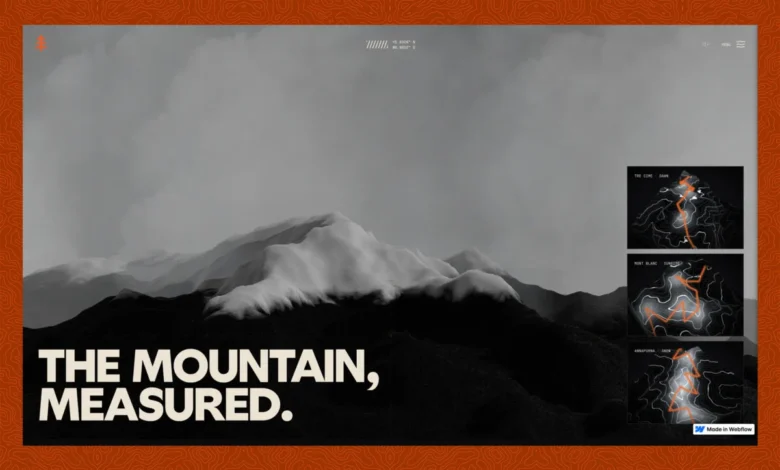
The emergence of high-fidelity, interactive web experiences has traditionally required a stark choice between the ease of use offered by no-code platforms and the performance capabilities of custom-coded frameworks. However, the recent development of the Ridgeline project—a cinematic hiking and photography site—demonstrates a significant shift in this paradigm. By integrating real-time 3D terrain rendering within the Webflow ecosystem, the project proves that genuine elevation data (DEMs) can be rendered live using Three.js without sacrificing the editability of a standard Content Management System (CMS).
Ridgeline serves as a technical case study in modern web engineering, utilizing a sophisticated stack that includes React, Three.js, and the Model Context Protocol (MCP) to bridge the gap between static web design and high-performance creative coding. The project successfully renders three distinct alpine treks—Dawn (Tre Cime), Sunrise (Mont Blanc), and Snow (Annapurna)—each utilizing actual geographic coordinates and survey-contour meshes rather than pre-rendered video loops or sprite sheets.
The Architectural Foundation: Hybrid Integration Strategies
A primary challenge in the development of Ridgeline was determining how to inject a heavy WebGL bundle into the Webflow environment. The engineering team evaluated two primary paths: the use of Webflow’s native Code Components (deployed via DevLink) and the implementation of a self-hosted JavaScript embed.

While Code Components offer a first-class experience within the Webflow Designer, the project’s specific requirements—including a complex Three.js build step, a Blender-baked asset pipeline, and GLB files hosted on Cloudflare R2—led to the selection of the embed method. This approach allowed for a decoupled architecture where the layout and structure remained within Webflow, while the complex behavioral logic was managed via a Content Delivery Network (CDN).
To maintain designer control, the team implemented attribute-driven mounting. This system allows a designer to place a host element in Webflow with a specific data attribute, such as [data-terrain-scene]. The external script then identifies these hooks and mounts the 3D scene into the designated slot. This ensures that while the code handles the rendering, the human designer retains control over the visual hierarchy and layout of the page.
Chronology of Development and AI-Augmented Workflow
The development of Ridgeline followed a compressed timeline, moving from concept to a fully functional site in approximately one week. This speed was facilitated by the use of advanced Large Language Models (LLMs), specifically Claude (Opus 4.8 and Fable 5), driving the Webflow MCP server.
- Phase One: Data Acquisition and Processing: The project began with the extraction of real-world elevation data. For the "Dawn" scene, a GPS track (GPX) was recorded during a hike above Cortina in the Tre Cime massif. This data was cleaned of GPS artifacts and normalized to protect specific route privacy while maintaining the recognizable silhouette of the terrain.
- Phase Two: 3D Pipeline Development: Using Blender, the team modeled the Shuttle Radar Topography Mission (SRTM) datasets. A custom Python script was utilized to automate the export of these models into the glTF format, incorporating Draco mesh compression to optimize file sizes for web delivery.
- Phase Three: Integration and Interactivity: The Webflow MCP was leveraged to build pages, components, and CSS variables directly from code. This allowed for a bi-directional workflow where an AI agent could maintain the project structure while keeping it accessible for manual human edits.
- Phase Four: Performance Optimization: The final stage involved a rigorous audit of frame rates and thread management. The team developed an in-page FPS profiler to identify bottlenecks in the rendering loop, leading to significant architectural adjustments in the final days of the build.
Technical Deep-Dive: The 3D Pipeline and Shader Engineering
The core of the Ridgeline experience is the "survey-map" aesthetic, which is achieved not through traditional textures, but through a custom fragment shader. This shader reads the world-space height of the mesh to generate contour lines dynamically.

A critical technical detail in this process is the use of the fwidth() function. By deriving the anti-alias width in screen space from the rate of change of the band index, the engineering team ensured that contour lines remain exactly one pixel wide, regardless of the camera’s zoom level or distance from the terrain. This prevents the "shimmering" effect often associated with fine lines in WebGL.
The pipeline also utilized Draco compression to a high degree of efficiency. Static meshes that originally totaled 11 MB were compressed to approximately 1 MB, representing a reduction of nearly 11 times the original size. This optimization ensured that the 3D assets were not the bottleneck for initial page loads, shifting the performance focus to GPU and main-thread execution.
Performance Metrics and Optimization Strategies
Achieving a consistent 60 frames per second (FPS) across various devices required a "removal-first" philosophy. The engineering team identified that the most significant performance gains came from stopping work that did not change a pixel.
| Section | Initial Performance | Post-Optimization Performance |
|---|---|---|
| Homepage Intro | 46fps (min 33) | 60fps (min 56) |
| Snow Scene (Particles) | 37fps | 60fps |
| Summit Reveal | ~1000ms freeze | Negligible (0ms) |
| Footer Entrance | min 7fps | min 57fps |
Key optimizations included:

- GPU-Based Particle Systems: In the Annapurna scene, the falling snow was moved entirely to the GPU. Instead of updating thousands of particle positions on the main thread, the positions were uploaded once, and the shader handled the movement and wrapping logic.
- Shader Pre-Warming: To prevent "jank" during transitions, the project implemented
compileAsync. This parallel-shader-compile extension allows the browser to compile materials off the main thread. By pre-warming the shaders before the terrain scrolled into view, the team eliminated a one-second freeze that occurred during the first reveal. - Layout Thrash Prevention: The team discovered that animating the width and height of elements during scroll-driven "frame collapses" forced the browser to re-compute
object-fitcrops every frame. By switching to a fixed-aspect-ratio box and usingtransform: scale, they moved the work to the compositor, resulting in perfectly smooth transitions.
Managing the "Seams": Preloaders and Audio Gating
The user experience of Ridgeline was designed to be seamless, yet the technical reality of web browsers presented several hurdles. One such hurdle was the "first-paint flash," where a browser might render a white background for a fraction of a second before the site’s JavaScript and dark theme initialized.
To solve this, the team injected a synchronous "guard" style into the HTML head. This CSS hides all body content and sets the background color immediately upon the first paint. A failsafe timeout was included to ensure that if the JavaScript failed to load, the content would eventually become visible, preventing a "dead" page.
Furthermore, the site addresses browser restrictions on autoplaying audio. Because modern browsers block audio until a user gesture occurs, the Ridgeline preloader concludes with an explicit "Enter" choice. This gesture serves a dual purpose: it signals the end of the loading phase and unlocks the Web Audio API bus, allowing for the atmospheric ambient soundscapes—such as the wind in the Tre Cime storm or the quiet of the Annapurna night—to begin without console errors.
Broader Impact and Industry Implications
The Ridgeline project represents a broader trend in web development where "low-code" platforms are being extended by "high-code" capabilities. The success of this integration suggests that the future of web design is not a choice between platforms like Webflow and custom React builds, but a synthesis of both.

From an SEO and discoverability perspective, the project offers a blueprint for high-performance creative sites. By keeping content within a CMS and rendering it in real HTML, the site remains readable by search engine crawlers and AI answer engines (AEO). This is a distinct advantage over "Black Box" 3D sites where content is hidden inside a canvas element, making it invisible to indexers.
Industry analysts suggest that the use of AI agents and the Model Context Protocol, as demonstrated in this project, will likely become a standard for complex web builds. The ability for an AI to maintain the structural integrity of a project while a developer focuses on high-level shader logic and performance optimization significantly reduces the "overhead" of creative coding.
Ultimately, Ridgeline stands as a testament to the fact that the web is moving toward a more immersive, data-driven future. By treating 3D terrain as a live, editable component rather than a static asset, developers can create experiences that are both technologically advanced and practically maintainable. The project concludes that while the 3D rendering is the visual hook, the true engineering success lies in the "seams"—the transitions, the performance optimizations, and the invisible architecture that allows the experience to feel effortless to the end user.