The First Three.js Conference in Paris: A Milestone for the Creative Development Community

The global creative development community is preparing to gather in Paris this September for the inaugural Three.js Conference, marking the first dedicated physical summit for the world’s most widely used 3D web library. Since its inception nearly 15 years ago, Three.js has served as the foundational framework for browser-based 3D graphics, powering everything from high-end digital marketing portfolios and interactive data visualizations to complex industrial simulations and browser-based gaming. The event represents a formal consolidation of a community that has largely existed in decentralized open-source forums, social media, and experimental code repositories since 2010.

The selection of Paris as the host city highlights the region’s growing status as a hub for creative technology and high-end digital production. Organized by David Ronai and a team of industry veterans, the conference aims to bridge the gap between technical engineering and artistic design, reflecting the multidisciplinary nature of the Three.js ecosystem.
A Fifteen-Year Evolution: From WebGL to WebGPU
The timing of the conference coincides with a critical juncture in the history of web graphics. For over a decade, Three.js relied on WebGL, a JavaScript API based on OpenGL ES 2.0, to render hardware-accelerated 3D graphics. However, the industry is currently undergoing a paradigm shift toward WebGPU, a more modern API that provides lower-level access to GPU hardware, offering better performance and more advanced compute capabilities.

The conference is expected to focus heavily on this transition, particularly the introduction of the Three.js Shading Language (TSL). TSL is designed to allow developers to write shaders that are agnostic of the underlying graphics API, facilitating a smoother transition from WebGL to WebGPU. This technological leap is essential for the next generation of web experiences, which demand higher fidelity, real-time physics, and more complex lighting models that were previously restricted to native desktop applications.
Technical Leadership and the WebGPU Frontier
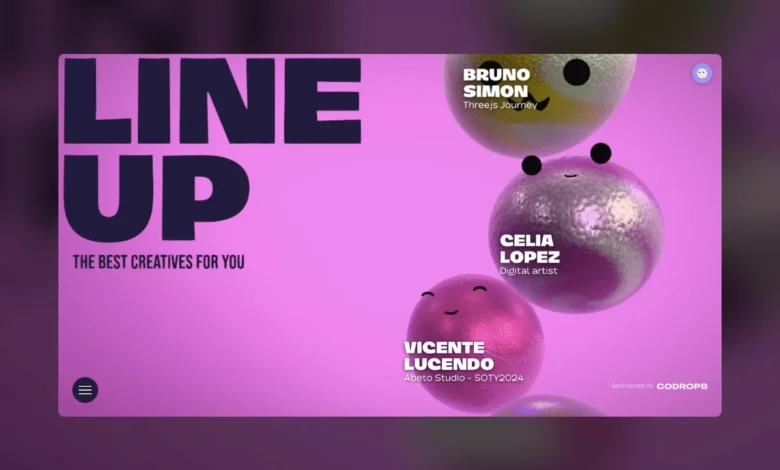
A significant portion of the conference programming is dedicated to the architects of the Three.js ecosystem. Bruno Simon, a prominent educator in the field and creator of the "Three.js Journey" course, is among the headlining speakers. Simon’s recent work has focused almost exclusively on the integration of WebGPU into the curriculum, a task he describes as a monumental update to the existing educational framework. His upcoming talk is expected to delve into the practicalities of building with TSL, using his own highly interactive portfolio as a case study for kinetic energy and physics-driven rendering.

Similarly, Jean Carlo Deconto, known in the community as "sunag," will present a "Tour of TSL." Deconto has been instrumental in refining the syntax and implementation of the Three.js Shading Language. His work emphasizes the separation of software responsibilities, creating modular systems that allow developers to extend the rendering pipeline individually. This engineering philosophy is viewed as vital for maintaining the scalability of Three.js as it adopts modern rendering techniques like nanite-style geometry and voxel-based fire simulations.
Browser Standards and the Integration of HTML-in-Canvas
The involvement of major technology stakeholders is further evidenced by the participation of Thomas Nattestad and Natalia Markoborodova from the Google Chrome team. Their presence underscores the importance of Three.js within the broader web standards ecosystem. A primary focus of their presentation will be the "HTML-in-Canvas" API, a development that addresses one of the longest-standing challenges in web development: the seamless integration of semantic HTML elements within a 3D canvas environment.

Currently, developers often struggle to overlay interactive text or UI elements on 3D scenes while maintaining accessibility and SEO standards. The HTML-in-Canvas API aims to allow semantic HTML to be rendered directly into a canvas while remaining interactive and accessible. Nattestad and Markoborodova are expected to discuss the balance between creative freedom and the rigorous requirements of browser security, privacy, and interoperability. Their research also extends into color space management, ensuring that 3D assets maintain visual consistency across diverse display configurations and HDR environments.
The Intersection of Artificial Intelligence and 3D Workflows
Artificial Intelligence (AI) has emerged as a dominant theme in the lead-up to the conference, with several speakers exploring how generative tools are reshaping 3D asset pipelines. Célia Lopez, a 3D designer at OFF+BRAND, has been investigating workflows that utilize AI for non-linear texture optimization and the transfer of AI-generated textures onto production-ready meshes. This approach addresses the "messy topology" often found in raw AI-generated 3D models, making them viable for real-time web applications.

Robin Payot, another scheduled speaker, will examine the role of AI coding assistants in production environments. Payot notes that designers are now shipping production-grade code with the help of AI, a development that was considered improbable only a few years ago. However, he maintains that a foundational understanding of web limitations remains a prerequisite for effective development. Payot’s recent experiments include Three.js animations that respond in real-time to AI-generated voices, illustrating the potential for more immersive, conversational interfaces.
Industry Applications: E-commerce, Real Estate, and Storytelling
Beyond pure technical experimentation, the conference will highlight the commercial viability of Three.js in various sectors. Daniel Beauchamp, who has worked extensively with Shopify and Rive, will discuss the evolution of interactive product customization. His work focuses on transforming e-commerce from a passive consumption model to an active experience where users can configure products in high-fidelity 3D environments, fostering an emotional connection before a purchase is made.

In the realm of architectural visualization and real estate, Anderson Mancini will present techniques for bringing high-end rendering to the browser. By combining Screen Space Global Illumination (SSGI) and Screen Space Reflections (SSR), Mancini has demonstrated that real-time web experiences can rival traditional offline renders. He has also developed tools like "r3f-webgpu-perf" to help developers monitor and optimize the performance of React Three Fiber (R3F) applications, ensuring they remain accessible across a wide range of devices.
The narrative potential of Three.js will be represented by Patrick Heng and Justine Soulie, the creators of "Ponpon Mania," an interactive WebGL comic. Their talk will provide a case study on the "creative ping-pong" between illustration and technical development, showing how hand-drawn art can be integrated with hand-tracking technology (via MediaPipe) to create tactile, interactive stories.

Design Philosophy and the Human Element
The conference also aims to address the design aesthetics of the 3D web. Julie Marting, who led the art direction for the conference website, will share insights into the visual identity of the event. Her work emphasizes the value of "productive mistakes"—the idea that the trial-and-error nature of 3D design often leads to unexpected creative breakthroughs.
Vicente Lucendo will offer a perspective on the psychology of motion, drawing inspiration from manga panel compositions and classical architecture. Lucendo argues that technical decisions should be guided by the emotion a project intends to evoke. He advocates for "fresh eyes" in development, suggesting that distance and peer feedback are essential for solving complex creative problems.

Broader Impact and the Future of the Web
The inaugural Three.js Conference arrives at a time when the "Spatial Web" is moving from a niche concept to a mainstream reality. As VR and AR hardware (WebXR) become more prevalent, the ability to deliver high-quality 3D content through the browser—without the friction of app store downloads—is increasingly valuable to brands and developers alike.
By bringing together the core contributors, browser engineers, and creative agencies, the Paris event serves as a formal declaration of the maturity of the Three.js library. It transitions from a collection of clever experiments to a robust professional standard capable of powering the next generation of the internet.

For those interested in attending, the organizers have partnered with various community outlets to offer registration incentives. Readers of Codrops, for instance, can utilize the promotional code "CODROPS" to receive a 15% discount on tickets. The event is expected to sell out, reflecting the high level of anticipation within the global developer community.
The two-day schedule in Paris will feature a mix of technical deep dives, live demonstrations, and networking sessions. While the primary focus is on the future of technology, the underlying theme remains the human community that has sustained Three.js for fifteen years. As the industry looks toward WebGPU and AI-integrated workflows, the conference provides a necessary venue for the exchange of ideas that will define the visual landscape of the web for the next decade.