Shopify vs. ThriveCart: A Deep Dive into Your E-commerce Platform Choices

Shopify and ThriveCart both aim to empower online sellers, but their fundamental differences are critical to understanding before investing. Shopify stands as a comprehensive e-commerce platform, offering a complete ecosystem from storefront and product catalog to inventory management, shipping logistics, and a seamless checkout process. In contrast, ThriveCart functions primarily as a sophisticated checkout and sales funnel tool, designed to integrate with existing online presences. This distinction is paramount for any business owner looking to establish or scale their online sales operations.
A rigorous comparison across eight key areas, with pricing meticulously verified against current public rates, reveals distinct strengths and weaknesses. For the vast majority of businesses building a robust online store, Shopify emerges as the superior choice. However, a more specialized segment of sellers, particularly those focused on digital products, online courses, and coaching services, may find ThriveCart’s unique one-time payment model exceptionally compelling.
The reality for many online entrepreneurs is that both platforms can coexist within their business strategy. A common and effective approach involves leveraging ThriveCart for its advanced checkout and affiliate management capabilities, while relying on Shopify to host the primary storefront and product catalog. This hybrid model allows businesses to harness the specialized strengths of each platform.
Delving deeper, we analyze where each platform excels and where potential pitfalls lie for businesses that misalign their needs with the tool’s core functionality.
Quick Comparison: Shopify vs. ThriveCart
| Category | Shopify | ThriveCart |
|---|---|---|
| What it actually is | Full hosted e-commerce platform | Checkout, cart, and funnel tool |
| Entry Price | $39/month ($29/month billed annually) | $495 one-time, no recurring fee |
| Higher Tiers | Grow $105/month, Advanced $399/month, Plus from $2,300/month | Pro+ at $295/year, Ultimate Bundle $985 one-time |
| Platform Transaction Fees | None with Shopify Payments; 0.6% to 2% with third-party gateways | None on any plan |
| Card Processing | 2.9% + 30c (Basic), down to 2.5% + 30c (Advanced) | Your processor’s own rate (Stripe, PayPal, Authorize.net) |
| Storefront & Themes | Yes, free and paid themes, full site builder | No storefront, checkout pages only |
| Inventory Management | Yes, multi-location, native | Minimal, not built for it |
| Order Bumps & Upsells | Via apps | Native, unlimited |
| Affiliate Program | Via third-party apps | Native affiliate center (Pro+) |
| Course Selling | Via apps | Built in (Learn / Learn+) |
| SEO & Blogging | Yes, native | No |
| Free Trial | Yes, plus a $1/month promo for the first three months | No free trial, money-back guarantee only |
| Best For | Physical products, growing brands, multichannel sellers | Digital products, courses, coaching, one-product funnels |
Key Takeaways
- Fundamental Difference: Shopify is a complete e-commerce solution, while ThriveCart is a specialized checkout and funnel builder.
- Pricing Models: Shopify operates on a monthly subscription, while ThriveCart offers a one-time payment for its Standard plan, with an annual fee for advanced features.
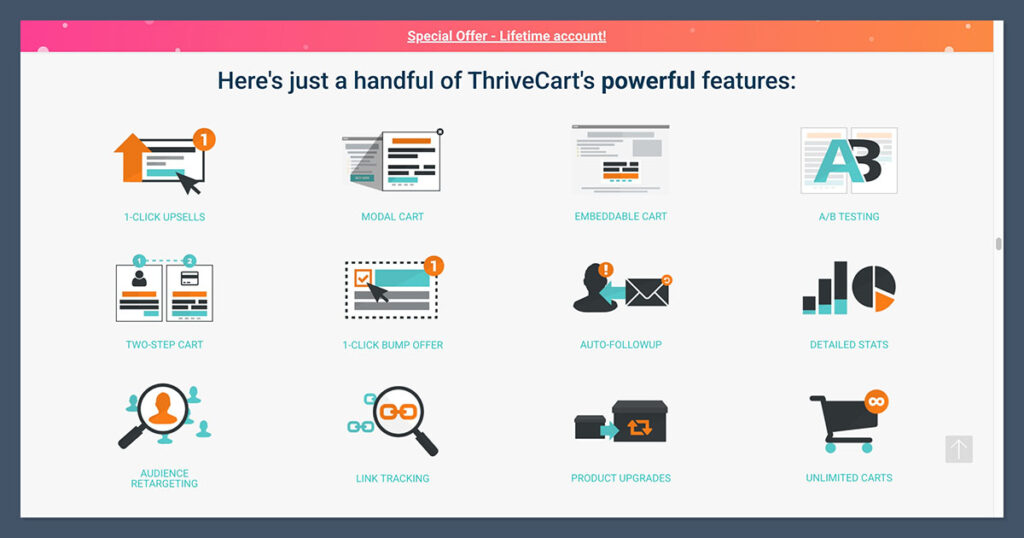
- Feature Set: Shopify excels in providing a full storefront, inventory management, and broad sales channel integration. ThriveCart shines with its native order bumps, one-click upsells, and integrated affiliate program.
- Target Audience: Shopify is ideal for businesses selling physical products and those aiming for broad market reach. ThriveCart is best suited for digital product creators, course instructors, and coaches focused on optimizing sales funnels.
1. Best for Pricing: ThriveCart (With a Serious Caveat)
ThriveCart’s marketing heavily emphasizes its one-time payment model, presenting a stark contrast to Shopify’s recurring monthly fees. While this initially appears to be a decisive cost advantage, a closer examination of the long-term financial implications reveals a more nuanced picture.
Shopify’s Pricing Structure:
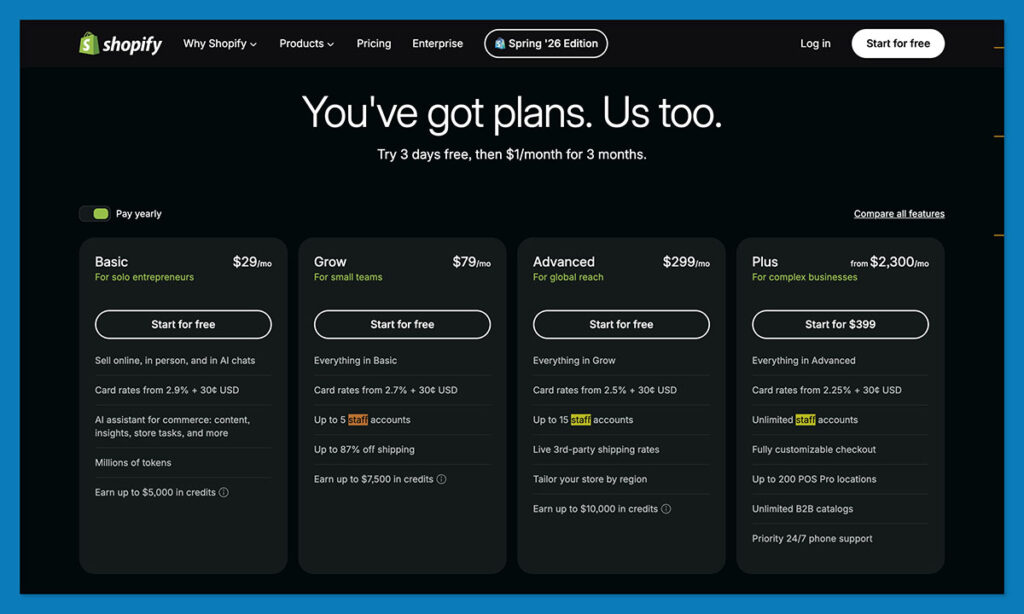
Shopify offers several tiered plans designed to scale with business growth. The Basic plan, often the starting point for new entrepreneurs, is priced at $39 per month, with a notable discount of 25% available for annual billing, bringing the monthly cost down to approximately $29.
- Basic Shopify: $39/month (or $29/month billed annually)
- Shopify: $105/month (or $79/month billed annually)
- Advanced Shopify: $399/month (or $299/month billed annually)
- Shopify Plus: Custom pricing, starting from $2,300/month
Crucially, Shopify provides a risk-free entry point with a free trial, often followed by a highly attractive promotional offer of $1 per month for the initial three months. This period allows new users to test the platform extensively without significant financial commitment, a feature ThriveCart does not replicate.
A common point of confusion regarding Shopify’s pricing is the platform transaction fee. If a merchant opts to use a third-party payment gateway instead of Shopify Payments, Shopify imposes an additional surcharge. This fee ranges from 2% on the Basic plan down to 0.6% on the Advanced plan. However, this surcharge is entirely waived when merchants utilize Shopify Payments, which aligns with industry standards for card processing fees (typically around 2.9% + $0.30 for basic plans).
ThriveCart’s Pricing Structure:
ThriveCart’s pricing model is distinct, centered around a one-time purchase for lifetime access to certain features.
- ThriveCart Standard: $495 one-time payment. This plan provides the core checkout functionality.
- ThriveCart Pro+: $295 per year. This tier unlocks advanced features such as the native affiliate center, advanced analytics, and more.
- ThriveCart Ultimate Bundle: $985 one-time payment. This includes all features of Pro+ and additional bonuses.
A significant advantage of ThriveCart is its complete absence of transaction fees. Merchants connect their own payment processors like Stripe, PayPal, or Authorize.net, and are only responsible for the standard processing rates charged by those providers. This direct relationship with payment processors means merchants retain full control over their revenue streams, a valuable asset if they ever decide to migrate platforms.
It is important to note that ThriveCart does not offer a free trial. Instead, it relies on a money-back guarantee. However, the reported duration of this guarantee has been inconsistent across various sources, underscoring the need for potential buyers to verify the exact terms directly on ThriveCart’s checkout page before making a purchase.
The Actual Math:
Considering the initial investment, Shopify Basic on an annual billing plan costs approximately $348 per year. ThriveCart Standard, at a one-time fee of $495, would theoretically break even after about 17 months of use compared to Shopify Basic. This sounds like a clear win for ThriveCart.
However, the cost analysis becomes more complex when considering essential add-on features. If a business requires an affiliate program—a common necessity for many digital product sellers—they must upgrade to ThriveCart’s Pro+ tier, which incurs a recurring annual fee of $295. In this scenario, the total cost for ThriveCart over three years becomes $495 (initial) + $295 (year 2) + $295 (year 3) = $1,085. Comparatively, Shopify Basic at an annual rate over three years amounts to approximately $1,044. The initial cost advantage of ThriveCart significantly diminishes, if not disappears, once advanced features are factored in. The "pay once" narrative is most potent for businesses that can operate solely within the Standard plan’s capabilities.
The Winner: ThriveCart, if you can live on the Standard plan.
ThriveCart Standard, at $495 with no recurring fee and no transaction charges, presents a compelling cost-effective solution for a specific niche. However, the moment advanced features like its native affiliate center are required, necessitating the Pro+ annual subscription, its long-term cost becomes comparable to, and in some cases slightly higher than, Shopify’s basic plans. Furthermore, Shopify’s introductory $1 per month promotion offers a significantly lower barrier to entry than ThriveCart’s upfront purchase.
2. Best for Selling Online: Shopify
This is where the comparison becomes less about direct feature parity and more about the fundamental purpose of each platform. Shopify is designed to be a comprehensive solution for online retail, whereas ThriveCart is a specialized tool for optimizing conversions at the point of sale.
What Shopify Offers:
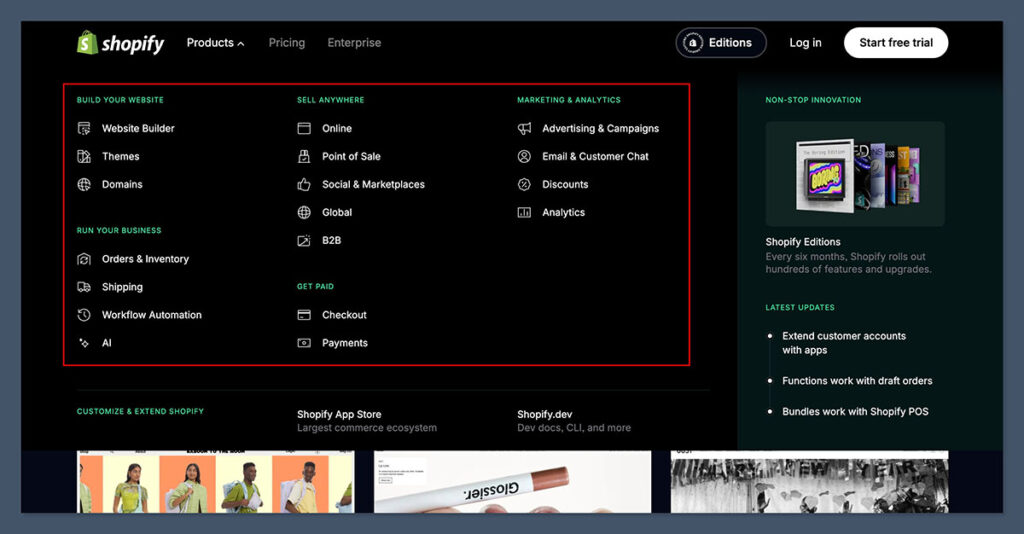
Shopify is engineered as a complete e-commerce operating system. It provides a fully functional, browsable online storefront complete with product pages, collections, and a visually appealing design system. Native inventory management, capable of handling multiple warehouse locations, is a core component. Higher-tier plans include robust shipping tools with real-time carrier-calculated rates, and even a point-of-sale (POS) system for integrating physical retail operations.
Multichannel selling is a significant advantage, allowing businesses to seamlessly sync inventory and product listings across major platforms like Amazon, Etsy, Instagram, TikTok, and Google Shopping. Every Shopify plan includes unlimited products, unlimited bandwidth, and essential features like abandoned cart recovery, fraud analysis, automated tax calculations, gift card issuance, discount code management, and customer accounts. For any business dealing with physical goods, these are not merely desirable features but the foundational requirements for operational success.
The expansive Shopify App Store, boasting thousands of applications, provides solutions for virtually any business need. However, this vast ecosystem can also lead to escalating costs, as many advanced functionalities—such as customer reviews, loyalty programs, advanced upsell strategies, and subscription management—are often available only through paid third-party apps, leading to multiple monthly subscription fees.
What ThriveCart Offers:
ThriveCart, by design, does not provide a traditional online store. There is no browsable product catalog, no collection pages, and no site-building tools. Instead, its focus is on creating highly optimized checkout pages. These pages can be presented as standalone URLs, embedded directly into existing websites, or linked from marketing materials like emails or advertisements.
Within its specialized domain, ThriveCart excels. It supports a wide array of pricing models, including one-time payments, recurring subscriptions, split payments, and "pay-what-you-want" options, all on the same product. While it can accommodate physical products by allowing the input of shipping weights and dimensions and integrating with fulfillment providers, this is an add-on rather than a core competency. It is unequivocally not designed for managing a large inventory of physical goods, such as a 200-SKU apparel store.
ThriveCart’s strength lies in its integration capabilities. It offers direct connections with popular platforms like Kajabi, Teachable, Thinkific, MemberPress, and various email marketing services including ActiveCampaign, ConvertKit, Mailchimp, and Drip. For any other integration needs, Zapier provides a robust bridge to thousands of other applications.
The Winner: Shopify, and it is not close for e-commerce.
For businesses that require a comprehensive online store with a product catalog, inventory management, and shipping logistics, Shopify is the undisputed leader. It provides an end-to-end e-commerce solution. ThriveCart, while powerful in its niche, is a complementary tool, assuming the existence of an established website and a reliable source of traffic. It does not aim to replace the entire e-commerce stack.
3. Best for Checkout Optimization: ThriveCart
Here, the roles are reversed. ThriveCart was meticulously engineered for a singular purpose: to maximize conversion rates at the checkout stage. It significantly outperforms Shopify in this specific area out of the box.
What ThriveCart Includes Natively:
ThriveCart’s core value proposition revolves around its powerful and intuitive checkout optimization tools.
- Order Bumps: Allow merchants to offer a single, impulse-buy add-on at the initial checkout stage, increasing average order value.
- One-Click Upsells: Present customers with a compelling offer immediately after their initial purchase is complete, without requiring them to re-enter payment details.
- One-Click Downsells: Offer an alternative, lower-priced product if a customer declines the upsell, helping to salvage a sale.
- Unlimited Split Testing: Enables A/B testing of different checkout page variations, pricing strategies, and upsell/downsell offers to continuously optimize conversion rates.
- Customizable Checkout Pages: Provides a range of templates and customization options to match branding and create a seamless customer experience.
- Subscription Management: Robust tools for handling recurring payments, including dunning management (automated follow-ups for failed payments).
- Integrated Affiliate Program (Pro+): A native affiliate management system that streamlines the process of recruiting, tracking, and paying affiliates.
- Course Hosting (Learn/Learn+): Built-in functionality for selling and delivering online courses directly through the platform.
How Shopify Compares:
Shopify’s native checkout is renowned for its speed, reliability, and strong conversion rates, further enhanced by the convenience of Shop Pay for returning customers. Shopify actively markets its checkout as performing exceptionally well compared to competitors.
However, features like order bumps and one-click post-purchase upsells are not native to Shopify. Implementing these crucial conversion-boosting tools typically requires integrating third-party apps, which can add significant monthly costs, ranging from $10 to $100 or more per month. Customizing the checkout page is also restricted unless a business subscribes to Shopify Plus, which unlocks checkout extensibility. For digital product sellers focused on optimizing a single sales funnel, the need to acquire and manage multiple paid apps can represent a substantial friction cost and complexity.
The Winner: ThriveCart owns the checkout.
For businesses whose primary strategy involves driving traffic to a high-margin offer and maximizing the average order value through strategic add-ons and upsells, ThriveCart is purpose-built for the task. Features like order bumps, one-click upsells, downsells, and split testing are standard inclusions, whereas on Shopify, they often necessitate additional app subscriptions.
4. Best for Marketing and Growth: Shopify
A highly optimized checkout page is ineffective if no one reaches it. This is where Shopify’s breadth of features becomes a significant advantage, while ThriveCart’s focused nature can become a limitation.
SEO and Content Marketing:
Shopify provides a robust foundation for organic growth. It includes native blogging capabilities, editable meta titles and descriptions, image alt text optimization, automatic sitemap generation, and clean URL structures—all essential for search engine optimization (SEO). This allows businesses to build organic traffic over time. Furthermore, Shopify’s product catalog integration with AI-driven shopping surfaces is increasingly becoming a vital acquisition channel.
ThriveCart, by contrast, has no built-in SEO capabilities because it does not offer a website or a browsable catalog. Its checkout pages are transactional rather than content-driven and are not designed for organic search ranking. If search engine visibility is a key component of a business’s customer acquisition strategy, ThriveCart cannot be the sole platform.
Sales Channels:
Shopify’s strength lies in its ability to connect with a vast array of sales channels. It facilitates seamless integration with platforms like Instagram, TikTok, Facebook, Google, Amazon, Etsy, and eBay, synchronizing inventory across all of them. This multichannel approach significantly expands a business’s market reach. ThriveCart, lacking a product catalog to manage, does not offer multichannel selling functionalities.
Email and Automation:
While Shopify includes Shopify Email for basic campaign management and automated workflows, its broader ecosystem offers extensive options through its app store. ThriveCart, while not an email marketing platform itself, offers powerful behavioral rules. These rules allow merchants to tag customers and trigger automations in their integrated email service provider based on specific actions, such as the payment option chosen, whether an order bump was accepted, or if a subscription payment failed.
The Winner: Shopify has the acquisition engine.
Shopify possesses the infrastructure to attract customers through multiple avenues, including SEO, social commerce, and marketplace integrations. ThriveCart’s role is to convert traffic that has already been generated. This fundamental difference highlights their distinct purposes: Shopify is designed for customer acquisition and broad market presence, while ThriveCart is optimized for conversion at the point of sale.
5. Easiest to Use: It Depends on the Job
Both platforms are designed with user-friendliness in mind, but they demand different types of effort and expertise from their users.
Shopify:
Shopify’s onboarding process is guided and straightforward. After answering a few questions about the business, users are presented with a dashboard featuring a setup checklist. Adding products, selecting and customizing themes, and configuring payment gateways are generally intuitive. The site editor uses a section-based approach, which ensures design consistency and prevents layout breakage, but it offers less freedom for highly custom designs without touching code. The primary complexity in Shopify arises not from the interface itself, but from the sheer breadth of features and the integration of numerous third-party apps, which can lead to a cluttered administrative experience.
ThriveCart:
ThriveCart’s interface is more focused, making it quicker to learn. Building a checkout page is a streamlined process: select a template, arrange elements, attach upsells and bumps, connect a payment processor, and publish. A functional, converting checkout can often be set up in under an hour. However, the ease of setting up the checkout itself is offset by the complexity of assembling the surrounding ecosystem. ThriveCart assumes the user already has a sales page, a website, an email marketing platform, and a content delivery mechanism in place. While the setup is simple, integrating ThriveCart into a larger tech stack requires managing multiple tools, and troubleshooting any issues with integrations, particularly those involving Zapier, falls on the user.
The Winner: ThriveCart for building one checkout, Shopify for running a business.
ThriveCart offers faster initial setup because its scope is intentionally narrow. Shopify requires a more comprehensive initial setup but consolidates many essential business functions into a single platform. The choice between them hinges on an individual’s preference for managing multiple specialized tools versus a single, integrated platform.
6. Best Design and Templates: Shopify
When it comes to aesthetic presentation and brand building, Shopify clearly leads.
Shopify’s Design Capabilities:
Shopify boasts an extensive library of themes catering to virtually every retail sector. Many of these themes are free and sufficiently professional for launching a business. Premium themes are typically a one-time purchase, ranging from $100 to $400, rather than a subscription, and all themes are responsive and customizable through the intuitive section editor. This system ensures that the visual presentation of a business’s brand is cohesive and professional across all devices.
ThriveCart’s Design Limitations:
ThriveCart’s templates are specifically designed for conversion-optimized checkout pages, not for full website design. While they are clean, tested, and mobile-friendly, and offer basic customization without requiring coding knowledge, they are limited to the checkout experience. The overall brand aesthetic and the user’s primary point of engagement with the brand will reside on the sales page or website that directs traffic to ThriveCart, a component that ThriveCart itself does not provide.

The Winner: Shopify, because ThriveCart is not in this race.
Shopify offers a comprehensive design system for an entire online storefront, allowing businesses to craft a distinct brand identity. ThriveCart provides a well-designed tool for a specific transaction point, but it does not contribute to the overall brand design of the business.
7. Best for Affiliate Programs: ThriveCart
This is one of ThriveCart’s most significant advantages and a primary reason why many Shopify merchants choose to integrate ThriveCart into their operations.
ThriveCart’s Native Affiliate Center:
The Pro+ tier of ThriveCart includes a robust, native affiliate center. This feature provides affiliates with their own dedicated portal, automatic tracking of links and sales, streamlined commission calculations (which correctly apply to upsells and order bumps), and automated payout processing via PayPal. Additionally, it offers a joint-venture platform for revenue sharing with partners. For creators who plan to launch products with a significant affiliate marketing push, this integrated system is an invaluable asset.
Shopify’s Affiliate Solution:
On Shopify, managing an affiliate program typically requires a third-party application. While many excellent affiliate apps exist, they represent an additional monthly cost, often between $50 and $200, and operate as separate entities from the core checkout process.
The trade-off is clear: while ThriveCart’s core Standard plan is a one-time fee, access to its powerful affiliate center requires the Pro+ tier, which is an annual subscription of $295. While still potentially more cost-effective than comparable Shopify apps, this moves away from the purely "one-time payment" model.
The Winner: ThriveCart, comfortably.
ThriveCart’s integrated affiliate center, offering automated payouts and seamless integration with its checkout, provides superior value at $295 per year compared to the monthly subscription costs of most Shopify affiliate apps. For businesses that rely heavily on affiliate marketing for product launches and ongoing sales, this feature alone can be a compelling justification for adopting ThriveCart.
8. Best for Support and Stability: Shopify
When considering long-term platform reliability and customer assistance, Shopify holds a distinct advantage.
Shopify’s Support Ecosystem:
Shopify provides 24/7 customer support through live chat, with options for escalation to human advisors. Its comprehensive Help Center, active community forums, and a vast network of agencies and freelancers knowledgeable about the platform offer extensive resources. While Shopify has discontinued email support, which can be a drawback for some users who prefer a written record, its other support channels are robust.
ThriveCart offers support primarily through a helpdesk and ticket system, supplemented by documentation and a user community. While adequate, it does not operate at the same scale or availability as Shopify’s 24/7 live support.
Platform Stability and History:
A more critical consideration for ThriveCart is its history of ownership changes. Long-time users have reported periods of instability, including downtime and unreliable payment gateway connectivity, before the platform stabilized under its current ownership. While the product is now actively developed and has recovered its reliability, this history is relevant, especially given the nature of a lifetime license. The security and longevity of a one-time payment model are intrinsically linked to the stability and future of the company providing it. This represents a structural risk inherent in such payment models.
The Winner: Shopify, on both support and platform risk.
Shopify offers unparalleled round-the-clock support and the most extensive partner ecosystem in the e-commerce industry. ThriveCart’s support is reasonable, but its past ownership transitions warrant consideration when evaluating the long-term value of a prepaid license.
How We Compared Shopify and ThriveCart
Our comparative analysis involved assessing both platforms across eight weighted categories. Feature and pricing data were meticulously gathered from each vendor’s current public documentation and cross-referenced with multiple independent sources.
Crucially, all pricing figures in this comparison were verified against live pricing pages at the time of review, rather than relying on outdated information from older reviews. This diligence is particularly important as ThriveCart has evolved its pricing structure, transitioning its Pro tier from a one-time upgrade to an annual subscription, a change that many older published reviews may not accurately reflect.
| Criterion | Weighting | What We Assessed |
|---|---|---|
| Sales and Checkout Features | 30% | Checkout capability, upsells, bumps, subscriptions, split testing, cart recovery |
| Store and Catalog Features | 20% | Storefront, product catalog, inventory, shipping, multichannel selling |
| Value for Money | 15% | Total cost of ownership over one, three, and five years, including add-ons and transaction fees |
| Marketing and SEO | 12% | Organic search capability, email tools, sales channels, affiliate management |
| Ease of Use | 10% | Onboarding, editor usability, time to a live, sellable page |
| Design and Templates | 5% | Template quality, customization depth, mobile responsiveness |
| Support | 5% | Channels, availability, documentation, partner ecosystem |
| Platform Stability | 3% | Ownership history, uptime record, development activity |
Shopify vs. ThriveCart: Our Verdict
For any individual or business embarking on the journey of building a comprehensive e-commerce operation, Shopify is the recommended platform. It consolidates essential components such as a storefront, product catalog, inventory management, shipping logistics, SEO capabilities, and multichannel selling into a single, integrated solution. This is further bolstered by 24/7 support and the most extensive partner network in the e-commerce sector. ThriveCart, by its design, does not aim to replicate these functionalities.
However, for those specializing in digital products, online courses, or coaching services, ThriveCart warrants serious consideration. Its out-of-the-box checkout optimization tools surpass Shopify’s native offerings, its affiliate management system is exceptionally strong, and the $495 Standard license, with its absence of recurring fees, presents a significant cost advantage for businesses that do not require a full storefront.
Two critical factors should temper the immediate allure of ThriveCart’s pricing model. Firstly, the "lifetime" aspect of its deal is truly realized only on the Standard plan. The Pro+ tier, essential for advanced features like the affiliate center, renews annually at $295. Secondly, the absence of a free trial means evaluating ThriveCart necessitates an upfront purchase, relying on the refund window for assessment.
The most practical recommendation for those uncertain about their needs is to begin with Shopify’s free trial and its $1 promotional period. This allows for validation of the need for a dedicated storefront with minimal financial risk. Should the business evolve to a point where its core strategy revolves around a single offer, a optimized funnel, and robust affiliate marketing, ThriveCart remains a viable and powerful option, and the decision to adopt it will be well-informed by a clear understanding of its specific benefits.
Frequently Asked Questions
Can ThriveCart replace Shopify entirely?
ThriveCart can only replace Shopify entirely if your business model involves selling a limited number of digital products and you do not require a browsable storefront. ThriveCart lacks a product catalog, site-building tools, inventory management, and SEO capabilities. It functions as a checkout tool, not a full e-commerce platform. If your customers need to browse, filter products, and add multiple items to a cart, Shopify is essential.
Can I use Shopify and ThriveCart together?
Yes, many sellers successfully integrate both platforms. A common strategy is to manage the primary online store on Shopify while utilizing ThriveCart for selling high-margin digital products, courses, or affiliate-driven offers through dedicated funnels. While deep integration is limited, requiring data reconciliation across both platforms, running them in parallel is entirely feasible.
Is ThriveCart’s lifetime deal actually lifetime?
The Standard plan, priced at $495, offers genuine lifetime access with no recurring fees. However, the Pro+ tier is not a one-time purchase; it renews annually at $295. This tier includes the affiliate center, advanced analytics, and other key features. ThriveCart previously offered a one-time Pro upgrade, but this has been replaced by the annual subscription model, making older reviews referencing a one-time Pro price outdated.
Does ThriveCart charge transaction fees?
No, ThriveCart does not charge any transaction fees on any of its plans. You connect your own payment processor (Stripe, PayPal, Authorize.net) and pay only their standard processing rates. Shopify also waives its platform transaction fee when you use Shopify Payments. However, it imposes a surcharge of 0.6% to 2% if you opt for a third-party payment gateway.
Which is cheaper over three years?
Shopify Basic, billed annually, costs approximately $1,044 over three years. ThriveCart Standard alone costs $495 upfront, making it significantly cheaper. However, if the Pro+ tier is required for features like the affiliate center, the three-year cost for ThriveCart approaches $1,085, making it slightly more expensive than Shopify Basic. The cost-effectiveness ultimately depends on whether you can operate solely within ThriveCart’s Standard plan.
Does ThriveCart have a free trial?
No, ThriveCart does not offer a free trial or a free tier. Evaluation requires an initial purchase, followed by a request for a refund within the designated guarantee period if the platform does not meet expectations. The duration of this guarantee period has been inconsistently reported by third-party sites, so verifying the terms directly on ThriveCart’s checkout page is advisable. Shopify, in contrast, provides a free trial without requiring credit card information, followed by a $1 per month promotional rate for the first three months.
Can I sell physical products with ThriveCart?
Technically, yes. ThriveCart allows for the input of shipping weights, prices, and dimensions for products and integrates with some fulfillment providers. However, it lacks robust inventory management, a product catalog, and comprehensive shipping rate calculation capabilities. It can work for selling a single physical product via a funnel but is not suitable for managing a store with a diverse product range.
Which one is better for selling online courses?
ThriveCart is generally the superior choice for selling online courses in most scenarios. It includes a built-in course builder and integrates the checkout, upsell, and affiliate program into a single platform. While Shopify can facilitate course sales through third-party apps, this often involves multiple subscription costs. However, for businesses where course hosting is the primary function rather than a supplementary offering, a dedicated course platform might offer a more specialized and enhanced teaching experience than either Shopify or ThriveCart.