X Launches Grok AI Integration in Ads Manager, Signaling Path to Full Advertising Automation

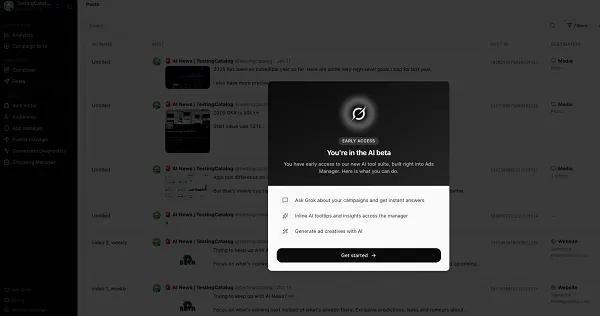
X, formerly Twitter, has officially commenced beta testing for the integration of its proprietary artificial intelligence chatbot, Grok, within its Ads Manager platform. This strategic move is poised to deliver enhanced AI-powered guidance for advertisers, marking a significant advancement in the platform’s ambitious push towards comprehensive advertising automation. The initiative underscores X owner Elon Musk’s long-term vision to revolutionize the digital advertising landscape by leveraging advanced AI capabilities, potentially leading to a fully automated system for campaign generation, optimization, and safety.
X’s Strategic AI Imperative and Grok’s Role
The introduction of Grok into the advertising ecosystem of X is not an isolated development but rather a pivotal component of a much broader strategic imperative championed by Elon Musk. Since acquiring Twitter and rebranding it as X, Musk has consistently articulated a vision to transform the platform into an "everything app," integrating a diverse range of functionalities, with artificial intelligence at its core. This vision extends to the advertising domain, where AI is seen as the key to unlocking unprecedented efficiency, relevance, and scale.
Grok, developed by xAI, Musk’s dedicated AI company, stands apart from many other large language models (LLMs) due to its unique characteristics. It is designed to access information in real-time directly from the X platform, a significant advantage for understanding current trends, public sentiment, and rapidly evolving conversations. Furthermore, Grok is intended to possess a distinct personality, often described as having a sense of humor and a willingness to engage with complex or controversial topics, distinguishing it from more conservative AI models. For advertisers, this real-time data access and nuanced understanding of platform dynamics are critical. The ability of Grok to process vast quantities of ephemeral data—such as trending hashtags, viral content, and user interactions—provides a dynamic intelligence layer that conventional ad platforms often struggle to replicate without extensive manual input. This capability is expected to allow advertisers to craft messages and target audiences with a precision previously unattainable, aligning campaigns with the most current cultural and social currents.
The establishment of xAI itself, announced in July 2023, was predicated on the goal of "understanding the true nature of the universe." While this grand ambition might seem distant from digital advertising, the practical application involves developing robust and innovative AI models like Grok. The integration of such an advanced AI into X’s commercial offerings demonstrates a direct translation of xAI’s research into tangible product enhancements. This synergistic relationship between X and xAI is crucial for understanding the depth of the platform’s commitment to AI-driven evolution.
A Chronology of X’s Ad Platform Transformation
The journey towards an AI-centric advertising platform on X has been incremental, with several key milestones preceding the current Grok integration.
-
Pre-Musk Era (Prior to October 2022): Before Elon Musk’s acquisition, Twitter’s advertising platform, while functional, was often perceived as less sophisticated than those offered by competitors like Meta (Facebook/Instagram) and Google. It relied on more traditional targeting methods, keyword matching, and audience segmentation. While it had its strengths, particularly for real-time news and event-based advertising, it lacked the deep AI-driven optimization capabilities that larger platforms were beginning to champion. Advertisers often reported a higher degree of manual intervention required to achieve optimal campaign performance. Revenue growth from advertising had been a consistent challenge for Twitter, leading to a desire for innovation.
-
Post-Acquisition Strategic Shift (Late 2022 – Early 2024): Following the acquisition, X underwent significant restructuring, including its advertising division. The company’s focus shifted towards re-establishing advertiser confidence amidst various changes and aiming for a more robust, technologically advanced advertising infrastructure. This period saw internal efforts to rebuild core components of the ad system, laying the groundwork for future AI integrations. The emphasis was on data utilization and creating a more efficient, scalable platform.
-
April 2024 – The Rebuilt Ad Manager Launch: A major turning point occurred in April 2024 when X officially launched its updated Ad Manager platform. This was heralded by the company as the "biggest ad system update in the company’s history." The rebuilt platform was designed from the ground up to offer AI-powered guidance at every level of campaign creation and management. X stated at the time that its new systems were vastly improved in their ability to understand user interests and behaviors. This enhanced understanding was intended to significantly improve ad relevance and delivery, aligning promotions with real-time trends and individual user preferences within the app. This foundational overhaul was critical; it provided the necessary infrastructure and data pipelines for more advanced AI models like Grok to operate effectively. The goal was to move beyond basic targeting to predictive analytics, anticipating user needs and market shifts.
-
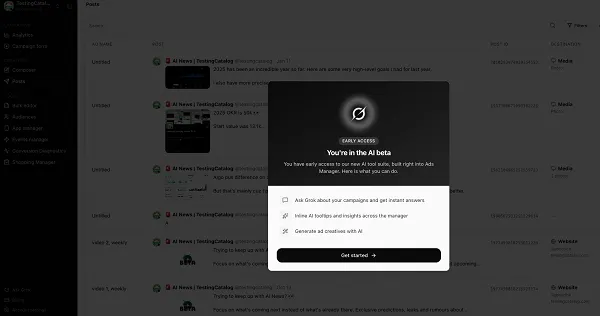
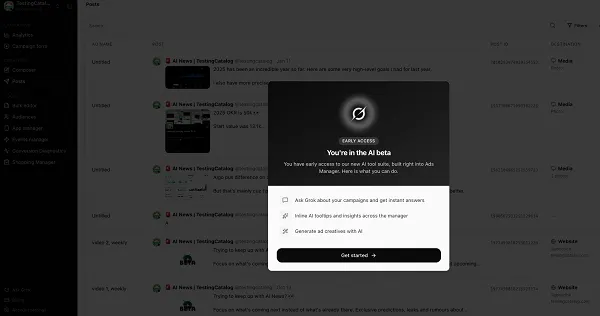
Current Beta Testing – Grok Integration (Mid-2024): The most recent development is the ongoing beta testing of Grok integration in Ads Manager. As evidenced by notifications received by some X advertisers and shared by sources like ‘testingcatalog’ on Threads, this integration allows advertisers to directly query xAI’s Grok chatbot for guidance on their ad strategies. This isn’t merely about automated suggestions; it’s about interactive, conversational assistance. Advertisers can ask specific questions about audience targeting, creative concepts, budget allocation, or performance optimization. The update also includes new tooltips and prompts designed to guide ad creation and generate innovative ideas for in-stream ad creatives. This interactive element transforms the ad manager from a static tool into a dynamic, intelligent partner for advertisers.
-
Future Vision – Full Advertising Automation (Elon Musk’s Projections): Looking ahead, Elon Musk has articulated an even more ambitious vision. In previous statements, he outlined his eventual goal for Grok to enable full advertising automation on the X platform. This isn’t just about offering guidance; it’s about the AI taking a proactive role in managing entire campaigns from conception to execution and optimization. This includes critical functions such as automated ad safety checks, ensuring compliance with policies and brand suitability, and sophisticated content matching to place ads in the most relevant and impactful contexts. The aspiration is for a system where advertisers might only need to provide high-level objectives, and Grok, powered by X’s vast data and real-time insights, would design, implement, and refine the entire advertising strategy autonomously.
Technical Deep Dive: The Mechanics of AI-Enhanced Advertising

The integration of Grok moves X significantly closer to what is known as "agentic ad generation." This advanced concept involves AI tools autonomously building and managing advertising campaigns based on a comprehensive, systematic understanding of the platform’s audience and a deep grasp of what prospective customers are likely to respond to.
At its core, agentic AI leverages massive datasets to identify patterns and predict outcomes. AI tools are uniquely suited for this due to their unparalleled capacity to assess and synthesize a huge array of data signals. For instance, an AI system can construct sophisticated persona matching models. By analyzing users who have previously made a purchase from a particular brand, the AI can identify commonalities across various profile indicators (e.g., demographics, stated interests, professional affiliations) and in-app activity indicators (e.g., content consumption patterns, accounts followed, engagement with specific topics, past ad interactions). From this analysis, the AI can generate likely profile matches that are aligned with the same traits and interests, thereby identifying new, high-potential target audiences.
X’s extensive user base is a critical asset in this endeavor. With more than 550 million monthly active users, X possesses an enormous volume of comparative data. This wealth of data is invaluable for training sophisticated AI models like Grok. The larger and more diverse the dataset, the more robust and accurate the AI’s insights and predictions become. When Grok’s LLM capabilities are combined with this vast data, it allows for the identification of subtle correlations and complex behavioral patterns that human analysis might miss or find too time-consuming to uncover. Consequently, xAI’s tools are expected to provide significantly improved automated matches for ads, optimizing targeting and creative relevance.
The Grok chatbot itself acts as an always-on assistant, guiding advertisers through the complexities of campaign strategy. Unlike static recommendation engines, Grok’s conversational interface allows for iterative questioning and refinement. An advertiser might ask, "How can I target Gen Z interested in sustainable fashion?" Grok could then respond with specific demographic parameters, relevant trending hashtags, suggested creator partnerships, and even generate initial creative concepts that resonate with that demographic. This dynamic interaction makes the AI not just a tool but a collaborative partner in the advertising process. The underlying natural language processing (NLP) capabilities of Grok allow it to understand nuanced queries, interpret intent, and provide contextually relevant advice, moving beyond simple keyword-based suggestions.
Implications for Advertisers
The integration of Grok into X’s Ads Manager carries significant implications for advertisers, presenting both substantial benefits and potential challenges.
Benefits:
- Increased Efficiency and Time Savings: Automating aspects of campaign planning, creative generation, and optimization can drastically reduce the manual effort required, freeing up advertisers to focus on higher-level strategy.
- Improved Targeting and Relevance: Grok’s ability to analyze real-time trends and user data allows for highly granular targeting and more relevant ad delivery, leading to higher engagement rates and better conversion prospects.
- Enhanced ROI: More precise targeting and optimized creative can translate directly into a better return on advertising spend (ROAS) as campaigns become more effective at reaching the right audience with the right message.
- Democratization of Advanced Strategies: Smaller businesses or those with limited in-house marketing expertise can leverage Grok’s AI guidance to implement sophisticated strategies that were previously only accessible to larger agencies with significant resources.
- Innovative Creative Generation: The AI can assist in brainstorming and even generating creative concepts, helping advertisers overcome creative blocks and produce fresh, engaging content tailored to specific audiences.
- Data-Driven Insights: Advertisers gain access to deeper, AI-generated insights into audience behavior, market trends, and campaign performance, enabling more informed decision-making.
Challenges and Considerations:
- Data Privacy Concerns: The extensive use of user data for AI-driven targeting raises ongoing questions about data privacy and user consent, which X will need to address transparently.
- Over-Reliance on AI: Advertisers may become overly dependent on AI suggestions, potentially stifling human creativity or critical oversight. A balance between AI guidance and human intuition will be crucial.
- Accuracy and Bias: Like all AI models, Grok’s suggestions are based on the data it’s trained on. There’s a potential for biases present in the data to be reflected in ad targeting or creative recommendations, requiring careful monitoring.
- Learning Curve: Advertisers will need to adapt to a new way of interacting with the ad platform, learning how to effectively prompt Grok and interpret its advice.
- Ethical Considerations: The power of AI to influence consumer behavior brings ethical responsibilities, particularly regarding manipulative advertising or the propagation of harmful content, even inadvertently.
- Transparency: The "black box" nature of some AI decision-making processes might make it difficult for advertisers to fully understand why certain recommendations are made, potentially hindering trust.
Broader Industry Impact and Competitive Landscape
The move by X to integrate Grok into its ad platform is indicative of a broader industry-wide shift towards greater AI integration and automation in digital advertising. Major players like Meta, Google, and Amazon have been heavily investing in their own AI capabilities for years.
- Meta’s Advantage+: Meta has been pushing its "Advantage+" suite of AI-powered advertising products, which automates aspects of targeting, creative optimization, and budget allocation across Facebook, Instagram, and other properties. X’s Grok integration can be seen as a direct competitor to Meta’s efforts to provide comprehensive AI-driven campaign management.
- Google’s Performance Max: Google’s Performance Max campaigns are another example, utilizing AI to maximize conversions across all of Google’s channels (Search, Display, YouTube, Gmail, Discover). X is positioning Grok to offer a similarly unified and intelligent approach within its own platform.
- The Future of Ad Agencies: As AI takes on more operational tasks, the role of traditional ad agencies may evolve. Instead of executing granular tasks, agencies might shift towards higher-level strategic consulting, AI oversight, data interpretation, and creative concept development that AI can then execute. The demand for professionals skilled in prompt engineering and AI-driven analytics will likely increase.
- Personalization vs. Privacy: The drive for hyper-personalization through AI inevitably intersects with growing concerns about user privacy. X, like other platforms, will need to navigate this delicate balance, ensuring that its AI-driven advertising is effective without alienating users or violating regulatory frameworks like GDPR or CCPA. While highly relevant ads can improve user experience by reducing irrelevant clutter, overly intrusive targeting can also provoke a backlash.
Inferred Statements and Reactions
While specific statements from advertisers and analysts are yet to be widely published regarding this beta, we can infer potential reactions:
- Advertisers: Early adopters and those focused on efficiency are likely to express excitement about Grok’s potential to streamline workflows and improve campaign performance. "This could be a game-changer for our ability to reach niche audiences on X with highly relevant messages," one might imagine an SMB owner stating. Larger brands, while cautiously optimistic, may emphasize the need for robust control and transparency. "We welcome AI assistance, but human oversight for brand safety and creative integrity remains paramount," an inferred statement from a brand marketing director could suggest.
- Industry Analysts: Analysts will likely view this as a crucial step for X to solidify its advertising revenue streams and compete effectively with established giants. "Grok’s real-time data access gives X a unique advantage in the AI advertising race. This move could significantly bolster X’s value proposition for advertisers and help it regain market share," an industry analyst might comment. Others may highlight the execution risk, "The success of Grok’s integration will depend heavily on its accuracy, user-friendliness, and X’s ability to maintain advertiser trust amidst ongoing platform changes."
- Privacy Advocates: Privacy groups might reiterate concerns about the aggregation and utilization of vast amounts of user data for commercial purposes, particularly with an AI model that learns from real-time interactions. "While AI offers efficiency, the ethical implications of data collection and algorithmic decision-making in advertising must be thoroughly scrutinized to protect user rights," a privacy advocate might argue.
Conclusion
The beta testing of Grok integration in X’s Ads Manager marks a significant milestone in the platform’s ongoing evolution under Elon Musk’s leadership. It represents a tangible step towards fulfilling the vision of an AI-driven "everything app" and a fully automated advertising ecosystem. By offering interactive, AI-powered guidance, X aims to empower advertisers with unprecedented tools for efficiency, relevance, and creative innovation. While the promise of agentic ad generation and enhanced ROI is substantial, the journey will require careful navigation of technical challenges, ethical considerations, and the dynamic competitive landscape of digital advertising. Ultimately, Grok’s success will be measured by its ability to deliver tangible value to advertisers, foster trust, and redefine the future of commercial engagement on X.
Related posts: