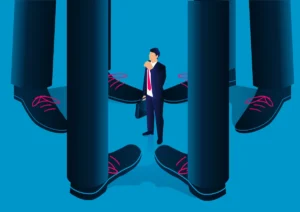
The End of Middle Management How Airbnb and Tech Giants Are Using AI to Flatten Corporate Hierarchies


Brian Chesky, the co-founder and CEO of Airbnb, has signaled a fundamental shift in the structure of the modern corporation, predicting the imminent disappearance of an entire layer of corporate hierarchy: the "people manager." Speaking on a recent episode of the Invest Like The Best podcast, Chesky argued that the traditional role of middle management—defined by oversight, coordination, and administrative relay—is becoming obsolete in an era increasingly defined by artificial intelligence and a renewed focus on direct execution. Chesky’s comments reflect a growing sentiment among Silicon Valley’s elite that the "managerial class" has become a bottleneck to innovation, and that AI provides the necessary tools to finally dismantle it.
According to Chesky, the role of the "pure manager"—someone whose primary responsibility is to oversee others without contributing directly to the work—holds little to no value in the future of the technology industry. He specifically targeted the culture of "recurring one-on-ones" and administrative oversight, stating that leadership styles centered on these activities will not survive the coming decade. Instead, Chesky envisions a "hands-on" model where every leader is a practitioner, deeply embedded in the technical and creative details of their team’s output. This philosophy aligns with Chesky’s own management style; he famously maintains a direct oversight role with approximately 50 employees, a structure that would be considered unsustainable under traditional management theories but which he views as essential for maintaining product quality and organizational speed.
The Shift from People Management to Work Management
The core of Chesky’s argument rests on a distinction between "managing people" and "managing the work." In the traditional corporate model, middle managers often act as human routers, translating executive strategy into actionable tasks for frontline workers and then aggregating progress reports to send back up the chain. Chesky contends that this "translation layer" is no longer necessary. In his view, if a manager is not intimately familiar with the "case law" of their department—whether that be code, legal documents, or design assets—they are effectively dead weight.
"You don’t manage the people, you manage the work," Chesky told the podcast audience. He used the example of a legal department to illustrate his point, noting that a legal manager should not just be checking in on their subordinates’ well-being or schedules but should be actively reading the case law and engaging in the legal strategy. This "player-coach" model requires managers to possess high-level technical skills and specialized expertise, moving away from the "generalist manager" profile that dominated 20th-century business education.
This perspective is not unique to Airbnb. It mirrors a broader "Year of Efficiency" movement that began in earnest across the tech sector in 2023. As companies face mounting pressure from investors to increase profitability and reduce bloated payrolls, the managerial layer has become the primary target for restructuring. The emergence of generative AI has accelerated this trend, providing executives with a technological justification for thinning the ranks of middle management.
The Broader Industry Context: Coinbase and Block
Chesky’s remarks coincide with aggressive restructuring efforts at other major technology firms. Brian Armstrong, CEO of the cryptocurrency exchange Coinbase, recently announced a significant reduction in force that specifically targeted "pure managers." Armstrong’s rationale was explicitly tied to the productivity gains offered by artificial intelligence. In a memo to staff, he noted that AI allows engineers to accomplish in days what previously required weeks of coordination across multiple teams. By removing the management layers that formerly coordinated these complex timelines, Coinbase aims to return to a leaner, more agile operating state.
Similarly, Jack Dorsey, the CEO of the fintech firm Block (formerly Square), has been vocal about his disdain for permanent middle management. In a March blog post titled "From Hierarchy to Intelligence," Dorsey argued that AI reveals the true nature of a company by stripping away unnecessary bureaucracy. Block has restructured its workforce into three distinct categories: individual contributors (ICs) who build systems, directly responsible individuals (DRIs) who own outcomes, and player-coaches who develop talent while remaining active builders. This restructuring followed a massive layoff of 40% of the company’s staff in February, a move Dorsey framed as a necessary evolution to keep the company close to its customers and its products.
Supporting Data: The Collapse of the Middle Layer
The trend toward flattening hierarchies is supported by recent projections from global research firms. Gartner, a leading technological research and consulting firm, predicts that by 2026, 20% of organizations will leverage AI to eliminate more than half of their middle-management positions. This shift is driven by the realization that AI can handle the three primary functions of a traditional middle manager: scheduling, reporting, and information synthesis.
Historically, middle management grew as a solution to the "span of control" problem. A single executive could not effectively oversee 500 workers, so layers of supervisors were added to maintain order. However, AI-driven project management tools and communication platforms now allow for "asynchronous oversight." High-level executives can use AI to summarize the progress of hundreds of projects, identify bottlenecks, and even assess employee sentiment without needing a human intermediary to filter the data.
Furthermore, data from the 2023 and 2024 tech layoff cycles indicates that management roles are being cut at a disproportionately higher rate than technical roles. While engineers and product designers are often retained or rehired quickly, "program managers" and "operations leads"—roles that focus on coordination—have seen a marked decline in demand.
Chronology of the Management Shift (2020–2024)
The path to this "management-free" future has developed through several distinct phases over the last four years:
- The Pandemic Hiring Surge (2020–2021): Fueled by low interest rates and a digital boom, tech companies hired aggressively. To manage the influx of new talent, they created vast numbers of middle-management roles, often hiring "managers of managers."
- The Remote Work Friction (2021–2022): As teams went remote, the "coordination tax" increased. Companies relied more heavily on managers to maintain culture and track productivity through Zoom one-on-ones.
- The "Year of Efficiency" (2023): Led by Meta’s Mark Zuckerberg, the industry began to question the "managerial bloat." Meta eliminated thousands of management roles, moving many former managers back to individual contributor positions.
- The AI Integration Phase (Late 2023–Present): With the release of advanced LLMs (Large Language Models), CEOs realized that the administrative tasks of management—writing status updates, summarizing meetings, and drafting emails—could be automated.
- The Airbnb/Coinbase/Block Manifesto (2024): Leaders like Chesky, Armstrong, and Dorsey have moved beyond temporary layoffs to a fundamental re-architecting of the corporate ladder, declaring the "people manager" role dead.
Official Responses and Stakeholder Reactions
While CEOs advocate for leaner structures, the reaction from the broader workforce and organizational psychologists has been more cautious. Critics of the "no-manager" model argue that while AI can manage tasks, it cannot manage humans. Soft skills such as conflict resolution, mentorship, career development, and emotional support are difficult to replicate with software.
Organizational experts warn that removing middle management can lead to a "vacuum of mentorship." Without experienced managers to guide junior employees, companies may find themselves with a highly efficient workforce in the short term but a lack of leadership pipeline in the long term. Furthermore, the "player-coach" model often leads to burnout, as individuals are expected to produce high-quality technical work while also handling the administrative and emotional labor of leading a team.
In response to these concerns, companies like Airbnb have emphasized that they are not abandoning leadership, but rather redefining it. Chesky’s vision involves "leaders" who are deeply involved in the craft, suggesting that mentorship will occur through collaborative work rather than scheduled one-on-ones.
Broader Impact and Implications for the Future of Work
The elimination of middle management signifies a broader transformation in the global labor market. For decades, the "managerial track" was the primary route to higher compensation and corporate status. If this track is removed, professionals will need to find new ways to advance their careers. The future corporate hierarchy may look less like a pyramid and more like a hub-and-spoke model, where a small group of highly skilled "player-coaches" directs the work of specialized individual contributors, all of whom are augmented by AI.
This shift also places a premium on "technical literacy" across all departments. As Chesky noted, even a legal or HR manager must now be a "doer." The era of the "professional manager" who can move between industries without deep domain knowledge is likely coming to an end. In the AI era, specialized expertise is the only safeguard against automation.
As Airbnb and its peers continue to refine these new organizational structures, the rest of the business world will be watching closely. If Chesky’s prediction holds true, the corporate office of 2030 will be a flatter, faster, and more technically rigorous environment, where the traditional "boss" has been replaced by a "builder." The "coordination class" that defined 20th-century capitalism is being dismantled, one AI-automated report at a time.
Related posts: