Speculative Decoding: Breaking the Latency Bottleneck in Large Language Model Inference

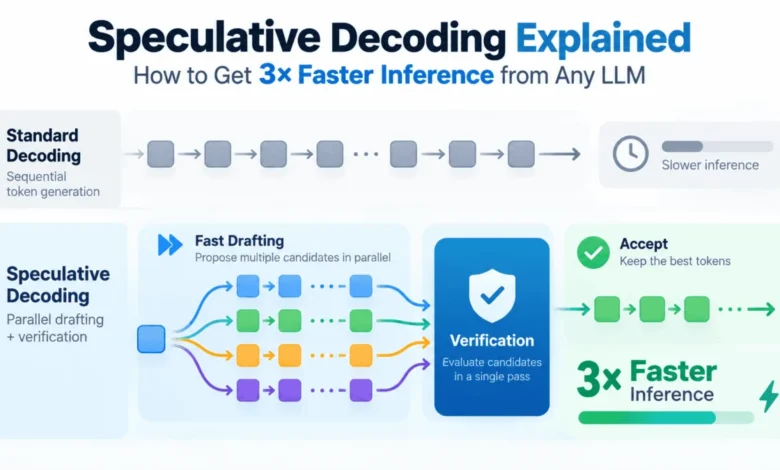
The deployment of large language models (LLMs) has revolutionized artificial intelligence, yet the industry faces a persistent physical constraint: the autoregressive nature of token generation. As these models scale to hundreds of billions of parameters, the sequential, one-token-at-a-time generation process has emerged as a primary bottleneck, creating significant latency for real-time applications such as coding assistants and conversational agents. Speculative decoding has surfaced as a sophisticated architectural solution to this challenge, enabling 2x to 3x improvements in inference speed without compromising the statistical integrity or the output quality of the original model. By decoupling the generation of candidate tokens from their verification, engineers can effectively bypass the memory-bandwidth limitations inherent in modern GPU architectures.
The Evolution of the Inference Bottleneck
To understand the necessity of speculative decoding, one must first examine the mechanics of contemporary LLM inference. Models like GPT-4 or Llama 3 operate on an autoregressive principle, where the probability of the next token is conditioned on the sequence of all preceding tokens. Each time a token is generated, the entire model architecture—comprising billions of parameters stored as weight matrices—must be transferred from the GPU’s high-bandwidth memory (HBM) to its computational cores.
Because the time required to move these weights significantly exceeds the time required to perform the actual floating-point operations, the system becomes "memory-bandwidth bound." In this state, the GPU’s high-performance compute units remain idle for the majority of each inference cycle, waiting for data to arrive from memory. This constraint has historically limited the throughput of LLMs, as adding more raw compute power fails to mitigate the delay caused by the memory-to-processor data bus.
The Chronology of Speculative Decoding Research
The academic and industrial pursuit of faster inference has moved rapidly since the theoretical foundations of speculative decoding were proposed. In early 2023, researchers began formalizing the "Blockwise Parallel Decoding" and "Speculative Sampling" frameworks, which provided the mathematical proofs that a smaller, faster "draft" model could propose sequences that a larger "target" model could verify in parallel.
By mid-2023, early implementations surfaced in research repositories, demonstrating that if a draft model could accurately predict the target model’s output even 70% of the time, the effective latency per token could be cut in half. By late 2023 and early 2024, the focus shifted from simple two-model setups to more advanced, integrated architectures. The introduction of Medusa and Eagle marked a turning point, as these methods moved away from the need for external secondary models, opting instead for architectural modifications or hidden-state analysis to facilitate rapid drafting.
Mechanics: The Two-Model Loop
The core mechanism of speculative decoding functions as a collaborative cycle between a draft model and a target model. The process begins with the draft model, which is typically a smaller, distilled version of the target model or a separate, lightweight architecture. This model generates a draft of multiple tokens (often a sequence of four to eight) in a single, rapid pass.
These candidates are then passed to the target model. Unlike standard generation, the target model evaluates the entire sequence of candidates in one forward pass. Through a process of probabilistic verification, the target model assesses whether each draft token aligns with its own internal probability distribution. If the target model’s confidence exceeds a specific threshold, the draft token is accepted. If not, the target model samples a replacement, and the sequence is corrected. This statistical rigor ensures that the final output is mathematically identical to what the target model would have produced on its own, satisfying the requirement for exactness in high-stakes fields like legal or medical text generation.
Supporting Data and Performance Metrics
Empirical testing across various inference frameworks, including vLLM and llama.cpp, has validated the efficiency gains of this approach. In scenarios involving natural language generation, such as creative writing or summarizing documents, speculative decoding frequently achieves a "speedup ratio" of 2.0x to 3.0x.
Data from recent benchmarks indicate that the success of this technique is highly dependent on the "acceptance rate"—the percentage of draft tokens that the target model retains. In tasks characterized by highly predictable language, such as structured data extraction or repetitive coding patterns, acceptance rates can climb as high as 80-90%, pushing throughput toward the theoretical maximum. Conversely, in highly entropic or chaotic text generation, where the draft model struggles to anticipate the target model, the overhead of generating the draft may result in marginal slowdowns. Consequently, practitioners are advised to monitor the trade-off between the computational cost of the draft model and the latency savings realized during verification.
Modern Implementations: Beyond the Draft Model
As the field matures, new paradigms have emerged that eliminate the reliance on external models, reducing the complexity of production deployments.
- Medusa: This approach adds multiple "prediction heads" to the target model. These heads are trained to predict the next several tokens simultaneously. By training these heads on the target model’s own activations, the model effectively gains the ability to "look ahead" without needing a second neural network.
- Eagle: An extension of the Medusa concept, Eagle utilizes the model’s internal hidden states to forecast future tokens. Because hidden states represent the latent semantic meaning of the prompt, this method offers superior accuracy in complex, domain-specific contexts where simple token prediction might fail.
- Prompt Lookup Decoding: A non-model-based approach that scans the input prompt for repeating phrases. By leveraging the existing context, it identifies chunks of text that are likely to recur, allowing the model to "copy-paste" segments of the response during the drafting phase. This is particularly effective for document editing, where the output frequently mirrors the input vocabulary.
Implications for Enterprise AI
The integration of speculative decoding into production stacks represents a major shift in how organizations manage AI costs and user experience. By increasing the speed of inference, companies can provide a more responsive user interface for AI agents, which is critical for maintaining user engagement. Furthermore, by reducing the time a request spends on the GPU, businesses can increase the number of concurrent requests handled by a single hardware cluster, effectively lowering the cost-per-token for large-scale deployments.
However, the implications are not entirely positive for all use cases. In environments with heavy batching—where a single GPU is processing hundreds of user requests simultaneously—speculative decoding can be counterproductive. The memory required to store the draft model and the computational resources used to verify candidates may be better spent serving additional requests in parallel. Therefore, the implementation of speculative decoding is not a "one-size-fits-all" solution but a strategic configuration choice that must be balanced against the specific workload requirements.
Conclusion and Future Outlook
Speculative decoding stands as a testament to the ongoing optimization of AI infrastructure. By acknowledging the constraints of memory bandwidth and the nature of autoregressive computation, researchers have unlocked a pathway to significantly faster performance without sacrificing accuracy. As these techniques become standard features in inference libraries, the barrier to deploying high-quality, real-time AI agents continues to lower. The next phase of development will likely involve hardware-level optimizations, where specialized AI chips are designed to perform speculative verification as a native function, potentially rendering the "one-token-at-a-time" era a relic of early large language model development. For developers, the message is clear: the path to faster AI lies not just in larger models, but in smarter, more parallelized execution strategies.