Pinterest Reports Strong Q3 2026 Results with 661 Million Monthly Active Users Driven by Gen Z Growth and AI Advancements


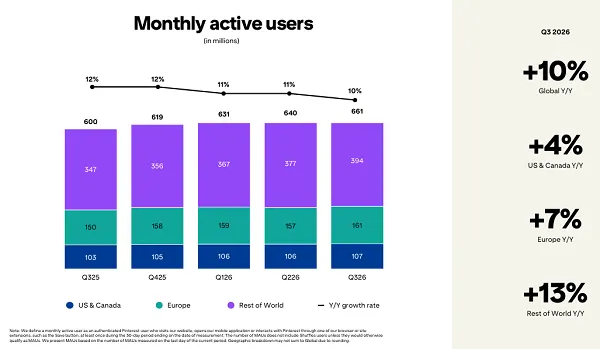
Pinterest’s financial and operational trajectory experienced a notable upward curve in the third quarter of 2026, underscored by accelerated global user acquisition, a resurgence in European engagement, and steady revenue expansion. According to the platform’s Q3 2026 earnings report published on October 29, Pinterest added 21 million global monthly active users (MAUs) compared to the preceding quarter, bringing its total active user base to an all-time high of 661 million. This robust performance reflects the platform’s successful adaptation to shifting digital consumer behaviors, increased reliance on artificial intelligence for ad targeting, and a strategic pivot toward community-driven commerce.
The latest results indicate that Pinterest is effectively capturing the attention of younger demographics, particularly Generation Z, while simultaneously navigating complex international regulatory landscapes and the industry-wide challenge of managing generative artificial intelligence content. As the platform looks toward the close of fiscal 2026, these metrics offer key insights into how visual discovery engines continue to carve out a distinct and profitable niche within the broader social media and digital advertising ecosystem.
Global User Growth and Regional Dynamics
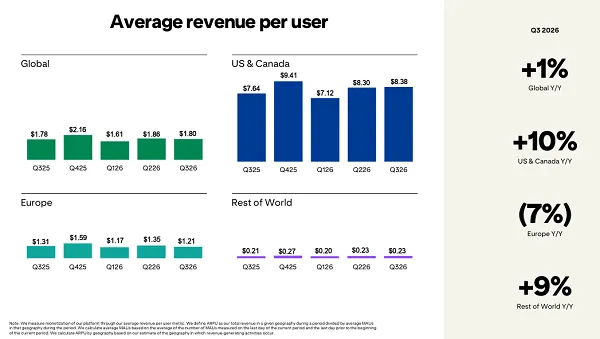
The core driver behind Pinterest’s Q3 milestone was its steady ability to attract new users across both established and emerging markets. The addition of 21 million MAUs quarter-over-quarter represents one of the platform’s stronger growth phases in recent years. A critical development in this period is the renewed momentum in Europe. Over the past year, European user growth had largely stagnated and, at times, experienced minor declines due to market saturation and shifting digital habits. The reversal of this trend is particularly vital for the company’s financial health, as users in the United States, Canada, and Europe historically generate a significantly higher average revenue per user (ARPU) than those in the Rest of the World segment.
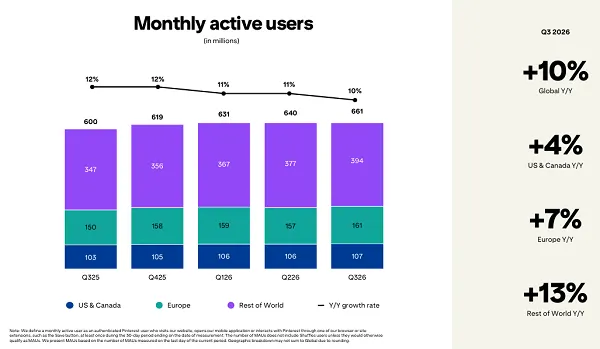
Despite the renewed strength in Europe, the majority of raw user acquisition continues to originate from international markets outside North America and Europe. Pinterest reported that it added 17 million users in the Rest of the World category during the third quarter alone. This geographic diversification broadens the platform’s global footprint, laying the groundwork for future monetization strategies as economic conditions and digital infrastructure in these emerging regions mature.
Domestically, in-app engagement across the U.S. and Canada has shown measurable improvement. Pinterest noted heightened activity in core functionalities such as search queries, board creation, and outbound clicks. Demographic shifts further reinforce this engagement; company disclosures accompanying the Q3 results revealed that Generation Z now accounts for 57% of Pinterest’s total audience. This concentration of younger users validates the platform’s ongoing efforts to modernize its interface, integrate creator-led content, and offer relevant lifestyle and shopping inspiration.
Financial Performance and Revenue Realization
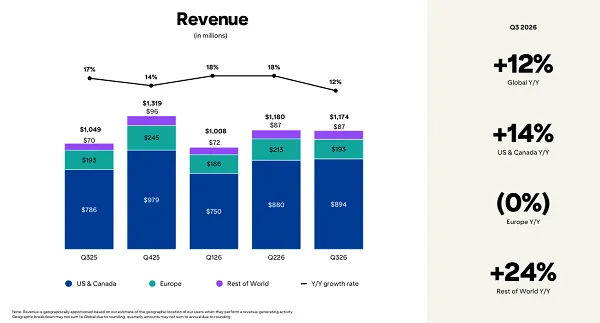
Financially, Pinterest posted total revenue of $1.17 billion for the third quarter of 2026, marking a 12% increase compared to the same period in the previous year. Revenue growth was particularly pronounced in the U.S. and Canada, where sales rose 14% year-over-year.
However, international revenue growth faced headwinds, primarily due to recent regulatory changes across Europe that impacted cross-border selling and digital advertising operations. These European regulatory shifts have required multinational technology platforms to adapt their compliance frameworks, occasionally causing temporary friction in advertising yield.
To counteract these regional monetization hurdles, Pinterest has focused heavily on optimizing ad relevance through advanced technology. The company highlighted the continued expansion of its AI-powered targeting processes, which integrate a broader array of user signals to deliver more accurate and effective advertisements. By improving ad matching without compromising the user experience, Pinterest aims to maximize the value of every impression, especially as advertisers demand higher returns on investment in an increasingly competitive digital marketplace.
Expanding Advertising Solutions and Commerce Integration
In tandem with its algorithmic upgrades, Pinterest has rolled out new commercial infrastructure designed to simplify the buying process for brands and expand revenue streams. A primary component of this strategy is the global rollout of its new programmatic buying solution, which is now live across all operational regions. This tool allows media buyers to purchase ad inventory more efficiently, aligning Pinterest with industry standards for digital advertising procurement.
Furthermore, the platform introduced visual search ads last month, enabling advertisers to place targeted promotions directly within Pinterest search results and Pin close-ups. These ad units capitalize on the exceptionally high shopping intent of Pinterest users, who collectively conduct more than 80 billion searches per month. By bridging the gap between inspiration and transaction, Pinterest positions itself as an indispensable tool for top-of-funnel and bottom-of-funnel marketing alike.
The company has also leaned heavily into creator partnerships as a means to drive authentic brand promotion. Brands can now sponsor creator Pins directly tied to their products, leveraging trusted voices within the community. This creator-centric commerce model extends beyond the application itself; Pinterest maintains a dedicated visual search show on Roku TV, where creators showcase and discuss products listed directly within the app, creating an omnichannel viewing and shopping experience.
Strategic Vision: Discovery Versus Endless Scrolling
A defining characteristic of Pinterest’s corporate strategy in 2026 is its deliberate positioning as a complement to real-world experiences rather than an addictive attention sink designed to trap users in endless scrolling loops. While major social platforms frequently chase viral engagement metrics through radical algorithmic shifts and aggressive video feeds, Pinterest has maintained its focus on intentional discovery, planning, and curation.
This philosophy aligns naturally with the platform’s core utility. Users typically turn to Pinterest to plan weddings, home renovations, recipes, and wardrobe updates—activities that culminate in physical-world actions. By keeping its AI integration grounded in visual search, taste profiling, and practical curation rather than disruptive generative experiments, Pinterest has largely avoided alienating its core user base.
Industry Challenges: Managing the Rise of AI-Generated Content
Despite its strategic clarity, Pinterest faces a challenge confronting nearly every major digital platform: the proliferation of artificial intelligence-generated content. As tools for creating synthetic images and text become more accessible, platforms like Pinterest have experienced an influx of AI-slop within user feeds.
Many users have expressed concern over the quality and authenticity of content populating their boards, forcing platform administrators to walk a fine line. On one hand, Pinterest utilizes AI to enhance ad targeting, visual search capabilities, and creative recommendation tools. On the other hand, the company must implement safeguards to prevent the misuse and oversaturation of synthetic content, which threatens to degrade the authentic, curated aesthetic that defines the platform.
Industry analysts note that maintaining trust will be paramount for visual discovery engines in the coming years. Whether Pinterest will institute stricter content moderation policies or algorithmic penalties specifically targeting low-quality AI-generated material remains an open question for future quarters.
Broader Market Implications and Future Outlook
The Q3 2026 results demonstrate that Pinterest’s calculated approach to product development, localized engagement, and measured AI integration is yielding tangible dividends. With 661 million monthly active users, a dominant Gen Z demographic, and diversified monetization avenues like programmatic buying and visual search ads, the platform has strengthened its financial foundation.
As Pinterest navigates international regulatory complexities and works to preserve content integrity against the tide of synthetic media, its disciplined focus on user utility rather than raw retention metrics may well serve as a blueprint for sustainable digital media growth. The company’s ability to successfully balance technological innovation with authentic user experience will ultimately dictate its momentum as it enters the final stretch of 2026 and prepares for the fiscal year ahead.