European Cross-Border Marketplaces Set to Command 175.8 Billion Euros in Gross Merchandise Volume

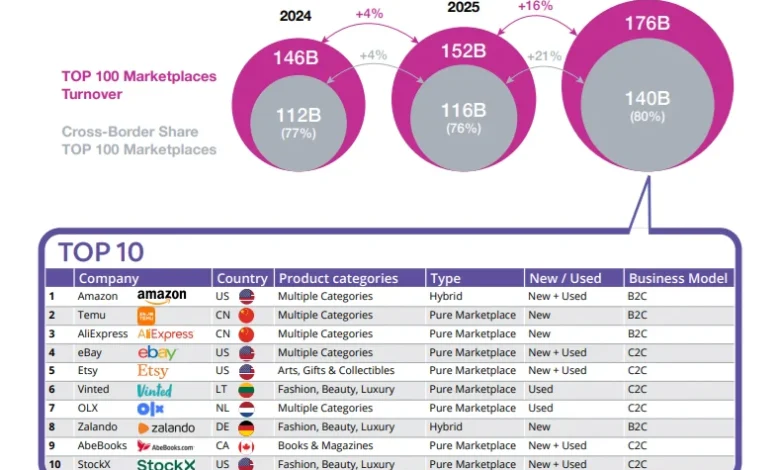
The landscape of European digital commerce is undergoing a structural transformation, with the continent’s top 100 marketplaces poised to capture a staggering 175.8 billion euros in gross merchandise volume (GMV). This figure, derived from the latest data released by Cross-Border Commerce Europe, underscores a pivotal shift in consumer behavior: the reliance on international platforms to bridge the gap between supply and demand across national borders. Currently, 79.5 percent of this massive volume is derived from cross-border transactions, a trend that analysts project will only accelerate as digital infrastructure matures and consumer trust in international shipping protocols deepens.
The findings, presented in the seventh edition of the “Top 100 Cross-Border Marketplaces Europe” report, provide a comprehensive snapshot of a sector that is increasingly defined by its ability to scale beyond domestic confines. By 2026, the report anticipates that cross-border sales will climb to 139.8 billion euros, effectively accounting for nearly 80 percent of the total GMV generated by these elite platforms. This trajectory highlights a move away from localized e-commerce ecosystems toward a unified, pan-European digital marketplace.
A Chronology of Market Expansion and Digital Integration
The evolution of the cross-border marketplace model in Europe has not occurred in a vacuum. It is the culmination of nearly a decade of rapid technological adoption and regulatory harmonization. In the early 2010s, European e-commerce was largely fragmented, with consumers preferring domestic players like Zalando or Otto. However, the mid-2010s saw the aggressive expansion of global giants, which utilized advanced logistics and data-driven personalization to capture market share.
By 2018, the “Top 100” reports began to signal a clear trend: the decline of purely national players in favor of platforms capable of offering a “one-stop-shop” experience. The COVID-19 pandemic served as a massive catalyst, forcing a digital pivot that compressed five years of expected growth into 18 months. As supply chains stabilized in the post-pandemic era, the focus shifted from simple availability to the sophistication of delivery and the integration of AI-driven search functions. Today, the sector stands at a crossroads where regulatory scrutiny—specifically regarding tax compliance and environmental impact—is beginning to balance the relentless pursuit of volume.
Projecting Growth: The 2027 Outlook
Looking toward 2027, the trajectory of these top-tier marketplaces suggests a compounding growth pattern. The total GMV for the top 100 entities is projected to expand by roughly 8 percent next year, reaching an estimated 190 billion euros. More tellingly, the cross-border component is expected to outperform the total market, growing by 10 percent to reach 154 billion euros.
This 10 percent increase is not merely a reflection of higher transaction counts; it represents a deepening of the cross-border value proposition. As these platforms integrate local fulfillment centers and regional hubs, the “cross-border” experience is becoming indistinguishable from a domestic one in terms of speed and reliability. Consequently, 81 percent of the total GMV generated by these 100 giants is expected to originate from international sales by 2027. This suggests that the “borderless” consumer is now the primary demographic driving European retail revenue.
The Dominant Players: Amazon, Temu, and AliExpress
The hierarchy of the European marketplace ecosystem remains dominated by three major entities: Amazon, Temu, and AliExpress. The ranking, which evaluates platforms based on a rigorous methodology including cross-border sales volume, SEO optimization, geographic footprint, and monthly unique visitors, confirms that these three companies have successfully navigated the complexities of the European regulatory environment.
Amazon continues to leverage its robust fulfillment network, which has been established in Europe for over two decades. In contrast, Temu and AliExpress have utilized different strategies, focusing on direct-to-consumer models that capitalize on efficient manufacturing connections and aggressive social media marketing. Their presence at the top of the list reflects a broader transition: the success of a marketplace is no longer solely dependent on the breadth of its catalog, but on the sophistication of its data-driven product discovery.

The Technological and Regulatory Tectonic Shift
Two distinct forces are currently reshaping how these marketplaces operate: the integration of AI and the tightening of the regulatory net.
AI-driven product discovery has fundamentally changed the consumer journey. Whereas users previously searched for items using keywords, current algorithms now predict needs based on behavioral data, visual trends, and social commerce triggers. Social commerce—where the line between entertainment and purchasing is blurred—is creating a new sales funnel that traditional e-commerce models struggle to replicate.
Simultaneously, European regulators are imposing stricter standards. From the Digital Services Act (DSA) to updated VAT regulations for non-EU sellers, the administrative burden on these 100 marketplaces is increasing. International platforms are responding by investing heavily in European infrastructure. By localizing fulfillment, these companies are not only circumventing potential shipping bottlenecks but are also aligning themselves more closely with European standards regarding consumer protection and data privacy. This localized strategy is essential for maintaining a competitive edge in an environment where “borderless” trade is increasingly under the microscope.
Economic Implications and Market Dynamics
The shift toward a cross-border dominant economy has profound implications for local European retailers. While the top 100 marketplaces provide unprecedented access to global goods, they also exert immense pressure on smaller, local businesses that lack the capital to invest in the sophisticated logistics and AI infrastructure required to compete.
The rise of these marketplaces is also shifting the nature of European trade deficits. As cross-border volume grows, the volume of goods flowing from non-European production hubs to the European consumer base increases, necessitating a robust conversation about the sustainability of current logistics chains. Furthermore, the growth in GMV indicates a shift in consumer loyalty; shoppers are increasingly loyal to the platform that provides the most efficient service rather than the retailer that offers the most localized product.
From a macroeconomic perspective, the 175.8 billion euro figure represents a significant portion of the European retail sector’s digital transition. For policymakers, the challenge lies in fostering an environment where these massive marketplaces can thrive without stifling local innovation. The investment in local fulfillment centers by international giants is a double-edged sword: it creates jobs and improves service speed, but it also entrenches the dominance of global entities within the European domestic market.
Future Outlook: A New Era of Marketplace Commerce
As we look beyond 2027, the marketplace landscape in Europe is expected to move toward consolidation. The barriers to entry are rising as the cost of compliance and the necessity of advanced AI technology become prohibitive for smaller players. The "Top 100" list is likely to remain relatively stable, with the primary battleground shifting toward service quality, sustainability initiatives, and the integration of emerging technologies like augmented reality (AR) in the shopping experience.
The data provided by Cross-Border Commerce Europe serves as a definitive roadmap for stakeholders. It highlights a market that is not only resilient but remarkably adaptive to global economic pressures. For investors, retailers, and policymakers, the message is clear: the future of European commerce is international, digital, and increasingly concentrated within the hands of a few, highly sophisticated global marketplaces. Whether this centralization of power will yield long-term benefits for the European consumer remains a subject of ongoing debate, but the trajectory toward 190 billion euros in total GMV suggests that the momentum is currently unstoppable.
The evolution of these platforms into integrated service providers—offering not just a place to buy, but a complete logistical and payment infrastructure—will likely define the next decade of trade. As the lines between national economies continue to blur through digital interaction, the top 100 marketplaces are poised to act as the primary architects of this new, borderless commercial reality. The data confirms that we are entering a new era, one where geography is secondary to the efficiency of the digital interface.